
A Missing Air-Fryer Basket Can Wreck a Pallet Flip
The viral pallet flip has two businesses inside it. Merchandise absorbs freight, damage and disposal while the reveal earns attention, ad revenue and sometimes a sponsor.
September 6, 2026 · 7 min read
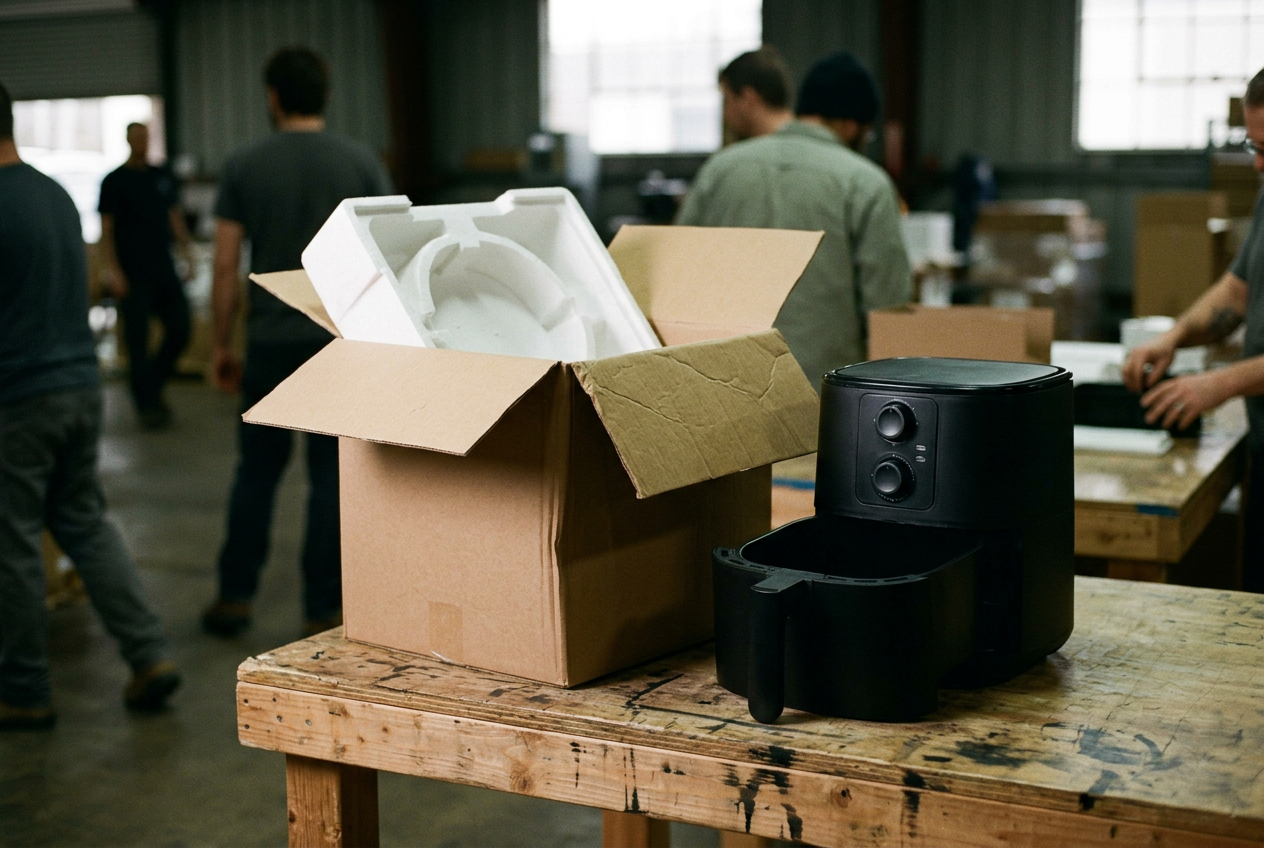
Follow one object through the edit: a matte-black countertop air fryer in an opened retail box, missing its removable cooking basket. The appliance may power on. Its heating element may work. The box may still carry a retail price large enough to make the pallet’s running total jump.
It is also close to unsellable as a complete air fryer.
That gap is the business. Liquidation videos turn uncertain inventory into a sequence of reveals, and each reveal invites the creator to count an item at something closer to its imagined retail value than the cash it will bring after testing, repair, storage and sale. The missing basket ruins that arithmetic, so the camera moves on.
Retailers liquidate customer returns, shelf pulls and excess stock because inspecting every item would consume labor and warehouse space. A liquidator combines the goods into lots, sometimes provides a manifest, which is a list of the products believed to be included, then sells the lot through an auction or fixed-price marketplace. The buyer accepts the uncertainty.
That arrangement works well for the retailer, which recovers some money and clears space. It works for the liquidator, which earns fees or a spread without promising that every object functions. It can work for an experienced reseller with cheap storage, repair skills and several sales channels. The viral version quietly proposes that it works for anyone with a garage and optimism.
The winning bid is not the cost
A pallet video usually gives the winning bid pride of place. That number is concrete, dramatic and incomplete.
The buyer may also owe a buyer’s premium, an auction fee added to the winning bid, along with sales tax where applicable, freight and delivery surcharges. A commercial address with a loading dock can receive freight more cheaply than a home that needs liftgate service. If the lot must be collected, the truck, fuel, rental time and physical help still belong in the calculation. None of this improves the air fryer.
Together, those charges form the landed cost, meaning the full expense of getting inventory to the place where it can be processed. Dividing that cost by the number of objects creates a tempting average cost per item, but pallets do not contain average objects. A sealed package of headphones and an air fryer missing its central component cannot carry equal shares of value merely because they occupied the same truck.
Then comes the retail total. Videos often flash the manufacturer’s suggested retail price, or MSRP, beside each reveal. MSRP describes what a new, complete product might be offered for through ordinary retail. It does not describe an opened return with an uncertain history, an expired model, a crushed package or an accessory that has wandered off somewhere in the reverse-logistics system.
The relevant number is expected cash collected. Reaching it requires a realistic selling price multiplied by the probability that the item sells, followed by deductions for every cost attached to that sale. The air fryer’s probability falls sharply once the basket is missing. A replacement might be unavailable, incompatible or expensive enough that a buyer would choose a complete used unit instead.
Counting MSRP at unboxing is not profit accounting. It is set decoration with numbers.
Sorting is the factory the video skips
The pallet arrives as inventory only in the loosest sense. Before most items can become listings, someone must identify the model, check recall notices, inspect damage, confirm accessories, test operation, clean the surfaces, photograph the result and describe every defect accurately enough to avoid a return.
That work is the reseller’s factory. The inputs are inconsistent, the quality controls change with every box, and the worker cannot rely on a retailer’s original inspection because the entire point of liquidation is that the retailer declined to perform one.
Editing compresses those hours into a montage. The viewer sees cardboard opened and products raised toward the lens. Off camera, batteries need charging, cables need matching, clothing needs measuring and appliances need more than a lighted display before anyone can responsibly call them functional. Storage also has a cost, whether it appears as warehouse rent, shelving or the gradual loss of a room in someone’s home.
Our air fryer now needs a model-specific basket search and a heat test. If the replacement part costs too much, the machine becomes a parts unit. Selling it that way demands another listing, a smaller pool of buyers and enough shelf space to wait for a person who broke precisely the component that remains intact.
Labor disappears most easily when the reseller owns the business. Unpaid owner time does not appear on a receipt, so a creator can treat an evening of sorting as free while presenting the eventual sales as return on capital. It is still work. Calling it hustle does not alter the ledger.
Every sale takes another cut
A product valued on camera has not yet found a customer. Online marketplaces may charge a percentage of the transaction, payment fees and optional promotion costs. Some calculate fees using more than the item price, which means shipping collected from the buyer does not pass through untouched.
The seller also needs packaging. A returned appliance in a weakened retail box may require a stronger outer carton, padding and tape, followed by a shipping label priced for a bulky object. If the buyer receives an item that differs from the description, the seller may pay for return shipping and issue a refund. Chargebacks and marketplace disputes add another layer of risk.
Local sales avoid some fees and shipping, but they exchange those expenses for slower turnover, messages that go nowhere and arranged pickups that do not happen. Fast liquidation usually means accepting lower offers from another reseller. The merchandise changes hands again, and the next buyer demands enough margin to justify taking it.
This is why sell-through matters. Sell-through is the share of listed inventory that sells during a given period. A pallet can contain goods with plausible listing prices while producing little cash because the items sit for months. Gross potential value looks wonderful in a thumbnail.
Rent is less sentimental.
The trash has an invoice
Some inventory will never sell. Liquidators know this. Retailers know it too, which is one reason mixed returns leave their warehouses in bulk rather than receiving patient, item-level attention.
Broken goods must be hauled away. Electronics may require specialist recycling under local rules, while damaged batteries need handling that ordinary trash service cannot provide. Donation is not a magic exit. Charities do not need unsafe appliances, incomplete products or bags of unsorted waste that transfer disposal labor to them.
The air fryer illustrates the threshold. If no replacement basket makes financial sense, no buyer wants it for parts and no recycler takes it without a fee, the reseller pays to store an object before paying to remove it. A pallet’s profitable items must cover that loss as well as their own selling costs.
Disposal is often missing from filmed flips because failure does not arrive at unboxing. It accumulates along a wall. By the time the seller admits an item has no market, the episode has already collected its views.
The camera runs a second business
A filmed pallet flip produces two kinds of inventory. One is merchandise. The other is footage.
The footage can earn platform advertising revenue, sponsorship money, affiliate commissions, memberships or attention that improves the performance of later uploads. Not every creator receives every stream, and video production has its own labor and equipment costs. Still, a creator with an established audience can recover value from the pallet before selling a single object.
The uncertainty that hurts the resale business improves the show. Sealed boxes create suspense. Damaged goods create reaction shots. One unexpectedly valuable item supplies a title and thumbnail, while the unremarkable products become quick cuts and the unsold remainder rarely receives a sequel.
Recommendation systems do not audit net margin. They respond to viewer behavior, and a jackpot reveal can hold attention even when the full lot loses money.
This does not mean every pallet creator is lying or every liquidation purchase fails. It means the apparent business model may have a subsidy. The pallet supplies low-cost production material for a repeatable video format, so the creator can tolerate merchandise margins that would punish a reseller with no audience.
Once content revenue enters the ledger, even disposal can become material. A destroyed product creates an update. A customer return becomes another episode. The resale operation may function as a content acquisition budget, with recovered merchandise sales reducing the cost of making videos.
The distinction matters when creators present the flip as replicable income. A viewer buying a first pallet does not inherit the creator’s audience, sponsor relationship, editing library or accumulated marketplace reputation. The viewer gets the freight bill and the air fryer without its basket.
Read the leftovers, not the reveal
A useful pallet video would begin with landed cost and end after the selling period, when the creator can report cash received, platform deductions, refunds, labor time and disposal. Few videos can hold attention for that interval, which is precisely why the genre favors opening boxes over closing books.
Watch what happens to incomplete products. Notice whether the creator tests electrical goods or merely powers them on, whether listed prices become completed sales, and whether the final accounting gives unsold inventory a realistic value rather than carrying it indefinitely at MSRP. A pile described as donation should identify a recipient willing to accept it. A dump run belongs in the expenses.
The matte-black air fryer does not need a dramatic ending. If it remains on a shelf without a basket when the video declares victory, its retail price was never revenue. It was a number placed on screen.
Questions people ask
Are liquidation pallets profitable?
They can be, particularly for buyers with product expertise, inexpensive freight, repair capacity, storage and established sales channels. Profit depends on cash from completed sales after landed cost, labor, fees, refunds and disposal, rather than the combined retail prices printed on the boxes.
Why do liquidation pallet videos look so profitable?
The videos often count estimated retail or listing value during the unboxing, before products have been tested or sold. They also compress labor and may omit freight, unsold inventory and disposal, while the video itself can earn advertising, sponsorship or affiliate revenue unavailable to an ordinary reseller.
What happens to liquidation items that do not sell?
They may be discounted, stripped for parts, bundled into another lot, donated when a recipient accepts them, recycled or discarded. Each route requires labor, and several cost money, so unsold goods remain a liability even after the profitable items are gone.
Who gets paid first in a pallet flip?
The retailer recovers part of the inventory’s value, while the liquidator, auction marketplace and freight carrier collect their charges before resale succeeds. Selling platforms take fees from completed transactions. The reseller receives what remains and bears the risk that the air fryer is still missing its basket.
One update a day
Today's story, in your inbox
One story each morning — no hype, no filler, no algorithm deciding for you.