
One Voice Session Can Become a License That Never Ends
A session fee can buy much more than the finished production. The dangerous permissions sit across purpose, training, adaptation, sublicensing, term and deletion.
August 12, 2026 · 8 min read
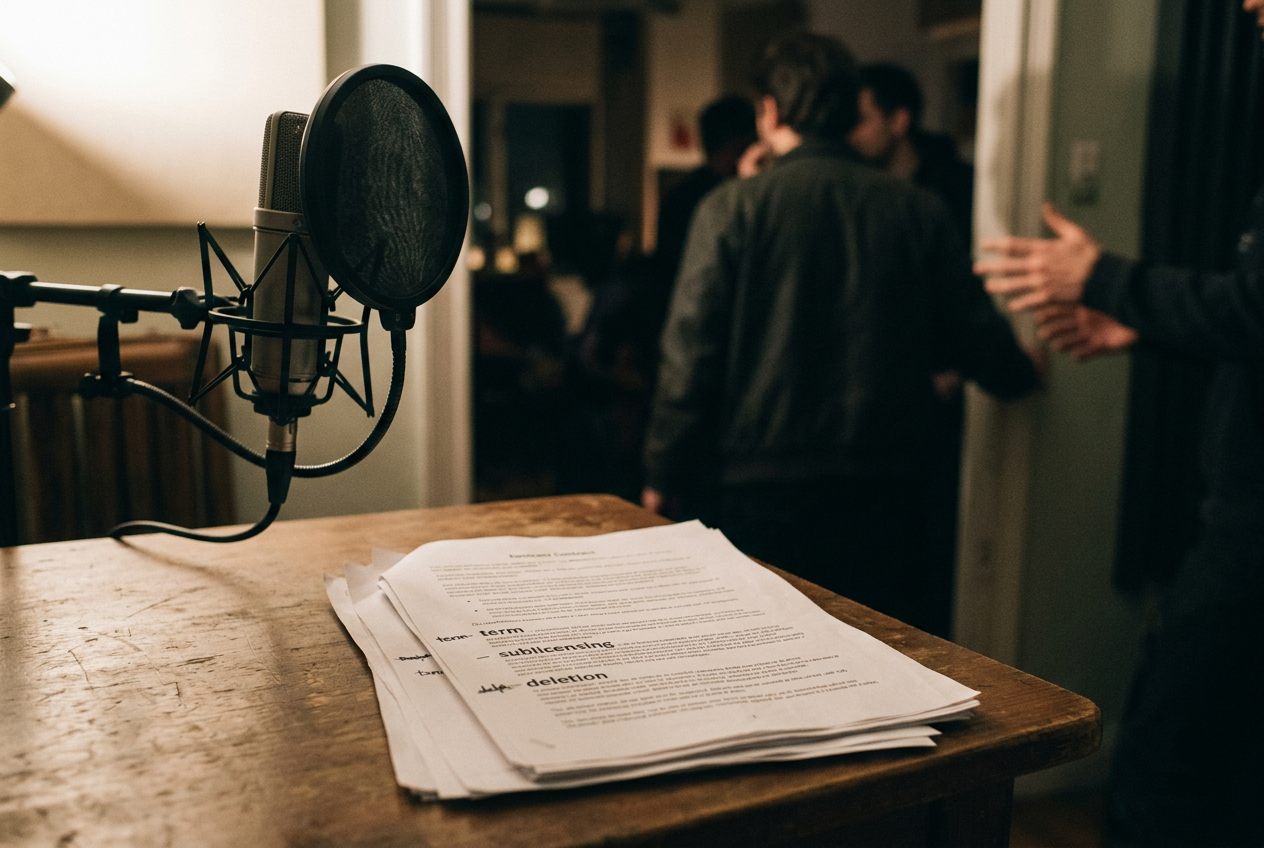
Use one concrete file as the anchor: a ten-second clean recording of a neutral greeting, captured at the end of a paid voice session. It sounds disposable. In the finished job, it may run once. Under a broad contract, the same ten seconds can become training data, a synthetic performance source, material for later versions and an asset passed to companies the performer never dealt with.
The invoice still shows one session.
This is how the economics get disguised. The contract does not need a section labeled permanent AI clone. It can assemble that result through ordinary-looking permissions scattered across ownership, permitted uses, modification, sublicensing and term. Each clause appears manageable alone.
Read together, they can detach the voice from the job that paid for it.
This guide explains that machinery. It is not legal advice, and contract law, publicity rights, biometric rules and labor protections vary by jurisdiction and agreement. A qualified lawyer or union representative can assess a specific document.
Start by defining the job narrowly
A production license lets a client use a recording in a named project, such as one game, advertisement, audiobook or animation episode. Model training is different: software analyzes recordings and adjusts internal parameters so it can produce new outputs later. Synthetic reuse is different again, because the resulting system generates speech the performer never recorded.
Those categories should not collapse into one broad definition of services or materials.
Return to the ten-second greeting. Permission to place that file in one finished commercial does not logically require permission to extract vocal characteristics, train a model or generate fifty revised greetings next year. A buyer may prefer one permission covering everything because it reduces future production costs. That preference is a business interest, not a technical necessity.
Look first at the definitions section, where contracts decide what later clauses can reach. Terms such as recordings, results, proceeds, performance data, voice characteristics and derivative materials may include far more than the approved final take. If raw files, outtakes, pickups and session audio all fall inside the same defined bucket, the buyer may claim rights in every sound delivered from the booth.
A narrow deal identifies the production and its intended versions. A broad one describes a category of possible exploitation. That difference carries the money.
Find the verbs that create the reusable asset
Contract permissions operate through verbs. Record and reproduce usually cover conventional production. Modify may permit edits, although its scope can extend beyond cutting breath noise or changing timing. Adapt, simulate, synthesize, digitize, train and generate point toward uses that can create performances beyond the original recording.
No single word settles the agreement. Context matters. A modification right limited to technical editing for the named production behaves differently from an unrestricted right to alter the voice, create new dialogue or combine it with software systems.
Pay close attention when the object of those verbs is the performer’s voice, vocal identity, likeness or characteristics rather than the delivered audio file. Rights in a file concern a fixed recording. Rights described around vocal identity can reach the recognizable human source, which is precisely what a voice model tries to reproduce.
The ten-second greeting crosses a line once the client can use it to create words, emotions or languages that were never performed. The original file may disappear from the final output. Its commercial value remains inside the system.
Separate training from generation
Training permission and generation permission should be treated as separate economic events. A company can ingest audio to improve a general model without releasing an obvious clone. It can also build a model intended to reproduce one performer. Both uses extract value, but the risks and markets differ.
The contract should make clear whether training is prohibited, allowed only for a named production tool, or permitted for broader commercial systems. References to research, testing, machine learning or service improvement deserve the same attention as an explicit AI section. Product-improvement language can function as a side door when the contract gives a platform access to session files and imposes no production limit.
Generation rights need their own boundaries: the project, kinds of output, languages, audience, distribution channels and whether new scripts require fresh consent. Later adaptation may include localization, a process that converts a work for another language or market, but synthetic localization can replace another paid performance rather than merely process the existing one.
The buyer will often frame broad permission as operational convenience. Convenience has a price. If the model can make future pickups without booking the performer, the buyer has acquired a substitute for future labor.
Read term, territory and media together
A perpetual term means the permission does not expire. Worldwide territory removes geographic limits. Language covering every current and future medium prevents the license from being tied to known distribution methods. Combined, those clauses can make a small session function like an indefinite asset transfer.
Conventional media contracts have long used broad term and territory language. AI changes the cost curve because reuse no longer requires replaying the original clip. The license holder can potentially generate new material at marginal cost, while the performer receives no new session fee unless the contract requires one.
The math is plain. Let the session fee be S and the number of commercial uses be N. The performer’s effective pay per use is S divided by N. If N keeps expanding while compensation remains fixed, pay per use keeps falling.
A perpetual synthetic-use grant removes the practical ceiling on N.
That does not mean every unlimited license will produce unlimited output. It means the buyer holds the option while the performer carries the risk. Options are valuable even when companies do not exercise them immediately.
Follow the file past the original client
Sublicensing allows one rights holder to authorize another party to use the material. Assignment can transfer the agreement itself. Affiliate language may extend permissions across companies under shared control, and vendor language can cover outside studios, cloud providers or AI contractors.
These clauses matter because the person sending the booking email may not be the company storing the voice model two years later. A production house can close, merge or sell assets. A platform can change vendors. A buyer can package a library into a larger transaction.
If the contract permits unrestricted transfer, the performer’s practical relationship with the user ends even though the permission survives.
For the ten-second greeting, storage location is less important than control. The useful questions concern who may access the recording, who may train on it, who may generate output and whether a recipient inherits every original permission. A promise from the immediate producer has limited force if the contract lets that producer hand the asset elsewhere without equivalent restrictions.
Confidentiality does not solve this. A company can keep a model secret while exploiting it extensively.
Approval, notice and deletion are different controls
Notice tells the performer that a use happened or will happen. Consent requires agreement. Approval may allow the performer to reject a script, output or context. Contracts sometimes blur these controls, replacing meaningful permission with a message sent after the decision is already made.
Specific consent should identify the proposed use closely enough to support a real choice. A blanket acknowledgment that synthetic technology may be involved provides little control over later political advertising, sexual content, defamatory speech or work that conflicts with an existing exclusivity deal.
Deletion also needs precision. Removing the uploaded audio does not necessarily remove trained model weights, which are the numerical settings learned during training, generated clips, backups or copies already transferred to another company. A deletion clause that covers only source files can leave the reusable part intact.
Revocation poses another problem. Some licenses declare permissions irrevocable, meaning the performer cannot withdraw them after signing. Even where withdrawal exists, the agreement may allow continued use of finished material or models already created. The ten-second file can be deleted from a folder while its learned features remain commercially active.
Security terms matter here, but security and permission answer different problems. Encryption may reduce unauthorized access. It does not limit authorized exploitation under a broad license.
Make compensation match the rights being purchased
A session fee pays for time and performance. A reuse fee pays when existing work runs again under agreed conditions. A model license pays for the continuing ability to generate or support new output. Folding all of them into one buyout, a single payment for broad future rights, hides three transactions inside one number.
The relevant comparison is not whether the offered fee seems decent for an afternoon. Compare it with the labor the client may avoid purchasing later: pickups, sequels, localization, revisions and fresh sessions for new scripts. Nobody can calculate that value from the contract alone, but the agreement can reveal who captures it.
Payment triggers should match identifiable events, such as training, deployment, generated output, a new production or transfer to another user. Reporting and audit rights matter because a performer cannot invoice for uses they cannot see. A promise of future compensation without records, timing or a method for calculating it is mostly atmosphere.
Union agreements may provide AI-related consent and compensation protections for covered work. Nonunion performers should not assume those terms apply automatically. A platform’s public ethics statement is not part of the bargain unless the contract incorporates an enforceable obligation.
The practical reading method is to trace the ten-second greeting through the document. Mark who owns the file, every permitted verb, every stated purpose, every recipient, the term, the payment trigger and what must be deleted. If the path ends with indefinite generation by unnamed parties for no additional pay, the session price is buying far more than a session.
Questions people ask
Can a client train an
AI model if the contract only mentions editing?
Editing usually describes changes to recorded material, while training uses recordings to adjust a system that can produce later outputs. The exact result depends on the full language and governing law, so a performer should not treat one isolated term as decisive or rely on an informal assurance that AI use is merely editing.
Does deleting the original recording delete the voice model?
Not necessarily. The source audio, training copies, model weights, backups and generated outputs are separate objects. A useful deletion provision identifies each one, states who must delete it and addresses material already shared with vendors or sublicensees.
Should synthetic voice use pay more than a normal session?
The key issue is the scope of rights, not a universal premium. A license that replaces future sessions, supports many productions or lasts indefinitely carries more economic value than permission to use one fixed performance in one named project, so one session fee may conceal substantial unpaid reuse.
Are union voice performers automatically protected from every AI use?
No. Protections depend on whether the work and employer fall under the relevant agreement, which version of the agreement applies, and what use is proposed. Public union guidance can help performers identify the issue, but a representative or qualified lawyer must interpret a specific contract.
One update a day
Today's story, in your inbox
One story each morning — no hype, no filler, no algorithm deciding for you.