That Background Actor Scan Form Can Outlive the Shoot
A scan is a work event and the resulting file is an asset. Here is how to read the consent, reuse, compensation, alteration, and storage language before your body enters the rig.
August 26, 2026 · 7 min read
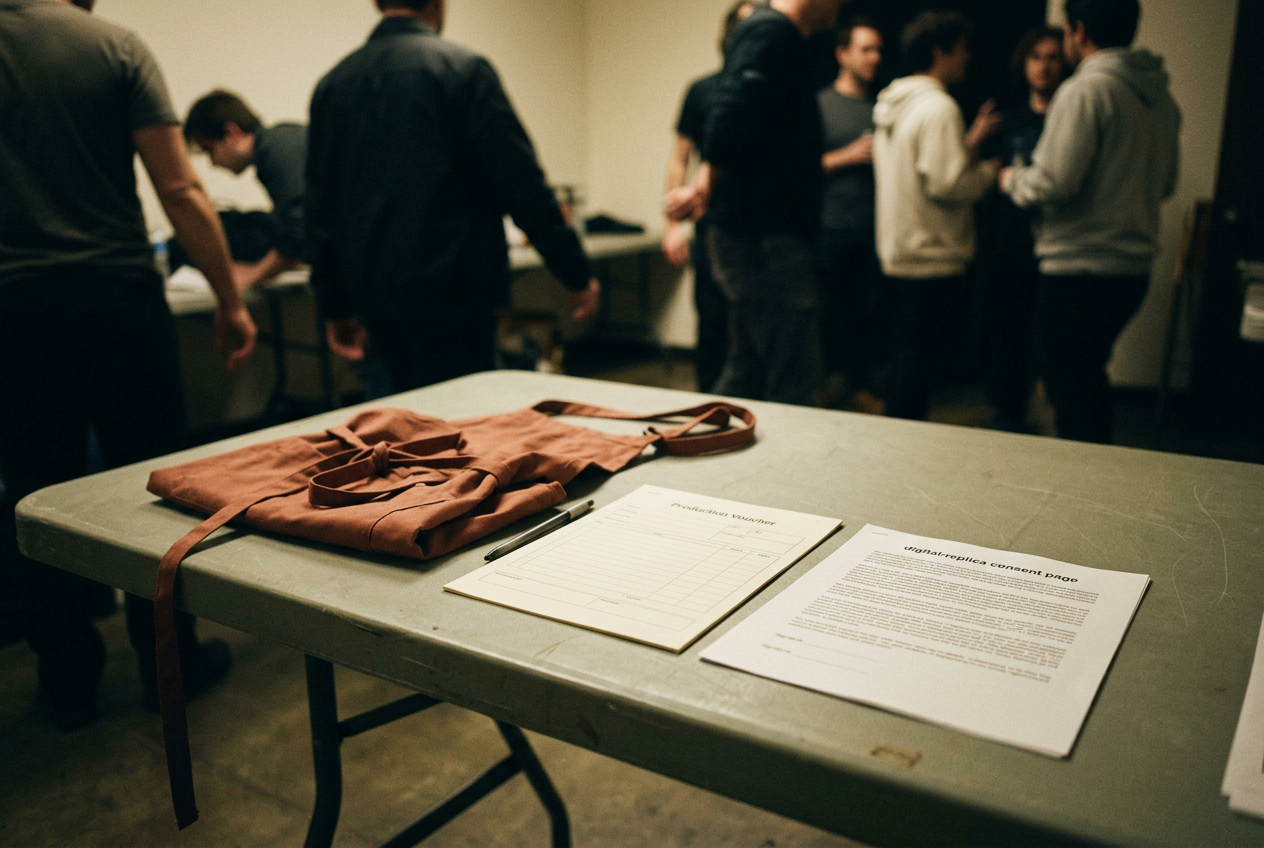
Use a deliberately ordinary setup. You are booked for one day as a diner worker, wardrobe puts you in a rust-colored polyester apron, and someone directs you toward a body-scanning rig after lunch. The apron belongs to production. The face, gait, proportions, expressions, and resulting digital file are the more complicated inventory.
The paperwork may describe that file as a digital replica, meaning a computer-generated version of an identifiable performer’s voice or likeness. Under SAG-AFTRA’s television and theatrical framework, employment-based digital replicas carry consent and compensation protections, including requirements around clear consent and reasonably specific descriptions of intended use. The clause deserves a slower read than it usually gets at holding.
This is contract literacy, not legal advice. Agreements differ by production, union coverage, jurisdiction, project type, and the exact document placed in front of you. If the page conflicts with your deal, your union or representative is the useful next call. The production assistant guarding the clipboard is not the appeals court.
Treat creation and use as separate transactions
The first transaction creates the asset. Cameras record your body from multiple angles, software converts those images into a model, and production stores files capable of generating or modifying your appearance. Scan time is work time under covered terms, with applicable pay rules, but payment for standing in the rig does not answer what happens afterward.
The second transaction uses the asset. Your replica might appear in the diner scene for which you were hired, populate another sequence in the same production, support later visual-effects work, or become the starting material for a use that requires fresh consent. Those possibilities carry different contractual consequences. A form that collapses creation and every conceivable use into one paragraph makes the producer’s permissions easy to administer and the performer’s bargain difficult to see.
Very efficient, provided you are the party keeping the file.
Read the page twice. On the first pass, locate permission to capture or create. On the second, mark every verb governing the finished replica: use, reproduce, modify, adapt, simulate, distribute, advertise, promote, archive, or authorize. The verbs reveal what production believes it is buying.
Back at our diner, consenting to a scan while wearing the rust apron does not automatically tell you whether the replica may sit in one booth, cross behind the lead in twenty shots, appear in marketing, or return in a later production. The garment is specific. The grant may not be.
Force the intended use out of the fog
Current union language emphasizes a reasonably specific description of intended use. That phrase matters because consent cannot mean much when the proposed use is described as entertainment purposes, related uses, or any media now known or later devised. A category broad enough to hold the industry is not a production plan.
Look for the named project, the type of scene, the expected action, and whether the replica can be altered. The form should let you distinguish crowd duplication from a generated performance, background placement from featured action, and post-production continuity work from a new scene assembled after your booking ended. Conventional editing and visual-effects practices can sit under separate contractual permissions or exceptions, which is why the label AI does less work than the production’s description of the act.
Ask for practical boundaries in writing. Identify whether production intends to multiply the scanned diner worker into a larger crowd, change the apron or body, place the replica near violence or sexual content, generate facial movement, or attach dialogue. The important distinction is not whether a tool looks advanced. It is whether the finished use asks your identifiable likeness to perform something you did not perform.
Silence deserves attention. If the form describes the scanner but not the output, ask for the output. If it names the movie but not publicity, ask whether trailers, posters, social clips, games, behind-the-scenes material, and promotional partnerships are included. Do not let the physical specificity of the scan distract from the contractual vagueness of the file.
Read compensation as a chain, not a single rate
A performer can be paid to report, paid while being scanned, and owed compensation when a replica substitutes for work under the applicable agreement. Those are separate links. The voucher for the diner day proves one payment event; it does not explain every permitted reuse.
For covered background work, SAG-AFTRA’s framework can tie replica compensation to the days the performer otherwise would have been employed, with different consent and bargaining questions arising when material moves beyond the production for which it was created. The exact application depends on the contract and use. That makes the production’s good-faith estimate of displaced work economically important, even if the estimate arrives dressed as an administrative detail.
Pin down who counts the days, what records support that count, and how you will learn that a use occurred. A right to payment becomes difficult to exercise when the performer receives no reuse notice and cannot inspect the calculation. Residuals, which are payments for certain later exhibitions or reuse under a collective agreement, are also not interchangeable with compensation for replica use. One label should not be allowed to swallow another.
There is a larger incentive here. A background actor hired for another day requires scheduling, payroll, transportation, wardrobe, meals, and a place to wait. A stored replica does not become hungry or hit overtime. The savings accrue to production only if the file can replace enough future labor, which is precisely why the compensation clause must be read as a substitution rule rather than a flattering fee for participating in new technology.
Follow the file after the apron comes off
Consent language tends to concentrate on the visible result. File governance decides who retains the practical power.
Find the provisions covering storage, access, transfer, security, and deletion. The vendor operating the rig may hold raw photographs, body measurements, meshes, textures, motion data, or derived files even when the producer controls the final replica. A derived file is material generated from the original capture, such as a modified model; deleting one exported character does not necessarily delete the source material that can build another.
The useful reading method is custodial. Name the company collecting the data. Identify the producer controlling it. Check whether affiliates, successors, visual-effects houses, distributors, and promotional partners may receive it.
Then look for a retention period and a deletion mechanism. Perpetual rights and indefinite storage are related, but they are not the same clause, and a narrow use restriction offers less comfort when a reusable body file remains distributed across vendors with no stated disposal date.
The rust apron will return to wardrobe at wrap. Your scan may travel through an effects pipeline, which is the sequence of vendors and software used to turn captured material into finished images. The contract should tell you more about that journey than the call sheet does.
Security also belongs in the money story. A digital replica has value because it can perform production work. Unauthorized access therefore threatens more than privacy; it can create uncompensated images, reputational damage, and a dispute over which company had custody when the file escaped. Look for a contact and reporting route rather than assuming a generic privacy policy covers production assets.
Preserve a record you can use later
Before the scan, save the complete consent page, the version date if one appears, your voucher, the project title, the production entity, and any written description of the scene. If a representative clarifies a restriction by email, keep that with the form. A verbal assurance at the rig may be sincere. It is still difficult to search two years later.
Write down enough to recognize the use: diner interior, rust polyester apron, tray in left hand, no dialogue, background crossing. This is not vanity documentation. A digital version of you may be altered, multiplied, partially obscured, or placed far behind the principal cast, so the original booking details help connect an eventual image to the captured source.
If the use changes before scanning, ask for the consent document to change with it. If production says the broader language is standard, that describes its repetition, not its meaning. If you cannot get a clear answer under time pressure, record what you received and contact the union or your representative before agreeing where possible.
The mechanism is plain. Production converts a temporary labor booking into a durable asset, then contract language sets the conditions under which that asset can replace, extend, or imitate later labor. The close read begins with the scanned body and ends with the stored file.
Questions people ask
Can a production scan a background actor without separate consent?
Under SAG-AFTRA’s covered television and theatrical terms, creating an employment-based digital replica requires clear, conspicuous consent and a reasonably specific account of its intended use. The exact paperwork and timing depend on the agreement. A general employment release should not be treated as self-explanatory permission for every replica use.
Does payment for scan time cover every later use?
No general assumption is safe. Scan time, use within the original production, displaced workdays, reuse elsewhere, and residual obligations can sit under different rules. Read the compensation paragraph beside the scope paragraph, because a promised rate means little until the document says which uses trigger it and who reports them.
Can a replica be changed after the scan?
A production may seek permission to modify clothing, movement, appearance, or performance, while some ordinary post-production changes can fall under existing contractual rights or exceptions. The consent should describe the intended alteration closely enough for the performer to understand the result. A blanket right to modify deserves more scrutiny than the scanner itself.
What should a performer keep after the shoot?
Keep the signed consent, voucher, project and production names, written use description, representative correspondence, and concrete scene details such as the rust apron and tray. Those records can help identify a later use and establish what production described when it obtained consent. The apron is forgettable. That is why it works as evidence.
One update a day
Today's story, in your inbox
One story each morning — no hype, no filler, no algorithm deciding for you.