
A Faceless YouTube Video Has Five Workers and One Owner
The “automated” channel is usually a production line built from fixed-fee labor. When a video fails, workers absorb the squeeze; when it hits, the owner keeps the asset.
August 17, 2026 · 7 min read
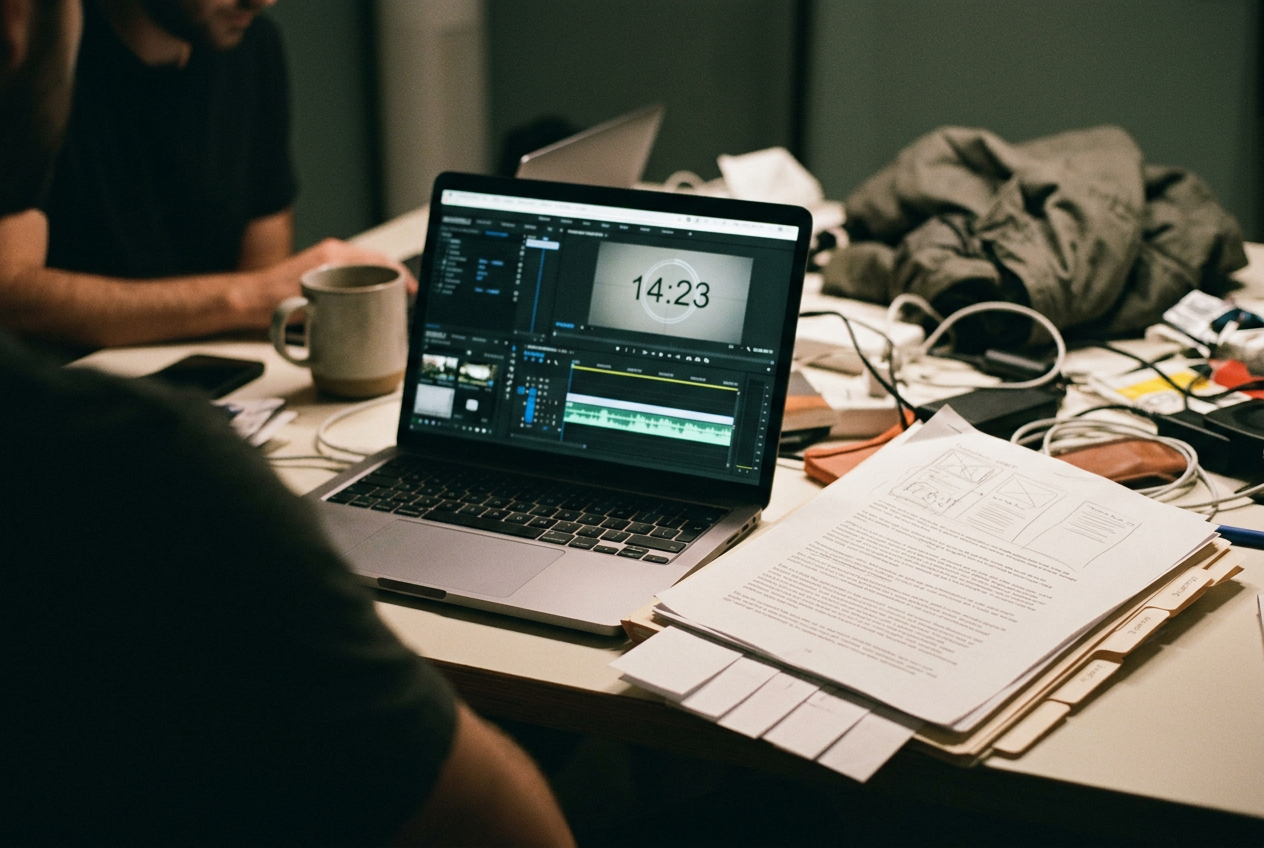
Take one ten-minute countdown about private jets. It has a 1,500-word script, a voice track, licensed or scraped-together visuals, brisk cuts every few seconds, and a thumbnail featuring a plane with the saturation pushed until the sky looks radioactive.
This is a composite production unit based on recurring public job ads, not a leaked order from one channel. The subject barely matters. Swap the jets for celebrity houses, military hardware, sports scandals, movie mistakes, or the private lives of billionaires. The worksheet survives.
The video is sold to viewers as frictionless information. Behind it sits a small piecework factory.
“Faceless” describes the person absent from the frame. “Automation” describes the sales pitch. The labor remains stubbornly human: somebody researches the jets, somebody turns the notes into a countdown, somebody records the narration, somebody finds footage and cuts it, and somebody makes the thumbnail. Generative tools can accelerate parts of that chain, but they do not remove the need to choose claims, repair bad output, avoid copyright trouble, and deliver something YouTube will monetize.
The channel owner coordinates the line and owns everything that compounds.
One video, five invoices
Start with research. The researcher receives a title or keyword and returns links, facts, clips, and a rough structure. On a weak operation, this job collapses into copying whatever already ranks on Google. On a stronger one, the researcher checks primary sources and flags claims that could trigger a correction, copyright complaint, or legal threat.
Both may appear in a marketplace under the same cheerful label: internet research.
The scriptwriter converts that packet into 1,500 words calibrated for retention, YouTube’s measure of how long viewers keep watching. The opening must delay the promise without exhausting it. Each item needs a miniature reveal. The writer is commonly asked to match reference channels, which means reproducing another publisher’s pacing while pretending the result emerged from brand strategy.
Next comes the voice. A narrator reads the script, cleans the audio, and may be expected to pronounce model names, currencies, or locations the research packet did not explain. Synthetic narration has taken some of this work, especially at the bottom of the market, but a human still has to catch the machine’s mangled emphasis. An AI voice can pronounce every word correctly and make the sentence sound dead.
Editing carries the largest visible burden. The editor sources images or clips, places captions, adds music, clears dead air, and manufactures movement from material that often consists of publicity footage and stock libraries. If the private-jet script mentions a particular cabin, the picture must match. If it does not, viewers may never notice, but the copyright owner might.
The thumbnail worker gets the smallest canvas and one of the highest-leverage assignments. A thumbnail changes the click-through rate, the share of impressions that become views, so a few hours of packaging can determine whether days of production receive distribution. Yet the designer usually owns no part of the result. The plane remains on the channel’s shelf, earning or failing without them.
Each handoff creates a boundary where the owner can reject the work, demand a revision, or replace the worker. That is the point of splitting the line. A complete producer is expensive and difficult to swap. Five contractors bidding on narrow tasks are easier to discipline.
The math is simple. The forecast is not.
For a conventional long-form video, the channel’s rough revenue equation is:
video revenue = views ÷ 1,000 × RPM
RPM means revenue per thousand views after YouTube’s share and other adjustments. It moves with viewer location, advertiser demand, topic, season, ad availability, and how many viewers were eligible to receive an ad. YouTube’s published terms say partners generally receive 55 percent of recognized net revenue from ads displayed on public watch-page videos. That split does not make a thousand views worth a fixed amount.
The owner’s production equation is:
margin = video revenue − research − script − voice − edit − thumbnail − tools and management
Course sellers like to put a confident RPM into the first equation and bargain-basement fees into the second. Then they multiply by a posting schedule and call the answer passive income. The spreadsheet does not include videos that receive few impressions, scripts abandoned after research, thumbnails replaced after launch, copyright claims, demonetization, or the owner’s time managing strangers across several time zones.
The ten-minute private-jet video can clear its production cost, miss it, or earn nothing. Nobody knows at commissioning. YouTube’s recommendation systems test viewer response, while advertisers value audiences unevenly and can leave a category without asking the publisher’s permission.
That uncertainty begins with the owner, who fronts the budget. It does not stay there.
How revenue risk travels downward
A researcher paid a fixed fee does not lose money merely because the jet video flops. In that narrow sense, piecework protects the contractor from performance risk. The uglier mechanism appears one level earlier: owners price future commissions around the failures, pushing expected volatility into lower fees, unpaid tests, compressed deadlines, limited revision terms, and sudden pauses in work.
A channel can spread risk across dozens of uploads and several contractors. One writer cannot spread the loss of an unpaid trial across a portfolio unless they have enough clients, enough negotiating power, and enough spare hours to treat rejected work as a rounding error. Gig-platform research from the International Labour Organization has repeatedly identified unpaid labor, including time spent searching, qualifying, communicating, and building reputations, as a central feature of platform work.
This is the quiet transfer. The owner keeps financial exposure to each upload, but workers carry income volatility without receiving the asset that offsets it. If the private-jet video fails, the owner can change the title, replace the thumbnail, recut the opening, or leave it online to collect search traffic later. The thumbnail designer cannot improve their old invoice.
The scriptwriter receives no dividend when the video finds an audience six months afterward.
Even revisions distribute risk selectively. A vague brief allows the buyer to discover their preferences after delivery, at the contractor’s expense. “Make it more engaging” can mean a new opening, different examples, and a rebuilt structure, none of which fits neatly inside a minor revision. Marketplaces may offer dispute systems, but the worker still weighs the value of contesting scope against a rating, repeat commissions, and time that could be sold elsewhere.
The factory runs on fixed fees at the bottom and uncertain residual income at the top. That arrangement is not unusual in media. What is unusual is how aggressively the automation pitch erases the factory while teaching would-be owners to become its purchasing department.
Ownership is the profitable role
The owner controls the channel account, monetization relationship, analytics, subscriber connection, and archive. Those rights matter more than authorship credits because YouTube rewards accumulated audience behavior. A back catalog can keep generating views, and its performance data helps the owner choose future subjects, packaging, and upload timing.
Workers commonly receive payment for a deliverable rather than equity, royalties, or access to the underlying analytics. They may never learn whether their private-jet script earned back its cost. Without that information, they cannot distinguish a genuinely unprofitable channel from a profitable buyer using failure as a bargaining posture.
The asymmetry gets sharper when one upload breaks out. Revenue rises with views while most labor costs remain fixed. The writer is not owed another fee each time the script plays. The editor does not gain a percentage because the recommendation system revived the video.
Every additional monetized view improves the owner’s margin after platform deductions and ongoing overhead.
YouTube also protects its position. Alphabet reports advertising revenue at corporate scale, while creators receive access under platform rules that can change and monetization policies they must continue satisfying. YouTube’s rules on reused and repetitious material can block channels that add too little original value or mass-produce near-identical videos. Outsourcing itself is permitted.
Low-value repetition is the risk, which means the contractors may be ordered to manufacture enough novelty to keep an industrial operation looking editorial.
That is why the private-jet video needs five sets of fingerprints but one legal owner. Human variation helps the channel pass as a publication. Fragmented contracts stop the humans from becoming one.
The course is selling the foreman’s desk
Faceless-channel courses tend to present outsourcing as a ladder: find a profitable niche, hire inexpensive specialists, publish steadily, and reinvest the proceeds. The useful part is banal. Media companies have always commissioned labor and retained rights.
The deception sits in the word “automated.” A buyer must write briefs, evaluate factual accuracy, check licensing, manage revisions, watch analytics, and absorb the uploads that die. If they do none of that, the likely result is disposable material assembled from other disposable material. YouTube may decline to monetize it, advertisers may avoid it, or viewers may leave before the first jet clears the runway.
There is a less extractive version. Owners can pay for trials, define revision limits, provide usable briefs, credit contributors where appropriate, and offer bonuses or revenue participation when a video crosses agreed performance thresholds. None of this guarantees a hit. It makes the risk legible and shares a little of the upside with the people whose work created it.
The harder fix is ownership. A cooperative channel, a profit-sharing production team, or a contractor agreement with transparent performance reporting changes who benefits from the archive. Those structures also require trust, accounting, and slower hiring. They are poorly suited to a course promising that strangers can run your media business while you sleep.
The radioactive private-jet thumbnail remains the cleanest diagram. The designer made the object that earns the click. The channel owner keeps the click, the viewer data, and whatever that viewer watches next.
Questions people ask
Are faceless YouTube channels really automated?
Usually only in fragments. Software can generate drafts, narration, captions, or rough edits, but people still commission topics, verify claims, clear footage, correct output, package the upload, and manage monetization. “Automation” often means the owner has outsourced the visible labor and retained coordination.
Who takes the biggest financial risk on an outsourced video?
The owner fronts production costs and faces uncertain ad revenue, but can spread that risk across a catalog and retains every successful asset. Contractors face a different risk: unpaid tests, revisions, interrupted commissions, and no participation in a breakout video’s long-term earnings.
Does
YouTube allow outsourced or AI-made videos?
YouTube does not ban a video because contractors or AI tools helped make it. Monetization can be refused or removed when material is repetitive, mass-produced, reused without meaningful original value, or otherwise violates program policies. The channel owner remains responsible for what gets uploaded.
Why do channel owners separate research, writing, voice, and editing?
Specialization can improve speed, but it also makes workers easier to replace and lets the owner compare bids for each task. The channel keeps the audience relationship and archive, while each contractor controls only one deliverable and usually receives no information about its eventual performance.
One update a day
Today's story, in your inbox
One story each morning — no hype, no filler, no algorithm deciding for you.