A “Leather Cleaner” Label Won’t Tell You What’s in Poppers
Poppers packaging describes a legal fiction, not a safety standard. The formula may change while the familiar bottle stays put, leaving buyers to manage risks the label was designed not to discuss.
August 18, 2026 · 8 min read
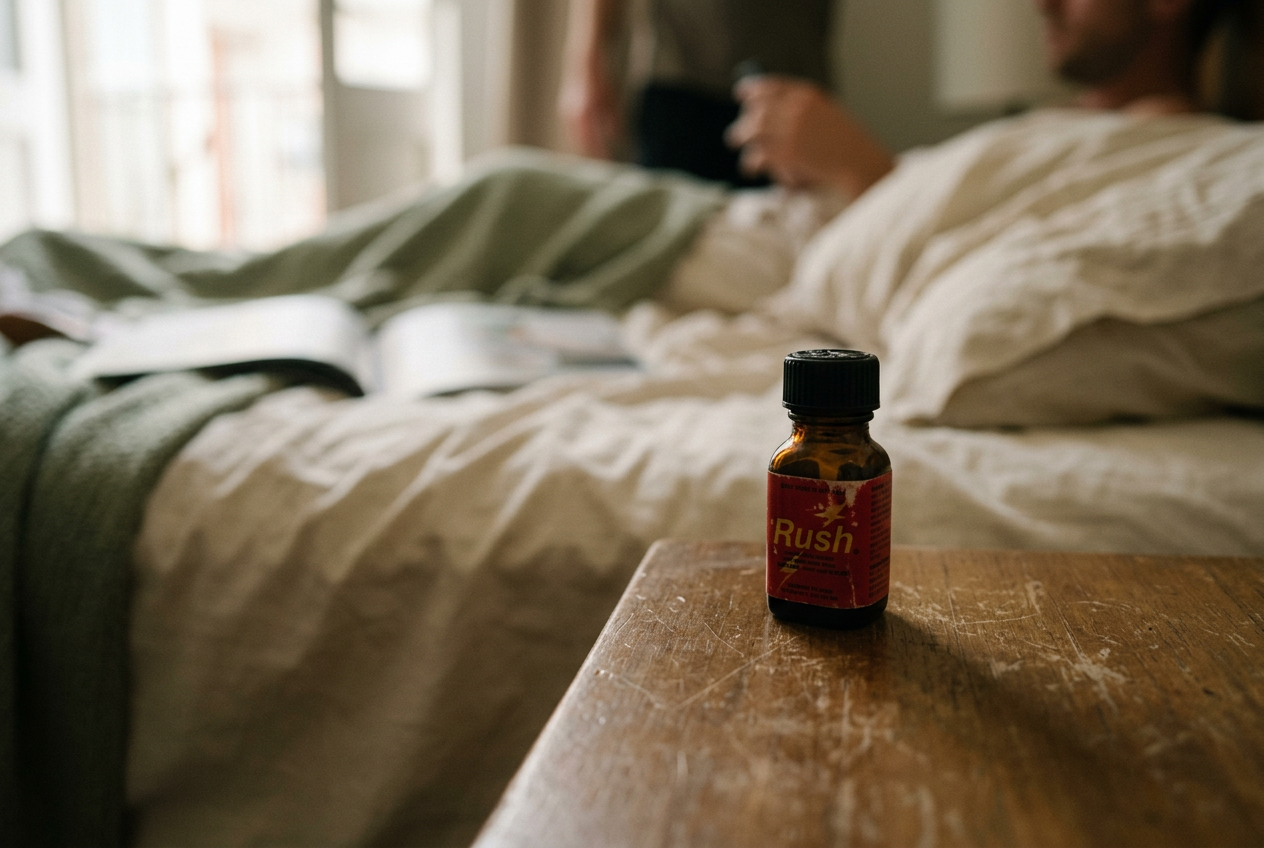
Take the small brown bottle sold under the Rush name, with its red-and-yellow label and cap sized for a few fingers. Depending on the seller and market, the listing around that bottle may call it an aroma, solvent cleaner or room odorizer. It may insist that the product is not for human consumption. The buyer is still expected to understand what everybody involved is declining to say.
This is not coy branding pasted over an otherwise transparent product. The euphemism helps determine how poppers reach the shelf, what the retailer can claim to be selling and how much useful information appears beside the checkout button. It also pushes the most consequential questions, including the chemical in the bottle and whether it has changed since the last purchase, onto the customer least equipped to answer them.
The Rush bottle is recognizable. Its contents are not necessarily predictable.
The label is doing legal work
“Poppers” names an effect and a use culture, not one chemical. Most products contain an alkyl nitrite, a family of volatile liquids that widen blood vessels and relax smooth muscle after inhalation. The resulting head rush is brief. During sex, that muscle relaxation is part of the point, particularly for people having anal sex, though the drug does not replace lubrication, communication or going slowly.
Amyl nitrite has a medical history, including prescription use for angina. That history does not mean a contemporary bottle contains pharmaceutical amyl nitrite, or that a nightclub product was manufactured to pharmaceutical standards. Consumer bottles have been reported with compounds including isobutyl nitrite, isopropyl nitrite and forms of pentyl nitrite. Similar names conceal meaningful differences.
In the United States, federal law restricts consumer products containing volatile alkyl nitrites when they are intended to produce intoxicating or physical effects, while preserving an exception for legitimate commercial uses. That makes intended use commercially important. A manufacturer selling “poppers” advertises the prohibited purpose. A manufacturer selling solvent cleaner has a defense built into the noun.
Regulators are not obliged to accept every wink. The Food and Drug Administration has warned consumers against nitrite poppers sold as products such as leather cleaners and room deodorizers, citing severe injury and death after ingestion or inhalation. Enforcement, however, has to contend with online sellers, changing company identities and products that can be reformulated or relabeled faster than a public warning travels.
The result is a market that borrows the appearance of ordinary retail without supplying ordinary product knowledge. The Rush bottle can have a brand name, a professional label and a tamper-evident cap while withholding the information a person would need to compare one batch with another. Packaging polish is cheap. Consistent chemical analysis is not.
One name can cover several formulas
Legal pressure does not merely affect where a bottle is displayed. It can change what goes inside.
Different alkyl nitrites have moved in and out of favor as governments classified individual compounds, revised medicines rules or examined whether poppers belonged inside broader drug laws. Britain’s Psychoactive Substances Act created uncertainty before alkyl nitrites were treated as falling outside that law’s central mechanism. Australia rescheduled alkyl nitrites under a more complicated framework that distinguishes between compounds and routes of access. Across borders, the same product name can therefore sit over a different legal category and, potentially, a different formula.
That is the mechanism underneath the rotating euphemisms. Regulation targets a chemical or intended use; suppliers adjust the compound, description or jurisdiction; retailers preserve the familiar visual identity because recognition sells. A buyer sees the same Rush branding and assumes continuity, even though the market rewards everyone upstream for keeping the useful claim vague.
Substitution matters. Isopropyl nitrite has been associated in medical literature and public health reporting with poppers maculopathy, damage affecting the central retina that can cause blurred or distorted vision. Other nitrites also carry serious risks, particularly a dangerous fall in blood pressure and methemoglobinemia, a condition in which altered hemoglobin cannot carry oxygen properly.
Storage adds another layer. Alkyl nitrites are volatile and degrade with exposure to heat, light and air, so a bottle left warm or repeatedly opened may not remain chemically identical to the product first packaged. A sharp change in smell, color or effect does not tell a buyer which degradation products are present. It only announces uncertainty after the fact.
A safety data sheet, when one exists, can show what the supplier declares for an industrial product. It is not independent batch testing. Nor does a bottle’s country-themed branding prove where the liquid was made, because online retail chains often separate the brand owner, packager and storefront while revealing little about any of them.
The information deficit is part of the business
The euphemism works for nearly everyone except the person opening the cap. Manufacturers preserve access to payment systems and distribution. Retailers can place the product in an adults-only category while repeating that it has no human use. Marketplaces can remove an individual listing without addressing the sellers that return under altered language.
The customer pays for a bottle whose advertised identity cannot explain its intended use, dosing uncertainty or drug interactions. That is a peculiar consumer bargain, but not an accidental one. Clear instructions would document the use the supply chain is structured to deny.
The Rush label keeps returning here because brand familiarity can feel like evidence. It is evidence of successful continuity in packaging. It does not establish that two bottles bought months apart, from different retailers or in different countries contain the same alkyl nitrite at the same concentration.
Independent testing could narrow that uncertainty, although ordinary drug-checking services may not accept volatile liquids and basic reagent tests cannot reliably identify every alkyl nitrite. Laboratory methods such as gas chromatography, which separates volatile compounds for identification, require equipment and handling beyond what a buyer can perform at home. Where checking is unavailable, certainty is unavailable too. The honest harm-reduction position starts there.
What the bottle declines to tell you
No label euphemism makes swallowing poppers safe. Ingestion can cause life-threatening methemoglobinemia and requires urgent help from emergency services or Poison Control. Skin and eye contact can cause chemical injury. The liquid is also flammable, which makes open flames, cigarettes and spilled product a bad combination rather than a matter of personal tolerance.
The most important interaction is with erectile dysfunction drugs such as sildenafil or tadalafil, and with prescribed nitrate medicines. Both lower blood pressure through related pathways; combining them with poppers can produce a profound drop, leading to fainting, injury, loss of consciousness or worse. Tadalafil can remain active well beyond the immediate sexual encounter, so separating the substances by a casual few hours does not erase the issue.
Harm-reduction guidance generally favors using less rather than repeatedly inhaling, remaining seated or otherwise protected from a fall, keeping the liquid away from skin and stopping when symptoms feel wrong. Fresh air does not neutralize an overdose, but a crowded room can make dizziness and breathing problems harder to notice. Nobody can derive a dependable dose from the size of a sniff when concentration, compound and bottle condition are uncertain.
Blue or gray lips, trouble breathing, severe weakness, confusion, chest pain or collapse need emergency attention. New central blurring, a bright spot or distorted vision also warrants prompt medical assessment and no further use. Telling clinicians that an alkyl nitrite was involved gives them more useful information than repeating “leather cleaner,” even when the exact compound remains unknown.
Practical handling is less glamorous and more useful. Keep the cap secure, store the bottle upright away from heat and flame, and do not transfer the liquid into a drink container or another unlabeled vessel. A leaking bottle is not improved by familiarity with the logo. Dispose of it according to local household hazardous-waste guidance rather than pouring it into a sink.
None of this turns an opaque product into a safe one. It lowers a few identifiable risks while leaving the central problem intact: the market’s legal language prevents the bottle from functioning as health information.
Questions people ask
What are poppers made of?
Most contain an alkyl nitrite, but that category includes several chemicals with different risk profiles. A bottle may contain isopropyl, isobutyl, pentyl or another nitrite, and the brand name alone cannot establish which one is present. Formulas may also differ between markets or change over time.
Why are poppers sold as leather cleaner or room odorizer?
In the United States, intended human use affects how alkyl nitrite products are treated under federal law. Describing a bottle as a cleaner or odorizer lets manufacturers and retailers claim a commercial purpose unrelated to intoxication, even when customers understand the coded language. The disclaimer protects distribution better than it informs use.
Does a familiar brand mean the formula is consistent?
No. Familiar branding shows that a package and name have remained recognizable, not that every bottle contains the same compound or concentration. Different suppliers, jurisdictions, storage conditions and reformulations can all alter what reaches the buyer. Only appropriate chemical analysis can establish a bottle’s contents with confidence.
What should someone do after swallowing poppers or becoming seriously ill?
Call emergency services or Poison Control and identify the product as a possible alkyl nitrite exposure. Do not rely on the cleaner label or wait for severe breathing problems to pass. Keep the bottle available for clinicians if that can be done without further contact, leakage or exposure.
One update a day
Today's story, in your inbox
One story each morning — no hype, no filler, no algorithm deciding for you.