A Positive Home STI Test Can Still Leave You Finding a Clinic
Everlywell, LetsGetChecked, myLAB Box and Nurx make collection easy. Their usefulness after a positive result depends on state law, the infection and whether telehealth can finish the job.
August 14, 2026 · 8 min read

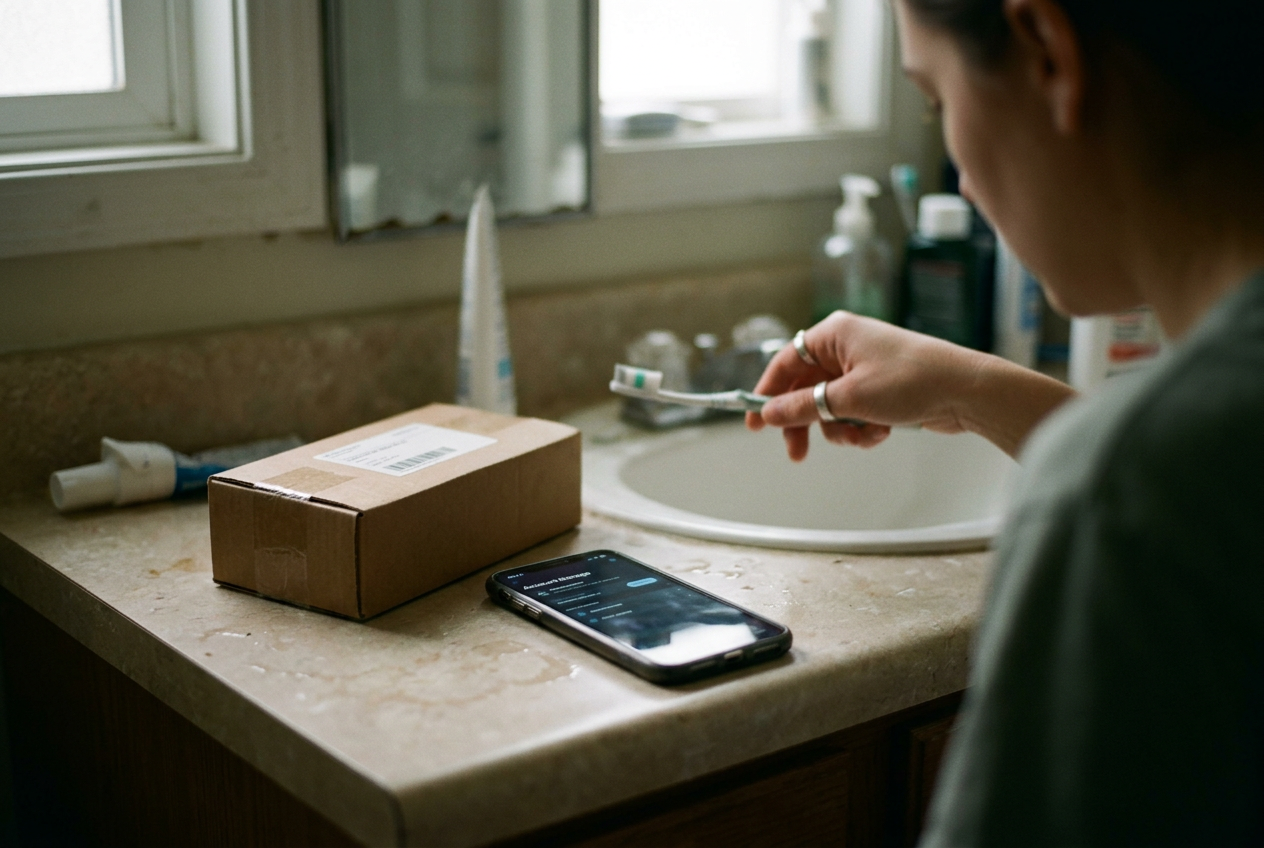
The object that explains this market is the prepaid return envelope. You seal a swab or blood sample inside, drop it in the mail and watch a portal until a result appears. The company has designed every inch of that route. Then the envelope disappears, a result turns red, and the service must cross from retail logistics into health care.
That crossing is where the promises narrow.
To compare them, take one concrete result: chlamydia detected in a vaginal swab collected at home. Chlamydia is commonly tested with a nucleic acid amplification test, which looks for the organism’s genetic material. The result may be clear enough for a clinician to treat without repeating the same test, but somebody still has to review medical history, prescribe where permitted, explain what happens with recent partners and arrange local care if remote treatment is unsuitable.
Everlywell, LetsGetChecked, myLAB Box and Nurx all sell more than a cardboard kit. Their documentation presents a managed pathway. Yet “clinician support” can mean a call, a portal message, a telehealth consultation or a referral that returns the work to you. Those are not interchangeable outcomes.
The kit and the care live in different systems
The home-testing business controls checkout, specimen instructions, shipping and the laboratory contract. Many services use CLIA-certified laboratories, meaning the lab operates under federal quality standards. CLIA certification says nothing about whether a prescription will arrive, whether a pharmacy will accept it or whether a nearby clinic can provide an injection.
Care runs through another stack. A clinician must be licensed where the customer is located. State telehealth and prescribing rules apply. The infection matters because some treatments can be prescribed remotely while others require an examination, an injection or additional testing.
Insurance, pharmacy charges and local clinic capacity enter after the kit company has already collected its money.
This split explains the soft verbs in brand FAQs: “may,” “where available,” “if appropriate.” They are legally useful and medically defensible. They also let a company advertise access without promising completion.
The prepaid envelope delivers your specimen to a controlled destination. A positive result can send you back into ordinary American health care, where the destination is less certain.
Everlywell offers a handoff, with boundaries
Everlywell’s documentation says test results receive physician review and describes access to an independent clinician network after certain positive results, with consultation offered without an additional charge where available. That is better than a laboratory PDF abandoned in a dashboard. A clinician can interpret the finding, discuss next steps and determine whether remote treatment fits.
The qualification matters. Everlywell does not present every infection, customer or state as eligible for the same prescription pathway. Its consumer pages separate the price of testing from medication and from care that must happen locally. For our positive chlamydia swab, the likely route described is clinician contact followed by treatment when the independent provider can legally and clinically prescribe it.
If the result or history calls for in-person care, the company points outward.
Confirmatory testing is also condition-specific. A reactive screening result, particularly for HIV, is not the same thing as a confirmed diagnosis, and Everlywell’s materials direct customers toward follow-up testing where needed. What the documentation does not consistently provide is a single operational map showing who orders that confirmation, where the specimen is taken and who pays.
Partner notification remains mostly a conversation. The clinician may explain that recent partners need information and care, but Everlywell does not advertise a comprehensive notification service that contacts them for you. Public health departments may become involved with reportable infections, though that is a government function rather than a feature of the kit.
Verdict: useful clinician access, but the word “access” carries more weight than “treatment.” Read the eligibility language before assuming the fee buys a prescription.
LetsGetChecked makes the phone call central
LetsGetChecked puts its clinical team closer to the center of the post-result pitch. Its documentation says nurses contact customers about abnormal results and discuss the finding rather than leaving interpretation entirely to an automated portal. For a person staring at that chlamydia result, a scheduled human call is a real piece of care, especially when the alternative is trying to decode a lab range alone.
The nursing contact does not erase the clinical and geographic limits. Brand materials describe treatment options for eligible positive results, with prescribing dependent on the infection and location. Cases that need examination, injections or specialist management move to local services. The company can explain the route; it cannot turn every mailed specimen into mail-order treatment.
LetsGetChecked is clearer about active outreach than services that merely make a consultation available. That distinction is easy to miss. “You can speak to someone” requires the customer to find the button, book the slot and keep pursuing the issue. “The clinical team will contact you” assigns the first move to the company.
Its documentation discusses confirmatory or additional testing when a screening result requires it, but local execution can still sit outside the platform. Partner notification is not presented as a staffed, done-for-you product. The nurse may cover disclosure and retesting, while the customer remains responsible for the uncomfortable messages.
Verdict: the strongest documented handoff of this group. The call is valuable, although it may end with an address rather than medication.
myLAB Box includes telemedicine, not universal resolution
myLAB Box advertises complimentary telemedicine consultations for positive results. The proposition is direct: buy the test, receive the lab finding, then speak with a clinician who can discuss treatment and prescribe when the condition and local rules allow it.
For the positive chlamydia swab, that could create a short route from portal to consultation to pharmacy. “Could” is doing honest work. The company’s documentation makes exceptions for infections requiring confirmation or in-person management, and prescription availability varies. Medication costs and pharmacy fulfillment also sit beyond the consultation promise unless a product page expressly includes them.
The free consultation is still meaningful. A separate telehealth appointment can cost more time and money than customers expected after paying for a home kit, and myLAB Box at least acknowledges that a positive result creates another clinical encounter. Yet its pathway becomes thinner once a local clinic is necessary. Referral language tends to mean guidance, not an appointment booked into a reserved network slot.
The same weakness appears around partners. Educational material tells customers to notify relevant partners, but the service does not document a broad anonymous notification operation or routine partner prescriptions across its market. The person who mailed the swab remains the coordinator.
Verdict: good value when telemedicine can close the case. Less impressive when “consultation included” produces a recommendation to locate outside care.
Nurx comes closest to ongoing care, for eligible patients
Nurx already operates as a telehealth clinic and pharmacy-facing service, so its STI testing sits inside a medical account rather than appearing only as a laboratory purchase. Its documentation says the medical team follows up on results, discusses treatment and can send prescriptions when remote care is appropriate. When it is not, the team refers the patient to in-person services.
That integrated model gives Nurx an advantage with the positive chlamydia swab. The result, questionnaire and prescribing conversation can remain in one message thread, subject to state availability and clinical review. The tradeoff is that testing charges do not automatically settle every later cost. Medication, consultation structures, insurance processing and outside clinic care can create separate bills or administrative steps.
Nurx also cannot dissolve the distinction between a diagnostic result and a reactive screen requiring confirmation. If another result needs a fresh specimen, physical examination or treatment that cannot be delivered remotely, the platform becomes a navigator. Its materials are more comfortable acknowledging continuing medical management than the pure kit sellers, but local referral still means leaving the system.
Partner handling remains advice-led rather than operational. A medical team can explain whom to notify and discuss available treatment routes, yet the documentation does not promise that Nurx will locate or contact partners. The social labor stays with the patient.
Verdict: the closest thing here to continuity, provided Nurx serves your state and the infection can be managed through telehealth. The polished account does not guarantee a closed loop.
The missing feature is completion
Across all four services, clinician access is the most marketable post-result benefit and the easiest one to provide at national scale. A video visit or nurse call can sit on top of the laboratory network. Prescriptions are narrower. Confirmatory testing depends on the assay and local facilities.
Partner notification carries privacy, consent and public-health complications that do not fit neatly inside checkout.
That structure rewards companies for being precise about specimen collection and vague about what happens after detection. The commercial transaction ends with a valid result. The patient’s problem does not.
The useful pre-purchase question is therefore not whether a physician reviews results. Most serious services arrange some clinical oversight. The sharper test is whether the documentation names the next actor: who contacts you, who can prescribe, who arranges confirmation, whether medication costs extra and what “referral” means in practice. If the page answers only with “support,” expect work.
The return envelope was engineered to remove friction. Once it has done its job, every unowned step comes back.
Questions people ask
Will a home
STI testing company prescribe treatment after a positive result?
Sometimes. Everlywell, LetsGetChecked, myLAB Box and Nurx describe clinician pathways that may lead to a prescription, but eligibility depends on the infection, medical history, state rules and whether remote treatment is appropriate. A consultation promise does not guarantee medication.
Does every positive home STI test need confirmation?
No. Some laboratory results can support treatment without repeating the same test, while reactive screening results for infections such as HIV require confirmatory testing before diagnosis. Brand documentation should identify that distinction, though the customer may still have to arrange the follow-up specimen locally.
Will the service tell my partners?
The services reviewed mainly offer advice about notifying partners rather than a comprehensive notification service. Certain infections are reported to public health authorities as required by law, and health departments may conduct partner services, but that work is separate from the commercial testing package.
What does a local referral usually include?
Usually guidance toward an outside clinic, primary-care provider or specialist, not a guaranteed appointment. The customer may need to make contact, transfer results, confirm payment and travel for care. That is the point where the convenience promised by the prepaid envelope most often ends.
One update a day
Today's story, in your inbox
One story each morning — no hype, no filler, no algorithm deciding for you.