A TikTok Rose Is Worth Less Every Time It Changes Hands
A viewer buys coins, taps a Rose and sees it bloom on a livestream. The creator gets Diamonds, then cash. TikTok controls every exchange rate between those moments.
August 25, 2026 · 7 min read
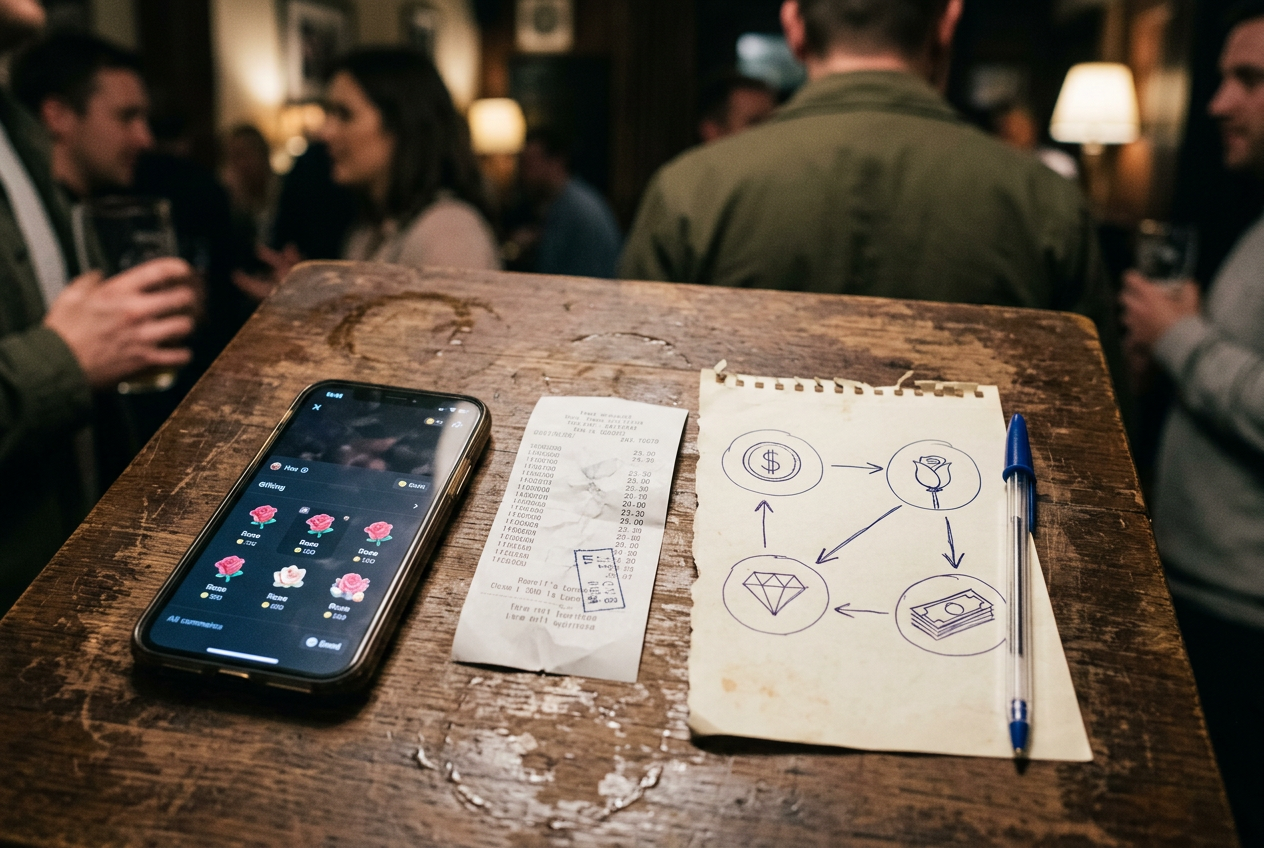
A Rose floats up the screen during a TikTok LIVE. It is small, familiar and cheap enough to send without ceremony. The host may thank the viewer by username before the animation disappears beneath comments, likes and the next Rose.
That tap looks like a direct exchange between two people. It is not.
The viewer bought Coins from TikTok. The Rose is a Gift, meaning an animated item purchased with those Coins. TikTok may then award the creator Diamonds, a reward unit linked to eligible LIVE activity, and the creator can eventually request a cash withdrawal under the rates and conditions shown in their account.
One Rose has now carried at least three values. There is the amount the viewer paid to acquire the Coins. There is the Rose’s price inside TikTok. There is whatever reward value reaches the creator’s balance.
The units change at each point, and TikTok runs every ledger.
This is more than cute interface design. By keeping the viewer’s purchase and the worker’s pay in different currencies, the platform makes its cut hard to see and difficult to calculate from either side of the screen.
The viewer does not buy a Rose with dollars
Before a viewer can send the Rose, they usually need Coins, TikTok’s prepaid virtual currency. Coins are sold in bundles, and TikTok’s public policies say the price and exchange rate appear at the point of purchase. The amount can vary by location, bundle and purchasing channel, which means a Coin does not carry one universal dollar value that can be printed beside every Gift.
The viewer therefore encounters the Rose as a price in Coins, not as a fraction of the card charge that funded the balance. The distinction matters. A bundle purchase feels like the spending event because that is when money leaves a bank account; sending the Rose later feels like using something already owned, even though the Gift is the point at which TikTok converts stored purchasing power into a visible social gesture.
Any Coins left after the LIVE remain in the account for another Gift. That remainder is useful to TikTok. It keeps the viewer inside the system and makes the next tap easier, while the original dollar price recedes behind a balance expressed in platform units.
TikTok’s Virtual Items Policy also treats Coins and Gifts as platform items rather than ordinary money. They cannot be passed around as cash, and the rules governing refunds, availability and use depend on TikTok’s terms and applicable local law. The viewer has paid real currency for a restricted balance whose permitted use is set by the company that sold it.
The Rose is the cleanest expression of that arrangement. It has a face value inside the app, displayed in Coins, but its dollar cost belongs to the bundle and rate through which those Coins were acquired. Two viewers can tap the same Rose while reaching it through purchases that were not priced in precisely the same way.
The Rose does not travel to the creator
When the Rose appears on screen, TikTok deducts its price from the viewer’s Coin balance. The creator does not receive those Coins. Nor do they receive the Rose as an asset that can be sold back at the viewer’s purchase price.
TikTok instead uses Diamonds to measure rewards associated with Gifts and LIVE activity. Its public help material describes Diamonds as a way for creators to receive recognition and potential rewards, while its policies reserve control over how those rewards are calculated. Eligibility depends on location, account standing, age and participation in the relevant features.
That conversion is the center of the business model. A normal card payment gives the buyer a dollar amount and gives the seller a transaction record denominated in the same currency, even if fees are deducted later. TikTok separates the two sides before the creator is credited. The viewer sees Coins and a Rose.
The creator sees Diamonds and an estimated reward balance. Neither screen has to show the other side’s dollar figure.
This makes the platform cut difficult to describe as one stable commission. Public explainers often try to turn the system into a fixed percentage, but TikTok’s own documentation does not promise one simple, permanent Coin-to-Diamond-to-dollar formula across every account and market. Rates, feature rules and withdrawal terms can change, and the app presents the applicable information inside the relevant transaction flow.
The honest calculation therefore starts with two records: the viewer’s receipt for the Coin bundle and the creator’s completed withdrawal. Without both, an observer can estimate only part of the route. The Rose animation supplies no audit trail.
TikTok benefits from that missing line. If the company displayed the viewer’s dollar cost beside the creator’s estimated cash reward, its margin and conversion rules would become legible at the moment of purchase. Instead, the apparent transaction ends when the flower reaches the host.
Cash-out is another conversion
Diamonds are not dollars waiting in a conventional wallet. They are an internal measure that may support a reward payment, subject to TikTok’s terms, the creator’s eligibility and the withdrawal options available in that market. A creator must reach the applicable withdrawal conditions, connect an approved payment method and request the transfer.
The account may show an estimated balance, but the amount that arrives can still be shaped by the rate TikTok applies, withdrawal rules, payment-provider charges and taxes owed by the creator. Not every condition applies identically everywhere. That variability is precisely why a viral chart claiming that every Rose pays one fixed amount should be treated as an approximation unless it is tied to a specific account, market and period.
For the worker, timing matters too. The viewer’s payment reached TikTok when the Coins were bought. The creator gets access to money only after the LIVE has produced eligible rewards and the withdrawal clears. TikTok holds the unit of account throughout, defines when it becomes withdrawable and can enforce account or policy restrictions before payment.
Return to the Rose. Its viewer-facing value is what it costs to send. Its platform value includes the revenue attached to the Coins, the engagement generated by the animation and the incentive for both participants to remain in the LIVE. Its cash-out value is the portion of eligible rewards that the creator can convert and receive.
Those are different things, even when the interface compresses them into one pleasant tap.
Play is doing accounting’s dirty work
The changing units make spending less legible without making it less real. Coins turn a card charge into a colorful balance. Gifts turn that balance into animations. Diamonds turn audience spending into a creator metric, after which a withdrawal screen turns the metric back into money.
Each stage has a local logic. The viewer does not need to calculate dollars while reacting to a joke. The creator can monitor rewards without seeing every supporter’s purchase history. TikTok can operate across currencies and payment systems.
Yet the combined effect favors the only participant with access to the entire chain.
The platform knows what it charged for the Coin bundle, which Gift consumed the balance, how it calculated the creator’s Diamonds and what it authorized for withdrawal. The viewer knows the first half. The creator knows the last half. Calling the Rose a gift encourages both people to understand the exchange as generosity between users, while TikTok remains the merchant, currency issuer, marketplace operator and paymaster.
That language also hides the labor around the Gift. A creator has to go LIVE, hold attention, read comments, recognize senders and keep the room active enough for more Roses to arrive. Small Gifts become meaningful only through repetition and volume, which turns the host’s responsiveness into part of the payment system. Gratitude is work here.
So is making the solicitation feel unlike a solicitation.
The viewer is not necessarily being tricked, and the creator is not confused merely because they participate. Both can understand the broad bargain. The problem is that informed participation requires information TikTok splits across purchase screens, reward dashboards and policy pages, while the LIVE itself presents a frictionless fiction of direct support.
What an honest Rose would show
TikTok could preserve virtual Gifts while displaying three figures together: the approximate dollar cost of the Coins being spent, the creator’s estimated reward from that Gift and any important qualification affecting withdrawal. Exact amounts could still vary by market or payment route. The screen could say so.
Such disclosure would not eliminate the platform’s fee. Running payments, moderation and livestream infrastructure costs money. It would make the fee visible, which is a more demanding standard than publishing a policy that says rates appear somewhere during a transaction.
Until then, the practical record of one Rose remains fragmented. The viewer has a Coin receipt. The creator has a Diamond balance and, later, a withdrawal entry. TikTok alone can place those records on the same line.
Questions people ask
How much does a TikTok Rose cost?
TikTok displays a Rose’s price in Coins inside the LIVE Gift panel. Its dollar cost depends on how and where the viewer bought those Coins, including the bundle and purchasing channel, so the Gift does not have one universal cash price that applies to every transaction.
How much does a creator make from one TikTok Rose?
There is no reliable universal cash figure in TikTok’s public documentation. TikTok uses Diamonds and other eligibility factors to calculate rewards, while the rate and withdrawal terms shown to a creator can vary by location and account. A completed withdrawal is stronger evidence than a generic online conversion chart.
Does TikTok take a cut of LIVE Gifts?
Yes, in the practical sense that the creator does not receive the viewer’s Coin purchase as a direct cash transfer. TikTok controls the conversion from paid Coins to Gifts, from eligible activity to Diamonds and from Diamonds to a reward payment, but its public materials do not reduce that chain to one guaranteed global commission rate.
Can viewers send money directly through a TikTok Gift?
No. A TikTok Gift is a virtual item purchased with Coins, not a peer-to-peer cash transfer. The Rose creates an on-screen signal and may contribute to the creator’s rewards, but TikTok remains between the viewer’s payment and the creator’s eventual withdrawal at every stage.
One update a day
Today's story, in your inbox
One story each morning — no hype, no filler, no algorithm deciding for you.