
Cash-Advance Apps Turn Payday Fees Into Friendly Buttons
A $100 advance can carry a tip, a membership charge and an instant-transfer fee without displaying one blunt price. The interface splits the cost before payday arrives.
August 12, 2026 · 7 min read
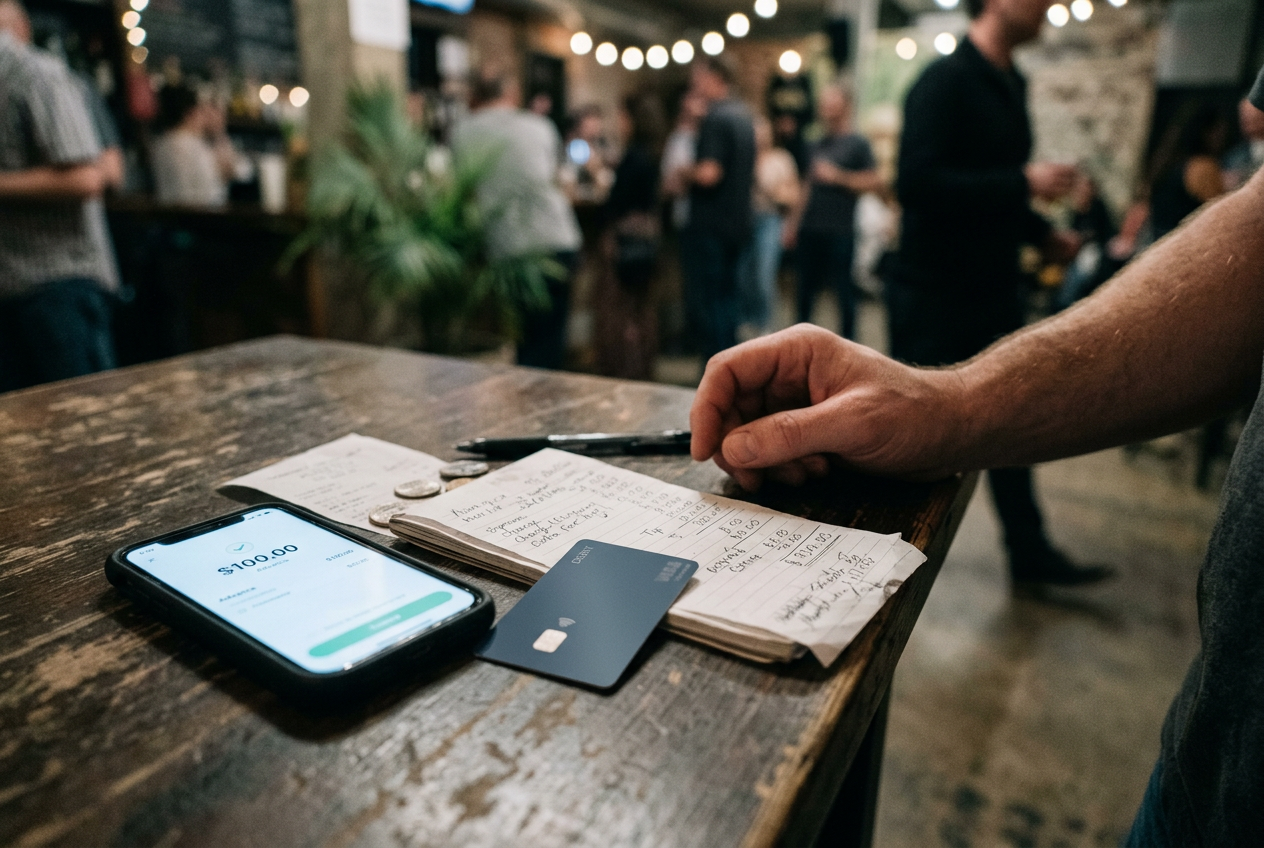
Put a $100 advance on the screen. The app says the advance carries no interest. Standard delivery is free. A tip is optional.
Instant delivery costs extra, and access may sit behind a monthly membership that also buys unrelated features.
Each sentence can be true. Together, they can still leave the user paying several separate charges to solve one problem: money earned, expected or urgently needed has not reached the checking account yet.
That $100 is the useful object here. Keep it on the screen while the labels change around it. EarnIn emphasizes optional tips and charges for its faster Lightning Speed transfer while offering a slower route without that delivery fee. MoneyLion’s Instacash documentation similarly separates optional tips from Turbo delivery.
Empower combines a recurring subscription with potential instant-delivery charges and an optional tip. Dave’s ExtraCash materials separate membership from express delivery, turning the price of access and the price of speed into different lines.
The products and eligibility rules differ. Some advances are tied to wages already earned, while others estimate what a user can repay from expected deposits. Some providers also change terms, fees and delivery choices by account or state. The common design is easier to see than the differences: the app avoids presenting liquidity as one product with one price.
The fee is being disassembled
Earned-wage access, usually shortened to EWA, lets a worker receive part of accrued pay before the employer’s scheduled payday. A cash advance can look similar on the phone, though the provider may base eligibility on recurring deposits rather than a direct record of hours already worked.
The distinction matters to regulators and lawyers. It matters less at the grocery checkout. The user has a timing gap and wants the $100 now.
A conventional lender usually has to state a finance charge in recognizable lending language. These apps often describe their products through the absence of familiar loan costs: no interest, no late fee, no mandatory tip, no credit check. The negative claims do real work. They invite comparison with a credit card or payday loan while directing attention away from the charges the product does use.
Those charges occupy separate conceptual boxes. The subscription is payment for membership. The tip is voluntary support. The expedited-transfer charge buys speed.
None needs to be called the price of borrowing, even when the user would have paid none of them without requesting the advance.
This is interface design doing accounting’s job. A single fee attached to $100 is easy to judge. Several smaller amounts attached to different moments are harder to total, especially when one recurs monthly, one appears during checkout and one is framed as a gesture of appreciation rather than payment to a company.
The tip borrows a social script
EarnIn and MoneyLion state that tips are optional. Their documentation also says users can access advances without tipping, subject to eligibility and product rules. That is materially better than a compulsory fee disguised as generosity.
It does not make the tip neutral.
A tip normally follows human service. Someone drove the car, carried the plate or cut the hair. Inside a cash-advance app, the recipient is a platform providing an automated financial product. The label imports a social obligation from service work into software, where declining can feel like taking something without contributing even when the company explicitly permits a zero tip.
The timing sharpens that pressure. The request appears when a user has already disclosed account data, checked an available amount and moved toward transfer. Backing out means leaving without the money. Continuing at zero requires an active refusal if the interface presents a suggested contribution.
Brand documentation tends to defend the formal choice. The user controls the tip. That is the narrow test. The better test is whether the screen makes zero feel like a normal price or an exception the user must choose against the grain.
Return to the $100. If the tip were displayed as a finance charge, the user could compare it with other ways of covering the same gap. Once it is called support, its economic purpose becomes fuzzier even though the checking-account result stays precise. The balance falls by the amount selected.
The subscription spreads the denominator
Empower and Dave use subscriptions around products that include cash-advance access, alongside other account, budgeting or credit-related features described in their materials. Bundling changes the arithmetic because the monthly charge no longer appears to belong entirely to the advance.
That defense can be fair for a customer who uses the wider package. It is weak for someone who joined to bridge one shortfall, kept the membership for several months and barely touched the extras. The app can attribute value across the bundle; the customer still has to decide how much of the recurring bill exists because the $100 button was there.
Subscription pricing also benefits from mismatched time frames. The advance may last days. Membership renews by the month. Comparing the two requires allocating a recurring cost to a short use of money, which the checkout screen has little incentive to do for you.
Suppose the user takes one advance during the billing period. For personal cost accounting, the full membership charge may belong in that transaction if the membership would otherwise have been canceled. If the user takes several advances and uses other features, the allocation becomes less obvious, but the charge does not disappear. It has merely moved outside the advance screen.
This is why the no-interest claim can be accurate and incomplete. Interest is one pricing method. A subscription is another. Consumers spend dollars, not categories.
Speed is the product most people came for
Free standard delivery gives providers a strong answer to criticism: the user can receive the advance without paying for expedited transfer. EarnIn, MoneyLion, Empower, Dave and Chime describe faster delivery options that can carry a charge, while their slower routes or qualifying alternatives may avoid it.
The practical value of that free route depends on the deadline. A transfer arriving after rent, an overdraft or a utility payment clears does not solve the immediate problem. The customer is not buying abstract access to $100. The customer is buying $100 before something else hits.
That makes expedited delivery more than a convenience upsell. It is often the feature that converts an available advance into useful liquidity, and the platform can keep advertising a free route because time, rather than eligibility, does the sorting.
The structure resembles priority boarding only at a distance. Missing an earlier boarding group usually costs patience. Missing the useful transfer window can trigger a separate bank fee, a declined purchase or another round of borrowing. The app does not create that deadline, but its pricing captures value from it.
There is also a real operational cost to moving money quickly. Card-network transfers and other instant-payment methods are not free to providers. Brand documentation, however, rarely tells a user how much of the expedited fee covers payment rails and how much remains with the platform. The checkout price is visible.
The split behind it is not.
Show the math the app separates
The clean calculation starts with every dollar that would not have been paid without the advance. Call that total cost C. Include the selected tip, the expedited-transfer fee and the relevant share of a subscription. Then divide C by the advance amount.
For the $100 on our screen, every dollar of cost equals 1 percent of the amount received. Duration matters next. If the advance remains outstanding for seven days, annualizing that percentage means multiplying it by roughly 52. A 5 percent seven-day cost, for example, annualizes to about 260 percent.
That annualized figure is a comparison tool, not a claim that the app will charge the same amount all year. Many products limit frequency or available amounts, and repeated use may not follow a fixed schedule. Still, the calculation exposes what friendly labels obscure: a modest dollar charge can become expensive relative to a small balance held for a few days.
Annual percentage rate, or APR, expresses a borrowing cost on a yearly basis. Some providers reject APR comparisons because they characterize advances as noncredit products, optional tips complicate the numerator and repayment structures differ from ordinary loans. Those distinctions affect legal classification. They do not stop a user from comparing the cost of getting money early.
The most honest screen would show both views. It would preserve the separate line items, because users should know what they are paying for, then add a total cost for this advance based on the options selected. If a subscription is required, the screen should say whether the displayed total includes it. If standard delivery arrives after a stated window, that timing should sit beside the price rather than under another tap.
Most interfaces stop short of that total. Fragmentation is useful. The tip can be defended as optional, the subscription as a bundle and the instant fee as payment for speed. No individual line has to carry the reputational weight of being the cost of short-term liquidity.
Who pays for payday moving upstream
Employers create part of the market by holding wages until scheduled payday even after labor has been performed. Banks contribute through settlement timing, low balances and overdraft exposure. The app arrives between those systems and sells a smoother clock.
Users pay when they tip, subscribe or choose speed. Employers may pay under some EWA arrangements, particularly when access is offered as a workplace benefit. Providers collect the charges identified in their terms, while payment processors and card networks can receive portions under commercial agreements that consumer-facing documentation does not fully itemize.
The person with the least control over payroll timing sees the most detailed menu.
That is the underlying mechanism. Cash-advance apps do not need to make a large fee look small. They make one price look like several unrelated decisions, each defensible on its own and each encountered at a different point in the flow. The $100 remains $100.
The cost changes names as it moves down the screen.
Questions people ask
Are cash-advance apps really interest-free?
Many leading apps state that their advances carry no interest. A user may still pay through a membership, an optional tip or an expedited-transfer charge, so “interest-free” does not mean cost-free. The relevant number is the total paid to receive and use the advance within the needed time.
Why do cash-advance apps ask for tips?
Tips let a provider describe payment as voluntary rather than mandatory. EarnIn and MoneyLion say users can choose not to tip, subject to their product terms, but the prompt still uses a social convention associated with rewarding human service to price an automated financial transaction.
Is instant transfer worth paying for?
It depends on what happens while the free transfer is pending. If slower delivery would cause an overdraft, missed bill or declined essential purchase, speed has concrete value. The comparison should include that avoided cost, the transfer charge and any subscription or tip attached to the advance.
How should I compare cash-advance app costs?
Add every charge connected to the advance, including the expedited fee, selected tip and relevant subscription cost. Divide that total by the amount received, then compare products over the same number of days. This is a cost comparison, not a legal determination that every advance is a loan.
One update a day
Today's story, in your inbox
One story each morning — no hype, no filler, no algorithm deciding for you.