
Disney+, Hulu and Max Are Rebuilding Cable One Bill at a Time
The bundle offers a real discount if you keep all three services. Its better trick is making three possible cancellations feel like one household subscription.
August 11, 2026 · 7 min read
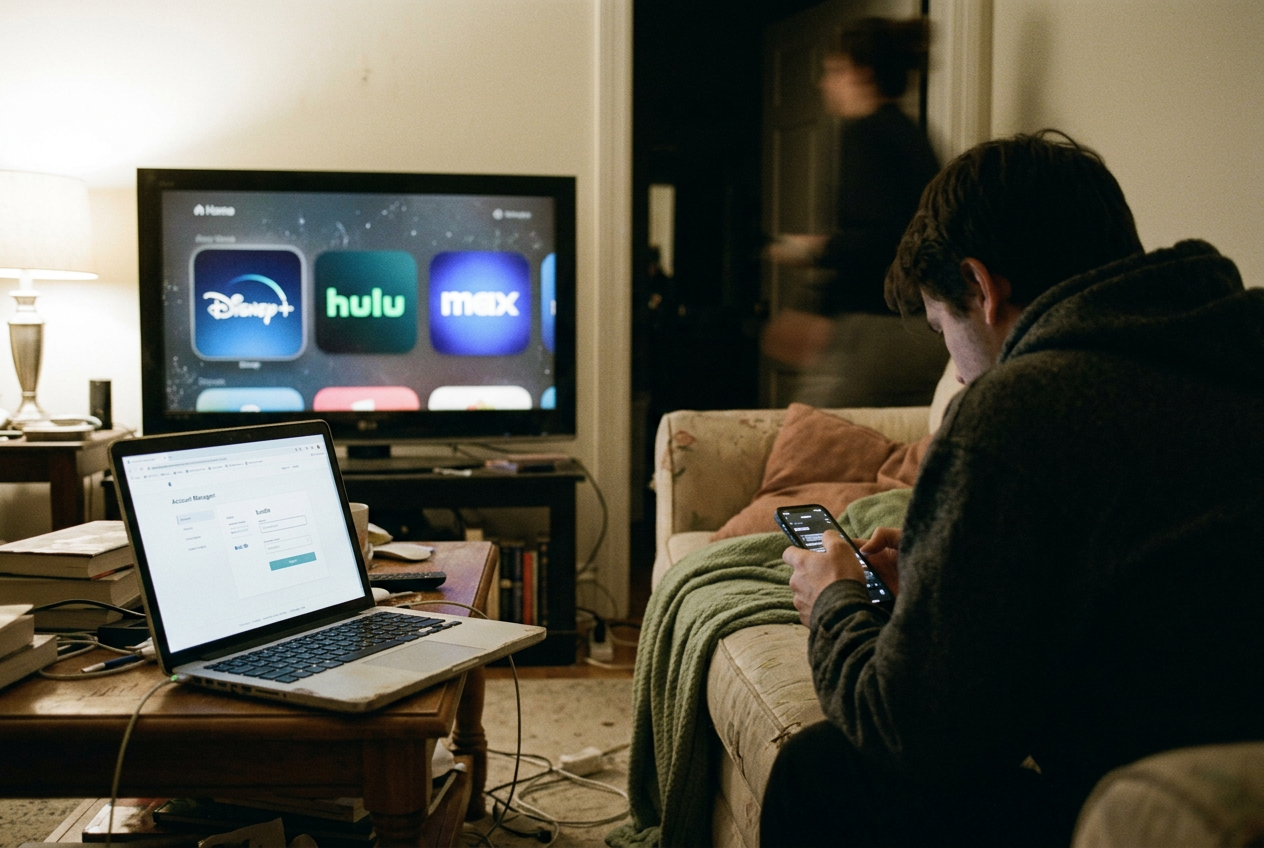
Start with the three app icons. You buy the Disney+, Hulu and Max bundle through one participating service, activate access, then still watch across Disney+ and Max, with Hulu available through its own app and increasingly folded into Disney+. The charge is consolidated. The television experience is not.
That arrangement, introduced in summer 2024, is the cleanest picture of where streaming has landed after years spent declaring cable dead. Disney controls Disney+ and Hulu. Warner Bros. Discovery owns Max.
The companies remain competitors, but they have agreed that getting into the same monthly charge is more useful than forcing every household to choose between them.
The customer gets a discount against keeping comparable versions of all three services separately. The companies get a subscription that is psychologically larger than any individual show, franchise or platform. A person may finish a season on Hulu and ignore it for two months, yet keep paying because Max has a new drama and Disney+ remains installed for children, Marvel completists or the annual return of a familiar movie. The bundle turns uneven use into steady billing.
This is cable’s central achievement, rebuilt without a technician carrying a box through your hallway.
The discount is real, within a narrow frame
The bundle saves money when the comparison is honest: the same ad-supported or ad-free tiers, purchased separately, against the bundled version. Someone who already intends to keep Disney+, Hulu and Max throughout the year can pay less by grouping them. That is the practical upside, and it does not need corporate poetry.
The frame narrows quickly. Hulu in this bundle is the on-demand service, not Hulu + Live TV, so it does not replace a full cable package for viewers who need local stations, live news and a broad sports lineup. Max carries HBO programming and Warner Bros. Discovery’s larger catalog, but its sports availability and tier rules can change.
Disney+ contributes its franchise library and selected Hulu integration. None of this creates a complete television service in the old sense.
A household that watches only two of the three may spend more than necessary, even after the discount. A household that rotates services can often spend less by subscribing for a month, finishing the desired programs and canceling. That practice is churn, the industry term for customers leaving a subscription, and it is precisely the behavior this product was designed to blunt.
Return to those app icons. The bundle does not make Max valuable during a month when nobody opens it. It makes the unused icon feel like part of a discounted whole, which changes the cancellation calculation from dropping one dormant service to breaking apart a deal.
Cable sold inconvenience as stability
Traditional cable bundles combined channels with installation, rented equipment and a customer account that could be surprisingly difficult to close. The worst versions added promotional rates that expired, early termination charges attached to fixed commitments, or a return deadline for hardware that remained the provider’s property. Not every cable plan used every tactic, but the system gave providers several points of leverage after the viewer had stopped watching.
Cancellation often required a call because the call was useful to the company. A retention agent, an employee tasked with preventing departure, could offer a temporary discount or move the customer into another package. The friction bought time, and time saved accounts. Even where formal contracts disappeared, a modem, set-top box or bundled internet plan could make leaving feel like household administration rather than a button press.
Streaming removed much of that burden. The Disney+, Hulu and Max bundle is generally sold month to month. There is no set-top box to return and no installation appointment to reverse. If the bundle was purchased directly, the customer can manage it through the billing service’s account page; if a third party handles payment, cancellation usually has to happen through that third party.
Access commonly continues through the paid billing period, subject to the seller’s terms.
That is materially better than a contract with an early exit penalty. It is also less simple than the image of three libraries flowing from one login suggests. Existing subscribers may need to activate or link access, credentials can behave differently depending on where the bundle was purchased, and each app still controls its interface, profiles and playback. Consolidated billing has arrived before consolidated television.
The new lock-in lives in the discount
Streaming companies cannot rely on a cable box bolted into the media cabinet, so they have developed softer forms of retention. Annual plans exchange a lower effective monthly rate for payment upfront. Ad-supported tiers reduce the visible entry price while opening another revenue stream. Bundles make the savings disappear if the customer tries to remove one component.
That last mechanism matters most here. Disney and Warner Bros. Discovery do not need to stop someone from canceling Max. They need to make the person evaluate Max as part of a larger household package, where the standalone value of each service becomes difficult to isolate and the discount can be presented as something the customer would lose.
Cable operators practiced a more developed version of the same arithmetic. A customer calling to remove several unwanted channels could discover that those channels were not priced individually, because the package had been designed to make subtraction unrewarding. The streaming bundle is less coercive, since the whole subscription can be canceled without returning equipment or paying out a long contract. Its logic is familiar.
Aggregation protects weaker or temporarily quiet parts of the package with the strength of whatever is currently essential.
The three app icons remain separate because full integration would require difficult decisions about technology, branding, customer data and whose interface gets to sit at the front. The bill can be merged faster than the products. That tells you what the companies needed first.
One charge can hide several businesses
Disney’s interest is straightforward. Hulu gives it general entertainment beyond the family and franchise identity of Disney+, and packaging both services has already trained subscribers to treat them as connected. Adding Max broadens the offer without Disney having to fund another prestige catalog from scratch.
Warner Bros. Discovery gets access to a larger bundle at a time when every major streaming company wants lower churn and steadier direct-to-consumer revenue. The internal division of subscription money between the companies has not been publicly detailed in the consumer offer, and that opacity is normal. Cable viewers also paid one provider while channels negotiated carriage fees, meaning payments from the distributor for permission to carry their networks, behind the screen.
The distributor role is now shared and partially disguised. One company may take the customer’s payment, while each service retains its app and measures viewing inside its own system. The customer sees a discount. The owners see a way to coordinate distribution without merging companies or surrendering their brands.
This structure also creates room for future price movement. Once a bundle becomes the default household purchase, increases can be judged against the higher total cost of buying its components separately rather than against the cheaper service a viewer originally wanted. Cable packages grew through the same comparison trick: the bundle remained defensible because unbundling had been made expensive or impractical.
The best deal depends on your tolerance for churn
For a household that uses all three services most months, the bundle is worth considering. It lowers the combined charge and removes several billing entries. The relevant comparison is against equivalent standalone tiers, including whether ads are acceptable, rather than the most flattering numbers on a sales page.
For someone comfortable rotating subscriptions, the bundle often loses its edge. Rotation costs attention rather than hardware: remember the renewal date, cancel through the correct billing provider, then reactivate when the catalog earns it. Streaming companies know many viewers will not maintain that discipline. The bundle prices convenience while calling the result savings.
There is no need to pretend the new system is identical to cable. It is easier to leave, more portable and less dependent on local infrastructure. The distinction is substantial. Yet the business goal has circled back to the same place: make the package broad enough that some part of it always feels necessary, then let the customer’s reluctance to reorganize the household protect the monthly payment.
On the home screen, Disney+, Hulu and Max still look like separate choices. On the card statement, they have already become a package.
Questions people ask
Is the
Disney+, Hulu and Max bundle cheaper than subscribing separately?
Yes, if you want comparable versions of all three services at the same time. The discount becomes less useful if one service sits unopened for months, or if you would otherwise rotate subscriptions and pay for only one or two at once.
Does the bundle use one app and one login?
It consolidates the purchase more fully than the viewing experience. Hulu programming is increasingly accessible inside Disney+, but Max remains its own app, and subscribers may need to activate linked access depending on where they bought the bundle and whether they had existing accounts.
Is this bundle the same as cable?
No. It is generally month to month, requires no rented set-top box and can usually be canceled online through the company that handles billing. It does reproduce cable’s package logic by using a discount to make individual services harder to evaluate and remove.
Who benefits most from the streaming bundle?
Regular viewers of all three services receive the clearest consumer benefit. Disney and Warner Bros. Discovery gain something more durable: lower churn, broader distribution and a monthly payment that does not depend on every platform releasing an indispensable show at the same time.
One update a day
Today's story, in your inbox
One story each morning — no hype, no filler, no algorithm deciding for you.