Your Premium Movie Ticket May Be Buying the Wrong Screen
IMAX, Dolby Cinema and theater-branded large formats can charge similar surcharges for radically different presentations. The logo tells you less than the projector, frame and room.
September 6, 2026 · 8 min read
Use Oppenheimer as the stress test. A center seat could buy access to an IMAX 70mm print using the film’s towering 1.43:1 image, a digital IMAX presentation capped at 1.90:1, a Dolby Cinema screening with superb contrast but a wider frame, or a theater chain’s own premium large-format room with specifications left tastefully vague.
The app presented each as an upgrade. The tickets did not purchase the same object.
That distinction matters because “premium” has become a retail category before it is a projection standard. IMAX and Dolby impose equipment requirements under their brands, though the exact IMAX setup varies considerably. A theater-branded premium large format, usually shortened to PLF, means the chain has designated a room as bigger or better and written its own rules. The surcharge is precise.
The promise is flexible.
My reference point remained the same center seat and the same film. Oppenheimer made the differences unusually visible because Christopher Nolan and cinematographer Hoyte van Hoytema built parts of it around the immense IMAX frame, while Nolan’s channel-based sound mix exposed the gap between owning an impressive speaker system and receiving material designed to use every advertised feature.
Start with the shape of the picture
Aspect ratio means the relationship between an image’s width and height. Most multiplex movies arrive around 1.85:1 or 2.39:1.
Oppenheimer moves between a wide 2.20:1 frame and taller IMAX material, reaching 1.43:1 in venues capable of showing the full image.
That taller frame is the concrete thing to track. In an IMAX 70mm auditorium built for 1.43:1, selected sequences extend high above and below the wide composition. The screen does not merely become larger.
The composition changes. Bodies occupy more vertical space, ceilings press down, landscapes open, and the Trinity test gains scale without the image being stretched.
A digital IMAX listing may instead show the expanded sequences at 1.90:1. That is still taller than the conventional version, and it can look excellent, but it removes part of the 1.43:1 frame.
Many ticketing pages call both presentations IMAX, leaving “70mm,” “laser” or a separate venue database to carry information the main logo declines to explain.
Dolby Cinema generally shows the version supplied for its wider screen geometry. With Oppenheimer, that meant giving up the maximum IMAX height, although the black levels and stable brightness could make the film’s faces, smoke and black-and-white passages look cleaner than they did in a poorly maintained film presentation. This is where format fandom becomes unhelpful. The intended frame has value.
So does a projector that is focused.
The chain-branded PLF is the hardest to judge from a listing. Some rooms use a large 1.85:1 screen that can hold a tall image generously. Others have a very wide screen where the same film appears letterboxed, meaning unused bands remain above and below it.
“Largest screen in the building” tells you nothing about how much of that screen the movie occupies.
Read the projector line, not the logo
IMAX currently covers several projection systems. IMAX 70mm runs a large-format film print through a specialized projector. Dual-laser IMAX uses two 4K laser projectors and can fill a 1.43:1 screen when the auditorium and movie support it.
Single-laser IMAX commonly tops out at 1.90:1. Older xenon digital IMAX systems typically use dual 2K projectors, with xenon referring to the lamps that produce their light.
Those versions share a brand while producing visibly different results. At the Oppenheimer center seat, IMAX 70mm offered the full vertical composition and the physical texture of film, including slight movement and occasional debris that belong to mechanical projection rather than the digital file. A good dual-laser presentation traded that texture for steadier alignment, strong brightness and fewer moving parts between the image and the screen.
Dolby Cinema is more consistent on paper. Its auditoriums use dual laser projection with Dolby Vision, the cinema system designed to produce high contrast and deep blacks. That matters during a movie filled with dark rooms, pale faces and bursts of severe brightness. Yet the label still cannot promise that the screen masking is correct, the two projected images are aligned, or the operator has caught a focus problem.
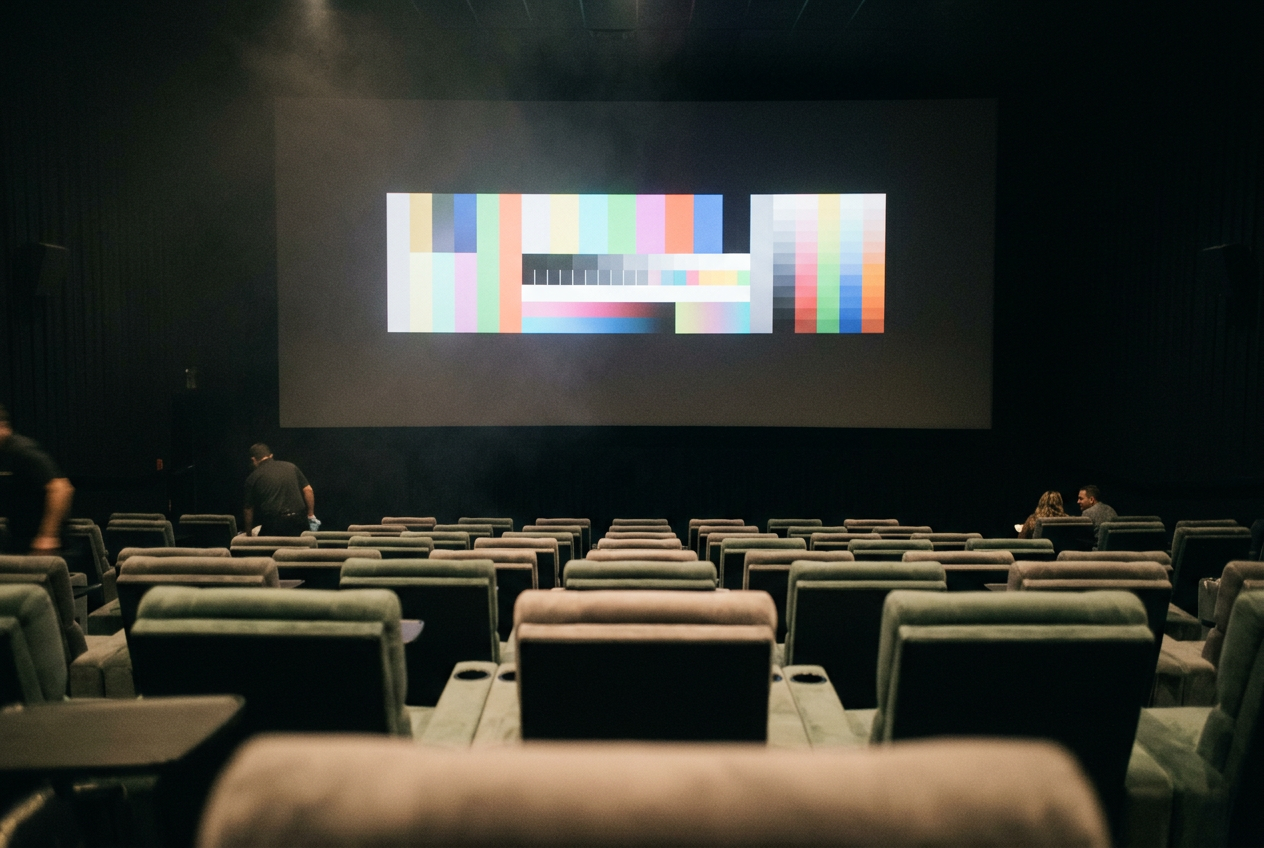
Masking is the movable black border used to fit a screen to the image. Many modern auditoriums leave screens permanently exposed, which saves labor and accommodates automated schedules but turns unused screen area gray under stray light. The picture has not changed. Its perceived contrast has.
A theater PLF may contain a capable 4K laser projector and outperform an aging branded room nearby. It may also contain older hardware aimed at a large screen from too far away, producing an image that is big, dim and soft. The chain controls what it discloses. “Laser” is useful.
“Premium projection” is copy.
The sound badge can exceed the soundtrack
Dolby Cinema rooms include Dolby Atmos hardware, an object-based system that can place sounds at specific points around and above the audience. Oppenheimer, however, was released with Nolan’s preferred 5.1 mix, a channel-based format sending audio to six defined speaker channels. Booking Dolby Cinema did not produce a secret Atmos version.
The room reproduced the supplied mix through its installed system.
That screening could still sound tremendous. A well-tuned room offers clean dialogue, controlled bass and speakers that match across the front wall. The benefit came from playback quality rather than an Atmos mix that did not exist.
IMAX uses its own sound systems, with configurations varying by auditorium generation. The strongest presentation made the film’s pressure shifts and low-frequency impacts feel integrated with the room, while a less disciplined one turned density into brute volume. Loudness is easy to sell because the audience notices it immediately. Clarity requires calibration, functional speakers and a room without a loose panel buzzing whenever the score reaches for dread.
PLF sound claims demand the closest reading. A listing may name Atmos, another branded system, or no format at all. If it only says “immersive sound,” the theater has supplied an adjective where a specification should be.
Maintenance decides whether the specification survives
Projection standards describe a room on commissioning day. You buy a seat on an ordinary night after thousands of screenings, minor repairs, rushed turnovers and whatever staffing level the theater owner has decided will do.
A film print can collect dust or drift out of focus. Dual-projector systems can lose convergence, the alignment that makes both images sit precisely on top of each other, leaving edges soft or doubled. Laser light sources age more slowly than lamps but still require calibration. Speakers fail.
Subwoofers rattle fittings. Exit signs throw light onto the screen. None of these defects appears beside the recliner icon during checkout.
This is the least glamorous reason two identical surcharges buy different screenings. Premium exhibition depends on routine inspection, yet multiplex automation has reduced the chance that a projectionist is watching the image with you. A format can meet its contractual equipment requirement while the lived presentation deteriorates around it.
At the Oppenheimer center seat, the full 1.43:1 frame remained the rarest feature and the hardest to reproduce elsewhere. I would still choose a maintained dual-laser IMAX room over a neglected film projector, and a sharp Dolby presentation over a dim PLF screen whose only confirmed attribute is acreage. Format hierarchy collapses once the room stops doing its job.
Make the checkout page earn the surcharge
Begin with the movie, not the brand. Look up whether the release contains expanded IMAX footage, whether that footage reaches 1.90:1 or 1.43:1, and whether the sound mix includes Atmos.
Official filmmaker or studio material can establish the intended formats, though it should be read as technical information rather than a command to purchase the costliest ticket.
Next, identify the auditorium. “IMAX 70mm” is specific. “IMAX with Laser” helps, but the screen ratio and single- versus dual-laser setup still matter. Dolby Cinema gives you a stronger equipment baseline, while the movie’s mastering determines how fully it uses that hardware.
For a chain PLF, search the theater page for a named projector, resolution and sound system. If the chain will not disclose them, price the uncertainty into your choice.
Then use local evidence. Recent audience comments about dimness, blown speakers or a dirty print are more relevant than arguments about which format wins in theory. Asking the theater directly can work if the question is concrete: projector type, screen ratio, Atmos availability or whether a film presentation has reported damage. “Is this the best screen?
” invites customer-service weather.
The business model rewards ambiguity. A premium auditorium lets an exhibitor charge more for a seat without adding another showtime or expanding capacity, while the distributor participates in the higher box-office revenue under its booking terms. Branded systems also cost theaters money through specialized equipment, licensing and support. A chain-owned PLF keeps more control inside the chain and can turn a large room into a proprietary product, even when the underlying upgrade is modest.
That does not make the surcharge fraudulent. It makes comparison inconvenient by design. The logos sort customers quickly, and most people will not research projector generations before a Friday-night booking. The informed buyer is doing work the listing could have done in one line.
For Oppenheimer, the decision was unusually clear: choose maintained IMAX 70mm or 1.43:1 dual laser when the expanded frame is the priority. Choose Dolby Cinema when contrast, consistency and room quality outweigh the missing image height. Choose the theater PLF only after learning what lives behind the name.
Bigger letters on the checkout page do not focus the projector.
Questions people ask
Is IMAX always better than Dolby Cinema?
No. IMAX is the stronger choice when a film has meaningful expanded footage and the auditorium can display its intended ratio. Dolby Cinema may produce deeper blacks and more consistent digital projection, especially when the available IMAX room uses older xenon hardware or has visible maintenance problems.
Does
Dolby Cinema always mean the movie has Dolby Atmos?
No. Dolby Cinema installs Atmos-capable sound hardware, but the movie must carry an Atmos mix to use object-based placement as intended. A film released in 5.1, including Oppenheimer, still plays through the room’s system and may sound excellent, but the badge does not create a new mix.
What does premium large format mean at a movie theater?
PLF is a broad category for an auditorium marketed as an upgrade, often through a larger screen, upgraded projection, stronger sound or enhanced seating. Theater-branded versions follow the chain’s specifications, which can vary by location, so the label alone does not identify the projector, image ratio or soundtrack capability.
How can
I tell which premium screening is worth it?
Match the movie’s intended aspect ratio and sound mix to the room’s confirmed hardware, then check recent reports about focus, brightness and broken speakers. If the listing gives only a proprietary name and vague adjectives, a standard screening in a well-maintained auditorium may be the more premium experience.
One update a day
Today's story, in your inbox
One story each morning — no hype, no filler, no algorithm deciding for you.