Hulu’s Ad Countdown Breaks The Bear Before the Commercial
Watching “Review” with and without Hulu ads reveals the deeper damage: the countdown turns suspense into advance notice of a platform transaction.
September 6, 2026 · 8 min read
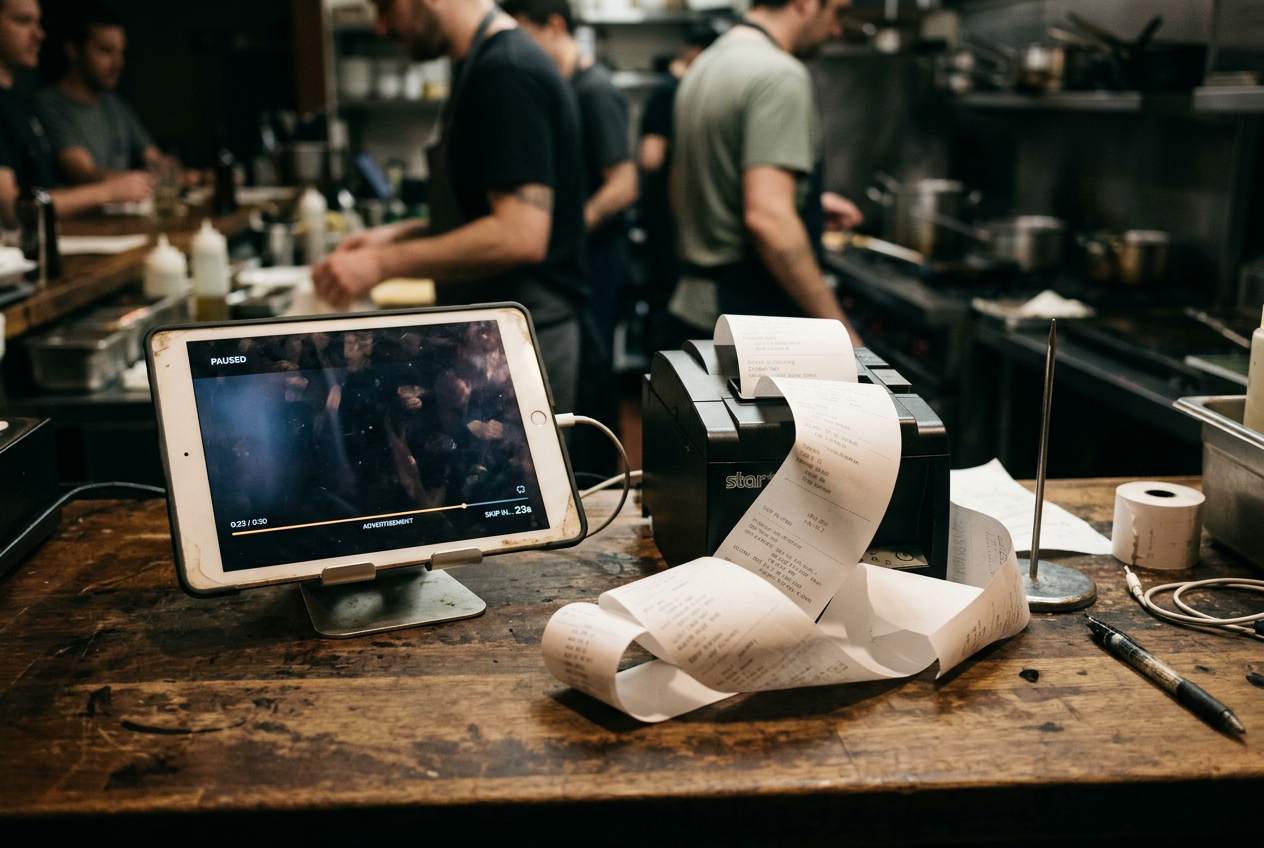
The ticket printer in “Review,” the seventh episode of The Bear’s first season, begins spitting orders that the kitchen cannot possibly fill, and the sound becomes the sequence’s governing fact: a mechanical demand that will not negotiate, pause or recognize that the people hearing it are already near collapse. On Hulu’s ad-free plan, the printer’s insistence accumulates inside the episode’s long, apparently continuous take. On the ad-supported plan I tested, another clock entered the frame.
A countdown warned that advertising was coming.
The commercial had not started, but the scene had already ended as an uninterrupted dramatic event. My attention moved from the kitchen’s escalating emergency to the platform’s schedule, from how long these characters could endure the pressure to how many seconds remained before Hulu relieved me of it. Suspense became logistics.
That distinction matters because the streaming services selling cheaper ad-supported access tend to describe advertising as material inserted between portions of a show, as though the program remains intact and a revenue unit merely occupies some adjacent time. The countdown exposes the fiction. An inserted break reaches backward. It changes the meaning of the seconds before it, announcing that the platform has identified this moment as expendable and instructing the viewer to prepare for departure.
The second clock
“Review” is unusually useful for testing this damage because the episode builds its pressure through duration rather than revelation. The central device is not a hidden killer, a locked-room secret or a late reversal. It is time spent inside an increasingly unworkable kitchen, with the camera moving among Carmy, Sydney, Richie and Marcus while orders multiply, resentments surface and ordinary professional mistakes become personal injuries.
The apparent single take binds those failures together. A cut would offer relief, even if only at the level of muscle memory. Without one, the viewer remains caught in the same operating system as the staff: every new problem arrives before the previous problem can be contained, and the printer keeps supplying proof that the work will outlast their capacity to perform it.
The ad countdown creates a second operating system. Its clock is not dramatic time, which stretches or contracts according to performance, framing and sound. It is inventory time, a fixed route toward a paid interruption. Once that clock appears, the ticket printer no longer has sole control of the sequence’s rhythm.
Hulu does.
Watching the ad-free pass immediately afterward made the loss plain. The printer’s noise continued to contaminate conversations even when it was outside the frame, the camera’s refusal to escape became oppressive, and the episode’s accumulating hostility felt causally connected because no external event had cleared the pressure. With the ad break, the kitchen remained narratively chaotic, but I had been allowed to leave it. The commercial pod, meaning a group of ads delivered in one interruption, supplied a reset that the form had explicitly denied.
This is more damaging than placing an ad after a cliffhanger. A cliffhanger can survive interruption because it has already converted action into a question and stopped the clock itself. “Review” depends on the opposite arrangement. Its tension lives in continuation.
The break does not delay an answer. It punctures the condition that made the sequence tense.
Where automation enters the cut
Streaming ad delivery combines decisions made at different layers. A show can carry cue points, metadata that identifies positions where a platform may place advertising, while the service’s ad system selects and delivers available campaigns according to the viewer, device and market. The advertiser may change. The dramatic wound remains.
Calling this automated can therefore blur two separate acts. Software may fill the slot, but someone or some production workflow first made the slot possible, whether by marking an existing transition, importing cue information or letting a platform system choose among eligible positions. Breaks can vary across accounts and devices, which means one viewing cannot establish a universal map. It can show the formal consequence of a break that appeared in that viewing.
In “Review,” there is no genuinely neutral place to put one once the take is underway. A platform can hunt for lower dialogue density, a shift in room, a pause after confrontation or a point where the image appears to settle, yet each apparent seam belongs to the choreography. The camera moves because power is moving. Silence is rarely empty.
A doorway can carry a character from one conflict into another without granting the viewer permission to forget the first.
The automated system reads availability where the episode has constructed continuity. That is the category error.
The countdown makes it worse because it occupies the approach to the cue point. Even without covering a face or obscuring a subtitle, the graphic changes the hierarchy of information on screen. Numbers descending toward zero carry a direct promise of action. The viewer has been trained across interfaces to understand that a countdown outranks whatever sits behind it, whether the destination is the next episode, a skipped credit sequence or an ad pod.
Interface suspense displaces television suspense.
The platform benefits twice. It sells the interruption, then uses the warning to reduce the irritation of surprise and keep the viewer from abandoning playback. What feels like a courtesy is also retention design. The countdown asks the show to absorb the emotional cost of the commercial before the advertiser arrives.
Commercial grammar without commercial television
Broadcast television developed a recognizable break grammar because episodes were written, staged and edited around known interruptions. A confrontation could peak before a cut; an act could end on a disclosure; the return could repeat a fragment of information or reestablish location for a viewer who had spent several minutes elsewhere. The bargain was visible in the shape of the work.
Streaming prestige sold itself partly through freedom from that shape. Episodes could vary in length, scenes could cross former act boundaries, and filmmakers could treat sustained attention as a formal resource rather than empty space waiting to be monetized. “Review” is an emphatic product of that promise. Its continuity is not ornamental virtuosity.
It is the episode’s argument about labor under pressure.
Ad tiers now want the money of commercial television without accepting its old obligation to build programs that can withstand commercials. The result is not a clean return to act breaks. It is a platform imposing break behavior on work commissioned under another aesthetic contract.
The practical industry response will not require an executive to order writers to make television more interruptible. Incentives can do quieter work. Once ad-supported viewing becomes a routine destination for expensive series, productions have reason to provide ad-safe moments: brief releases of tension, establishing shots long enough to leave and reenter, scene endings that can host a pod without severing a performance. Editors can preserve an ostensibly continuous ad-free cut while supplying alternative cue points or shaping sequences around likely insertions.
Nobody has to admit that the commercial is back in the script. The script merely learns to leave doors open for it.
This is how distribution alters form before viewers can point to a ruined scene. The ad-free customer will also receive episodes whose rhythms have been made compatible with the cheaper tier, because studios rarely fund separate aesthetic systems for the same season. The premium fee may remove the ads while leaving behind the architecture built to accommodate them.
What the countdown destroys
The obvious complaint is immersion, a word broad enough to let platforms treat the problem as personal sensitivity. The more exact loss is control over anticipation. Suspense depends on filmmakers deciding what viewers wait for and how that waiting feels. A countdown transfers part of that control to the distributor, which introduces a competing event with a guaranteed arrival time.
During the ticket-printer sequence, the episode wants the next order, mistake or insult to feel imminent but unscheduled. Hulu’s numbers impose certainty. Something will happen at zero, and however irrelevant the coming advertisement may be to the kitchen, it becomes the most precisely timed event in the frame.
Removing the graphic while keeping the break would lessen the advance damage, though the interruption would still reset duration. Better placement can protect scenes designed around conventional acts. Neither fix can preserve a sequence whose meaning lies in refusing release. The honest alternative is to keep certain episodes or passages free of midroll ads, treating formal continuity as part of the program rather than unused surface around inventory.
That choice costs sellable attention. This is why it will remain exceptional unless contracts, filmmakers or audience pressure make the cost visible.
The ticket printer offers the cleaner account. In the ad-free version, it measures labor that cannot be completed. In the ad-supported version, Hulu places its own timer above the crisis and converts the viewer’s mounting discomfort into a runway for commerce. The break does not sit outside the episode.
It competes with it, and wins.
Questions people ask
Do ad-tier countdowns change suspense before an ad starts?
Yes. The countdown introduces a guaranteed event with a visible arrival time, redirecting anticipation from the scene toward the interruption. In a sustained sequence such as “Review,” that warning breaks the dramatic clock before playback stops and tells the viewer that the platform, rather than the episode, now controls the release of tension.
Are streaming shows being written around commercials again?
Some shows already carry cue points, but one viewing cannot prove how a production chose them. The larger pressure is clear: as ad tiers become central to distribution, writers and editors have reason to create pauses that can host commercials, even when the ad-free version keeps playing through them. Commercial grammar can return without a formal broadcast act structure.
Why are ad breaks worse in continuous-take episodes?
A continuous take creates meaning by denying the relief of a cut and preserving the causal pressure between actions. An ad pod gives the viewer an external exit, resets attention and severs performance rhythm. Playback may resume on the same image, but the duration the scene was built to make you endure has already been broken.
Can better ad placement solve the problem?
It can reduce damage in episodes built with real transitions, especially if platforms avoid dialogue, crucial gestures and sustained action. It cannot make every scene interruptible. In “Review,” the ticket printer keeps running because the characters cannot escape its demand; any midroll break grants the audience the release the episode deliberately withholds.
One update a day
Today's story, in your inbox
One story each morning — no hype, no filler, no algorithm deciding for you.