Streaming Ads Behave Best When the Show Was Built for Them
The same ad tier can preserve one episode and carve through another. The decisive factor is often whether the show arrived with commercial breaks already authored into it.
August 27, 2026 · 8 min read
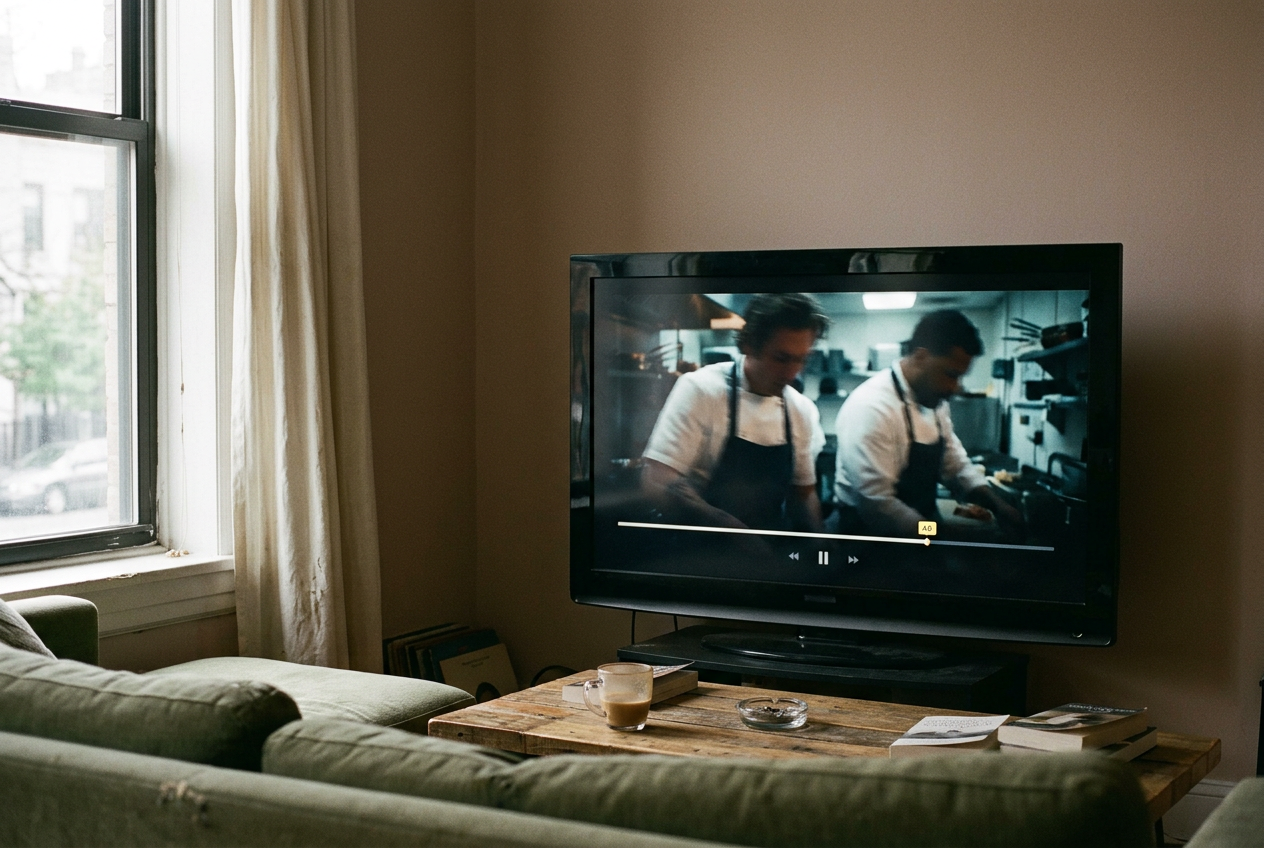
One yellow notch in a playback bar can tell you more about streaming economics than a quarter of executive interviews. It marks the point where an episode stops being a sequence of authored images and becomes available inventory, with the viewer’s attention sold inside a cut the director may never have intended.
The useful stress test is “Review,” the seventh episode of the first season of The Bear. It is built around a sustained rush through the restaurant kitchen, presented as one continuous take as orders stack up and the staff turn on each other. The form supplies the pressure. Interrupt that movement and the episode does not merely take longer.
Its central decision stops working.
That makes “Review” a cleaner test than an episode assembled from conventional scenes. There is no polite doorway for an advertiser. A platform can put commercials before it, after it or inside it. Only the third option creates more inventory, which is precisely why the yellow notch matters.
The cut test is about the show, not the logo
A streamer does not watch television as you do. Its ad system sees cue points, timestamps where playback may hand off to an advertising server, run a commercial and return to the program. Some cue points come from the master delivered by a broadcaster. Others are added for streaming, either by people reviewing the episode or by software looking for black frames, silence, fades and changes in shot or location.
Those signals are imperfect. A fade can close an act, but it can also sit inside a scene. Silence can indicate transition, grief or somebody deciding what to say next. A hard cut may jump to a new location while preserving the tension and sound from the previous shot.
Software can locate an edit. It cannot assume that the edit grants permission to leave.
That is why a universal ranking of ad tiers quickly falls apart. Hulu can treat a network sitcom cleanly because the distributor may already have commercial act breaks embedded in the delivered version, then handle a Hulu-first drama less gracefully because no such doors exist. Peacock and Paramount+ have the same structural advantage across large parts of their broadcast catalogs. Max does not gain that advantage merely by offering fewer interruptions.
The correct unit of analysis is the episode-platform pair. A service passes when it honors an authored cut. It scrapes through when it finds a genuine scene boundary. It fails when the interruption breaks continuous action, carries dialogue across the commercial or returns on a reaction shot whose cause the viewer last saw several ads ago.
Hulu inherits the best seams, when they exist
Hulu has access to an enormous quantity of television made around commercials. On those programs, the break is part of the episode’s original architecture. Writers accelerate toward it. Editors may land on a reveal, hold a reaction or let a joke resolve before the screen leaves the story.
The ad remains an interruption, but it is an anticipated one.
This gives Hulu an advantage that can be mistaken for superior technology. Often it is superior provenance. The platform has received a version carrying the decisions made for broadcast, rather than asking an insertion system to reverse-engineer dramatic structure from a completed file.
Hulu originals and streaming-first FX titles complicate the picture. The Bear may carry the FX name, but “Review” was not constructed like an hour of cable drama with regular exits. Its continuous kitchen movement denies the platform a harmless midroll. If an ad product requires one, the system must choose which damage looks smallest.
The yellow notch becomes an editorial override. It says the episode’s shape is subordinate to the number of places where attention can be sold.
Peacock and
Paramount+ benefit from television’s old machinery
Peacock and Paramount+ also hold deep catalogs of programming built for linear channels, meaning scheduled television transmitted as a continuous feed. Those shows tend to arrive with dependable act boundaries, and ad insertion can reuse them rather than search for a convenient patch of silence.
For viewers, that usually produces the least destructive version of interrupted streaming. The show raises a question, cuts away, then returns with the answer or the next act. The rhythm may feel dated in a binge interface, particularly when a recap or repeated establishing shot survives from the broadcast master, but the commercial has not sliced through a sentence.
Streaming originals on either service deserve a separate grade. Once an episode is commissioned without an expectation of fixed commercial acts, the platform faces the same retrofit problem as everyone else. Brand history does not rescue the cut. A service descended from broadcast television can still interrupt a streaming drama at an arbitrary transition if the delivered master lacks intentional markers.
Disney+ is two distribution systems sharing an app
Disney+ carries both commercial television and expensive serials made for uninterrupted streaming. The former can preserve inherited breaks. The latter requires new decisions.
An ABC episode with authored act outs presents obvious inventory slots. A Marvel or Star Wars streaming series may be structured around long set pieces, delayed reveals and transitions that move directly from one narrative line into another. A commercial placed at a location change can still break the sequence if the score, threat or conversation continues across the edit.
Disney+ therefore illustrates the weakness of judging placement by visual neatness. A break that lands on a hard cut may look defensible in a spreadsheet because no line of dialogue is severed. In the episode, it can wreck a musical bridge or drain tension from the shot that follows. Finding a cut is not the same as finding the seam.
Netflix can avoid the ugliest cut without finding a good one
Netflix built its signature programming around uninterrupted episodes. Its ad tier had to retrofit commercials onto a catalog whose pacing helped establish the binge model in the first place.
The platform can screen out obvious failures, such as putting a break in the middle of spoken dialogue. That clears a low bar. Prestige drama often carries meaning between scenes through sound, match cuts and unresolved reactions, so an insertion at a technically clean transition can still alter the edit’s argument.
Netflix also demonstrates why “natural break” is an industry phrase worth distrusting. Natural to whom? The advertiser needs enough distance from the next interruption. The platform wants viewers to remain in the session.
The episode needs the cut to preserve duration, tension and association. Those interests overlap only occasionally.
A marker added after delivery is platform-specific metadata, information attached to the video for that service rather than authored into the original picture. Move the episode to another platform and the marker may disappear. Change the ad product and it may move. The show stays fixed.
Its commercial anatomy does not.
Max has the prestige problem in its purest form
HBO spent decades selling television partly through the absence of commercials inside its programs. Max’s ad tier asks that same work to accommodate breaks after the fact.
This is especially rough on episodes organized around extended conversations. A scene may contain many edits, but none creates an exit. Cutting after one character speaks and returning before another reacts does not divide two scenes. It rents out the pause between cause and effect.
Max can reduce the harm by using fewer midrolls or by placing them around larger structural transitions. It cannot create authored act breaks retroactively. The clean alternative is front-loading ads before especially resistant episodes, including installments built as continuous action, but that caps the available inventory. The economic pressure runs the other way.
Prime
Video makes the retrofit impossible to ignore
Prime Video’s advertising shift made commercials part of the default viewing experience unless subscribers pay more to remove them. That matters because its catalog mixes Amazon originals with licensed films and television produced under incompatible assumptions about interruption.
Broadcast material may carry workable seams. Movies and streaming-first series often do not. A feature can run for a long stretch before presenting anything resembling an act break, while an advertising system prefers regular opportunities rather than one crowded block near the beginning or end. Once cadence takes priority, timestamps begin to beat judgment.
Prime Video is therefore the clearest place to see the business model pressing against form. The platform already has the subscription payment. Advertising extracts another revenue stream from the same viewing time, while the surcharge for removing ads monetizes the viewer’s desire to restore the uninterrupted version.
That yellow notch is doing two jobs. It opens a slot for an advertiser and advertises the value of making the slot disappear.
What a real pass looks like
The strongest ad placement is not the one you barely notice. Commercials are noticeable. A pass means the platform has preserved the relationship between the shots on either side of the break, respected an authored act boundary where one exists and declined inventory when the episode offers nowhere honest to put it.
That last condition is the expensive one. It asks a service to treat “Review” differently from a network procedural, rather than forcing both through a system designed to deliver a predictable number of opportunities. It also requires episode-level judgment, which costs more than attaching markers at regular intervals or accepting whatever cue sheet arrived with the file.
A proper cut log should record the title, program timestamp, shot before the interruption and first shot after it. Restarting the episode can show whether the cue point remains fixed even when the ads change, while checking another device can reveal whether placement belongs to the title or to a particular playback system. The commercial itself is almost beside the point. The scar is where the program leaves and returns.
For “Review,” the acceptable result is severe: no midroll. The episode chose continuous pressure, and there is no manufactured seam that preserves it. Any platform that sells one anyway has answered the cut test. Inventory won.
Questions people ask
Which streaming service places ads most cleanly?
Hulu, Peacock and Paramount+ have an advantage on shows made for broadcast because those episodes often arrive with authored commercial breaks. None is consistently clean across streaming originals, films and older licensed titles, so the relevant comparison is the specific episode on the specific platform.
Why do streaming ads sometimes cut into a scene?
The platform may be using a timestamp added after the episode was finished. Software and reviewers can detect edits, fades or silence, but those signals do not prove that a dramatic beat has ended, especially when dialogue, music or action continues across the cut.
Can a streamer move an ad break after an episode is released?
Yes. A platform-specific cue point can be changed without altering the underlying video file, and different playback or advertising systems may use different markers. That flexibility helps services manage inventory, but it also means the commercial structure is not necessarily part of the version approved by the episode’s makers.
What should happen when an episode has no clean ad break?
The least destructive options are to run ads before the episode or decline a midroll. That produces less inventory, which is why continuous episodes such as “Review” expose the real priority: preserving the work requires the platform to leave a sellable slot unused.
One update a day
Today's story, in your inbox
One story each morning — no hype, no filler, no algorithm deciding for you.