A Neon SMILE Shirt Explains Why Horror Stays in Theaters
Studios give horror time to become a public event. Comedy reaches home sooner because distributors increasingly assume its audience wants convenience, proof and a subscription login.
September 4, 2026 · 8 min read
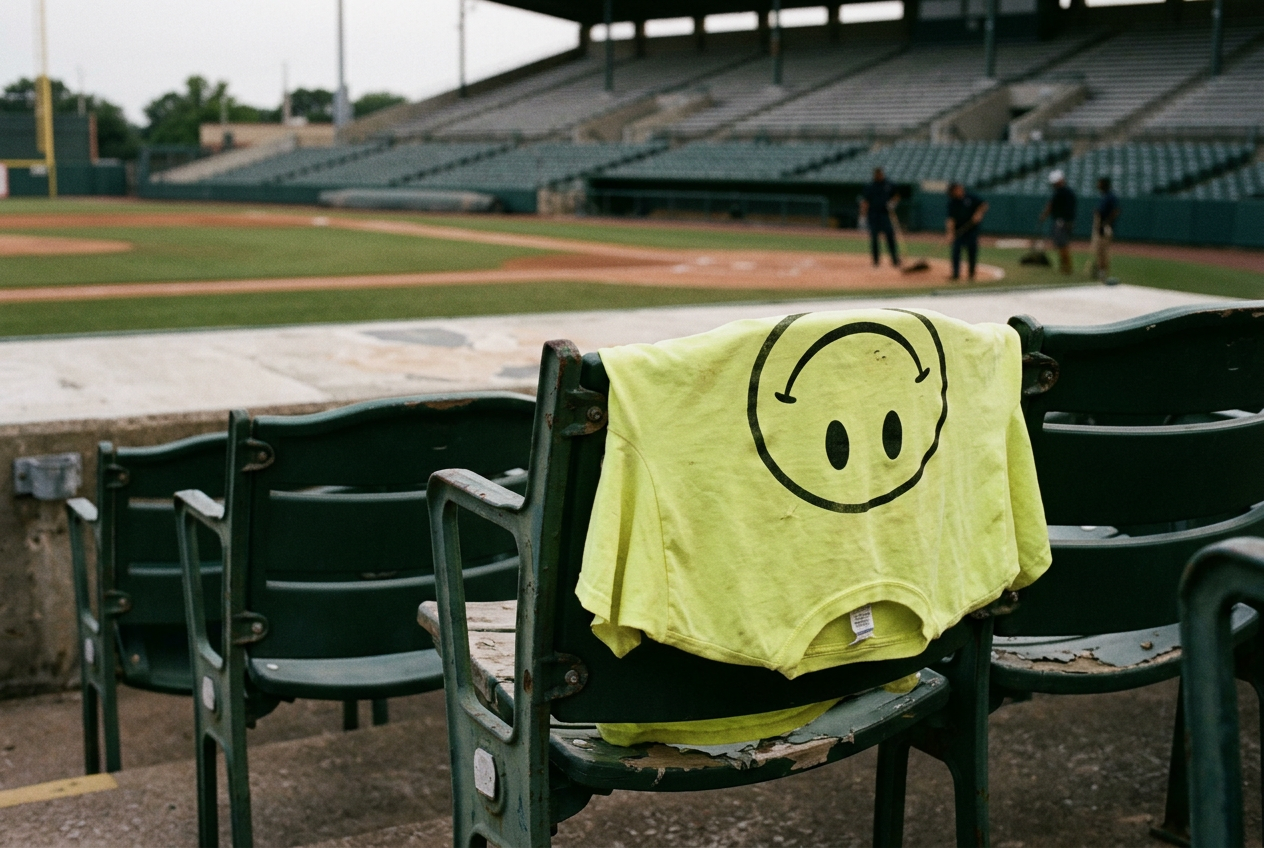
In late September 2022, performers wearing neon yellow T-shirts printed with the word SMILE appeared behind home plate at televised baseball games, holding the same rigid expression while the innings passed. Paramount was promoting Smile, Parker Finn’s horror film about an entity that travels through trauma, but the stunt did more than advertise a title. It placed an unexplained image inside a live event, where television cameras, spectators and social feeds could circulate it before anyone had paid to see the movie.
The shirt was cheap media with a theatrical purpose. It turned recognition into suspense, then left theaters as the place where recognition could be converted into an answer.
That conversion matters because the theatrical window, the period when a film is available in cinemas before reaching homes, no longer behaves like a standard industrial interval. It has become a genre judgment. Recent horror releases have often received enough exclusive or semi-exclusive time to accumulate reaction, while studio comedies that open poorly can reach premium video on demand, the higher-priced rental and purchase tier before subscription streaming, in less than three weeks. The calendar now records what distributors believe each audience needs before paying.
Horror gets anticipation. Comedy gets availability.
The window is an audience theory
Smile remained a theatrical-only proposition for roughly six weeks, long enough for the campaign’s grinning figures, the film’s jump scares and its ending to move through distinct waves of public attention. Its sequel followed a comparable route to subscription streaming, even though home rental arrived sooner. Other recent horror titles, including Barbarian and Talk to Me, also spent around a month and a half establishing themselves theatrically before ordinary home viewing took over.
That is not an ancient window. It would have looked aggressively short before studios began compressing release schedules, first under pressure from streaming competition and then during the pandemic. It is long by current standards because it lets a modestly budgeted film survive more than one marketing weekend.
Compare that treatment with Joy Ride, Bros and Strays, studio comedies that moved to home rental around or before their third theatrical weekend after disappointing starts. Their subscription destinations varied, and premium rental is not the same thing as appearing inside a service at no additional charge, but the signal to audiences was similar: waiting would not require much patience. The theatrical release became a brief publicity stage for the home release.
This is often described as flexibility, which is the word an industry uses when it wants a retreat to sound responsive. The studio watches opening-weekend demand, negotiates around exhibitor agreements and moves a film onto digital storefronts where the ticket is replaced by a household transaction. The platform takes a cut. The distributor receives the rest without splitting another round of admissions with a theater, though it also gives up the scarcity that made leaving home necessary.
The shortened window may recover some revenue from viewers who were curious but unconvinced. It also teaches them.
If a comedy that looks moderately appealing will be rentable before its trailer has stopped appearing online, postponement becomes rational. Weak opening attendance triggers early digital release; early digital release makes future attendance weaker. Studios then read that behavior as proof that comedy belongs at home, although their own calendar helped produce it.
Horror sells evidence that other people were there
The neon SMILE shirt worked because horror does not need universal approval to build momentum. It needs reports. Someone says the theater screamed during a sequence, someone else posts that the ending is cruel, and a third person wants to test whether either claim survives contact with an actual audience. Disagreement is useful.
Spoilers are dangerous. Both conditions reward speed.
A horror film can therefore turn the theatrical room into part of the product without pretending every screening is communal bliss. Laughter is usually offered as comedy’s equivalent, but studios have stopped trusting it as a sufficient reason to buy a ticket. Horror promises sound, darkness, scale and the involuntary behavior of strangers. A comedy must persuade viewers that strangers will improve timing rather than ruin it, while competing with an enormous supply of sitcoms, stand-up specials and familiar movies already covered by monthly subscriptions.
There is also a cleaner financial proposition underneath the aesthetic one. Contemporary studio horror is often produced below blockbuster cost, so a solid opening does not need to carry a giant negative, the industry term for the film’s production expense before marketing, on its back. Each additional theatrical week can collect admissions while attention builds, and a successful run supplies a legible number for sequel development, talent negotiations and overseas sales.
Comedy has a different cost problem. Stars, locations and conventional production can make it expensive without supplying franchise spectacle, while jokes do not travel between markets as smoothly as a masked killer or a supernatural premise. When opening weekend disappoints, the distributor has less incentive to keep spending on theatrical advertising. Moving home quickly turns the film into a fresh tile for digital rental, then into subscriber inventory for a platform that needs recognizable faces more than packed auditoriums.
The genres are being asked to perform different jobs. Horror must generate cash and intellectual property. Comedy must generate engagement, retention and the vague sense that a streaming catalog contains something new.
The comedy audience has been trained to wait
The supposedly natural home audience for comedy did not materialize without instruction. For years, streamers commissioned romantic comedies, action comedies and star vehicles that arrived without box-office exposure, then presented instant access as a benefit rather than a lower-status release. Studios also sent theatrical titles online faster, sometimes announcing home availability while the films were still fighting for screens.
Audiences learned the schedule because schedules are interfaces. A horror campaign often withholds enough to preserve the event, opening on a date that fans can organize around and letting reaction advertise the following weekend. A comedy campaign tends to disclose its whole machine: premise, celebrity chemistry, several punch lines and, soon enough, the digital destination. One asks the viewer to join a developing conversation.
The other asks the viewer to remember a title until it becomes convenient.
Anyone but You exposed the limits of the home-audience theory. Sony’s romantic comedy opened softly in late 2023, remained in theaters and grew through the holiday period as clips, songs and word of mouth circulated. Its run did not prove that every comedy deserves months of screens. It proved that a disappointing first frame is not the same thing as exhausted demand, particularly for a genre whose appeal can depend on viewers seeing other people enjoy it.
That distinction has become harder for conglomerates to tolerate. Public companies report on quarters, streaming services need a steady flow of additions, and marketing teams concentrate spending around launch. Theaters need films that keep selling after the first weekend, but studios can redirect a struggling title toward a service they own or a licensing arrangement that produces a different kind of value. The comedy’s theatrical potential is weighed against its immediate usefulness elsewhere.
Elsewhere often wins.
No public metric makes the comparison clean. Box office is visible each weekend; streaming performance is usually described through self-selected viewing charts, hours watched or corporate declarations that cannot be audited against ticket sales. A studio can call a comedy successful online without showing whether it attracted subscribers, prevented cancellations or merely played for people who were already paying. The opacity favors the pivot.
Failure in theaters is public. Mediocrity on a platform can be renamed reach.
A shorter window changes the film before it opens
Distribution does not sit outside criticism. It shapes form, expectation and the conditions under which a movie can become meaningful.
A horror director working within a theatrical mandate can build around sustained darkness, sharp sound transitions and the knowledge that viewers cannot pause when tension becomes unpleasant. The form anticipates captivity. Comedy also benefits from collective rhythm, particularly when a held reaction shot or delayed cut needs laughter to occupy the space, but a distributor rushing toward streaming treats those choices as portable assets rather than reasons for the room.
This changes what gets funded. If theatrical comedy is judged mainly by immediate opening demand, studios will prefer established intellectual property, famous ensembles or premises that can be summarized before the trailer ends. Mid-budget films with unfamiliar combinations of performers need time to develop an audience, yet time is the resource the compressed window removes. Streaming then receives films designed for low-friction sampling, and their completion rates remain hidden.
A genre once built around timing is reorganized around convenience.
The neon SMILE shirt expressed the opposite confidence. Paramount put a strange image in public and allowed uncertainty to do some of the marketing, trusting that the film could turn curiosity into admissions over several weeks. Comedy campaigns rarely receive that patience because the studio has already imagined the viewer at home, scrolling past the title card while deciding whether the evening can support another commitment.
The window is therefore less a neutral response to demand than an instruction about value. Horror is allowed to prove that an audience exists in public. Comedy is uploaded before its audience has the same chance.
Questions people ask
What is the theatrical window?
The theatrical window is the period between a movie’s cinema opening and its home release. Studios now adjust it film by film: a title may reach premium rental first, then move later to subscription video on demand, where viewing is included with a monthly service.
Why do horror movies stay in theaters longer than comedies?
Horror can build through spoilers, audience reactions and relatively controlled production costs, so another theatrical week may add meaningful revenue. Studios increasingly assume comedy viewers will wait for home access, especially after a weak opening, which encourages distributors to shorten the window and use the movie to feed rental stores or streaming catalogs.
Does an early digital release mean a comedy failed?
It usually indicates that the distributor no longer expects theatrical revenue to justify continued support, but digital performance is difficult to evaluate because platforms disclose selective data. The larger consequence is behavioral: each rapid move home makes waiting more sensible, reinforcing the studio’s claim that comedy audiences no longer go out.
Can theatrical comedy still build slowly?
Anyone but You showed that it can when a distributor keeps the film in circulation after a soft opening and lets public response accumulate. The obstacle is not an audience incapable of discovery. It is a release system that grants horror time to create demand, then treats comedy’s missing time as evidence of missing demand.
One update a day
Today's story, in your inbox
One story each morning — no hype, no filler, no algorithm deciding for you.