
Check the Foil Pouch Before You Trust a Drug-Testing Strip
Packaging, moisture, heat and expiration can undermine a drug-testing strip before it touches a sample. This checklist identifies obvious failures, not hidden ones.
August 11, 2026 · 8 min read
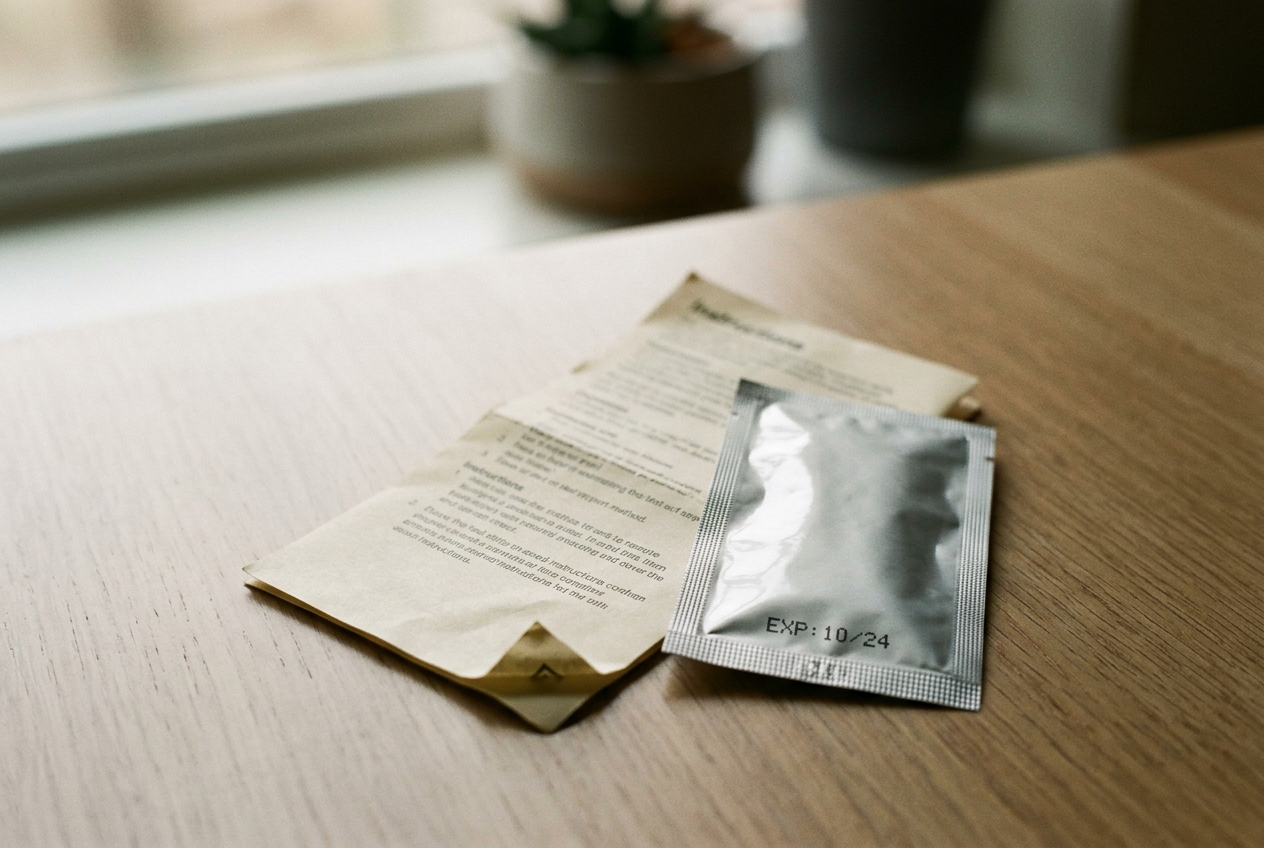
The object to keep in view is small: one white lateral-flow strip, a paper-like test that moves liquid across reactive material, sealed inside a crimped silver foil pouch. The pouch has been sitting loose in a backpack. Its expiration date is readable. One corner is bent.
Nobody can say whether the bag spent an afternoon in a hot car.
That uncertainty matters more than the strip’s clean appearance.
Drug-testing strips are often treated as disposable truth machines. Dip, wait, read. Yet the chemistry begins aging before the package is opened, and the supply chain between a factory and somebody’s kitchen table can include warehouses, delivery vans, outreach kits, pockets and bathroom cabinets. A strip may cost little enough to replace.
The decision built around its result may carry much more weight.
This checklist cannot certify that a strip is good. It can only identify reasons to reject one, which is still useful because storage failures tend to disappear from view at the exact moment a crisp control line makes the test feel official.
Start with the instructions for that exact strip
Find the manufacturer’s instructions for use, or IFU, the product-specific sheet that states how the test must be stored and operated. Use the instructions matching the brand, test type and format in your hand. Guidance for a fentanyl strip does not automatically apply to a xylazine strip, and instructions for one manufacturer’s product cannot safely be pasted onto another because the membranes, antibodies, packaging and validated temperature ranges may differ.
The pouch should show enough information to connect the strip to those instructions. Look for the product name, manufacturer or distributor, lot number and expiration date. Some details may sit on the box rather than each wrapper, which becomes a problem when individual strips are handed out loose. If you cannot identify the product or locate reliable instructions, you cannot verify its storage requirements.
Treat that as missing evidence, not permission to improvise.
Return to the silver pouch in the backpack. Its date is visible, but the brand and lot have rubbed away. The strip might still function. There is no defensible way to match it to a temperature limit, check a recall or establish which interpretation guide belongs to it.
Cheap field testing pushes this administrative burden onto the person with the least access to the supply chain.
Read the package as a barrier, not decoration
For an individually wrapped strip, the foil pouch protects the reactive material from ambient moisture and contamination. Inspect the full perimeter under decent light. A clean bend is not automatically a breach, but a tear, puncture, split seam, peeled edge, open notch or wet stain means the barrier may have failed. Do not repair it with tape and call it sealed.
Tape can close a hole; it cannot reverse exposure.
Check whether the wrapper looks as though it was opened and pressed shut, particularly around the crimped edges. If strips arrived in a multi-test container rather than individual pouches, follow that container’s rules for closing it and for how long its contents remain usable after opening. The expiration date on a factory-sealed package may no longer describe an opened container.
A loose strip with no wrapper should not inherit the printed expiration date from a nearby box. That date generally applies to the product under the manufacturer’s specified storage conditions, often while unopened. Once the barrier is gone, nobody gets to pretend the original condition still exists.
Packaging can rule a strip out. It cannot rule one in. An intact silver pouch may have crossed a temperature limit without showing any mark, and a desiccant packet, where the product includes one, only manages moisture within its intended packaging. It is not a witness to every warehouse shelf and glove compartment.
Moisture is the quiet failure
Lateral-flow tests depend on liquid moving through a membrane at a controlled rate while labeled reagents bind to targets. Unwanted moisture can start changing that system before the sample arrives, affecting how material flows or how the stored chemistry performs. The damage may be invisible.
Obvious warning signs include a damp wrapper, condensation inside clear packaging, staining, a warped strip, softened paper components or reactive areas that look smeared before use. Do not dry a wet strip and reuse it. Drying removes water; it does not restore reagents to their earlier condition.
Bathrooms, unsealed kitchen drawers and bags holding leaking bottles are poor storage sites unless the manufacturer explicitly allows those conditions and the protective packaging remains intact. Refrigeration is not a universal fix. Moving a cold pouch into humid air can create condensation, while some products must reach the stated operating temperature before opening or use. Follow the IFU rather than the household instinct that colder means preserved.
The backpack pouch has no water stain, but it sat beside a bottle with a loose cap. If the foil is intact and the outside alone got wet, the barrier may have done its job. If a seam lifted or moisture reached the strip, discard it. The meaningful line is not whether the wrapper once touched water.
It is whether the validated barrier and storage conditions remained intact.
Temperature history matters even when the strip looks fine
Read the printed storage range. Manufacturers validate products within particular conditions, and those limits vary. Do not substitute a generic room-temperature rule when the package gives a different range.
Heat can accelerate chemical degradation. Freezing may damage components or alter flow. Repeated movement between hot and cold conditions can add stress and condensation risk, particularly after a package is opened. None of this guarantees a dramatic visual failure.
That is what makes temperature history harder than checking a torn seam.
Ask where the strip has been, in practical terms. A climate-controlled cabinet with a known history is different from a car console through summer, a parcel left outdoors, luggage in a freezing trunk or a box stored beside a heater. If a known excursion exceeded the manufacturer’s range, follow the manufacturer’s disposal or technical-support guidance. If the history is unknown after a plausible extreme exposure, the cautious conclusion is that the strip cannot be relied upon.
Do not try to rehabilitate the backpack pouch by leaving it indoors overnight. Returning a product to its approved range does not erase time spent outside it. The cost of replacement is another strip and some delay. The cost of misplaced confidence may be a falsely reassuring result.
Expiration is a condition, not a magic date
Check the expiration date before opening the pouch. Do not use a strip past that date unless an identifiable manufacturer or regulator has issued a documented extension covering that exact product and lot. A seller’s reassurance, an unlabeled social post or the fact that the control line appeared once is not equivalent.
Expiration also assumes compliant storage. An in-date strip damaged by heat or moisture does not become trustworthy because the calendar is favorable. Conversely, a strip that expired yesterday did not visibly transform at midnight, but its validated performance period has ended. Harm reduction has to work with imperfect access; it does not need to convert uncertainty into certainty for the sake of convenience.
If the date is missing, cut off or illegible, discard the strip or contact the supplying program for a documented replacement. Outreach organizations should distribute strips with product identification, instructions and storage information attached, rather than handing over anonymous slivers of chemistry and making recipients solve procurement failures themselves.
Open it only when you are ready
After the external checks pass, open the package at the time directed by the manufacturer and use the strip within any stated window. Confirm that the strip matches the diagrams in the instructions. Reject one that is discolored, dirty, delaminated, visibly damaged or missing expected markings.
Then follow the product-specific directions for sample preparation, dilution, timing and interpretation. Storage is only one failure point. A strip can be well stored and still produce a misleading result when the sample is too concentrated, the wrong amount of water is used, the result is read outside the stated time or the tested portion does not represent the rest of the supply.
A control line, the mark showing that the test’s internal flow control reacted, is necessary on many strips for a valid run. It is not a storage certificate. It shows that part of the device functioned during that test; it cannot reconstruct whether heat reduced sensitivity or whether moisture altered performance in a subtler way.
The defensible checklist is therefore strict. Keep the strip only when you can identify it, match it to current instructions, confirm that it is unexpired, find no package breach or moisture damage, and account for storage within the stated range. One failed check is enough to replace it. An unknown history is not the same as a passed check.
Even a properly stored strip is a screening tool, not a guarantee that a drug contains only what the result indicates. It may test for one substance, have cross-reactivity, or miss unevenly distributed material. Professional drug-checking services can use additional methods and offer interpretation that a single strip cannot. Where opioids may be present, broader harm-reduction measures such as carrying naloxone, avoiding use alone and starting with a small amount remain relevant regardless of a negative strip result.
Questions people ask
Can an intact foil pouch prove that the strip was stored correctly?
No. Intact packaging supports moisture protection, but it cannot reveal every heat, freezing or age-related problem. You still need the product identity, expiration date, manufacturer’s storage range and a credible account of where the strip was kept.
Is a drug-testing strip still usable after being left in a hot car?
Check the exact manufacturer’s temperature limits and any guidance on excursions. If the car plausibly exceeded that range and the manufacturer does not document continued usability, replace the strip rather than treating an eventual control line as proof that heat caused no damage.
Does a control line mean storage did not damage the test?
A control line usually confirms that liquid moved through the device and the control chemistry reacted. It does not verify the strip’s full sensitivity, identify earlier temperature exposure or guarantee that a negative result is accurate.
What should
I do if I cannot verify how the strip was stored?
Use a new, identifiable strip from a source that can provide its instructions and storage history, or contact a harm-reduction or professional drug-checking service. Do not let an uncertain strip overrule other precautions, especially when a negative result could encourage greater risk.
One update a day
Today's story, in your inbox
One story each morning — no hype, no filler, no algorithm deciding for you.