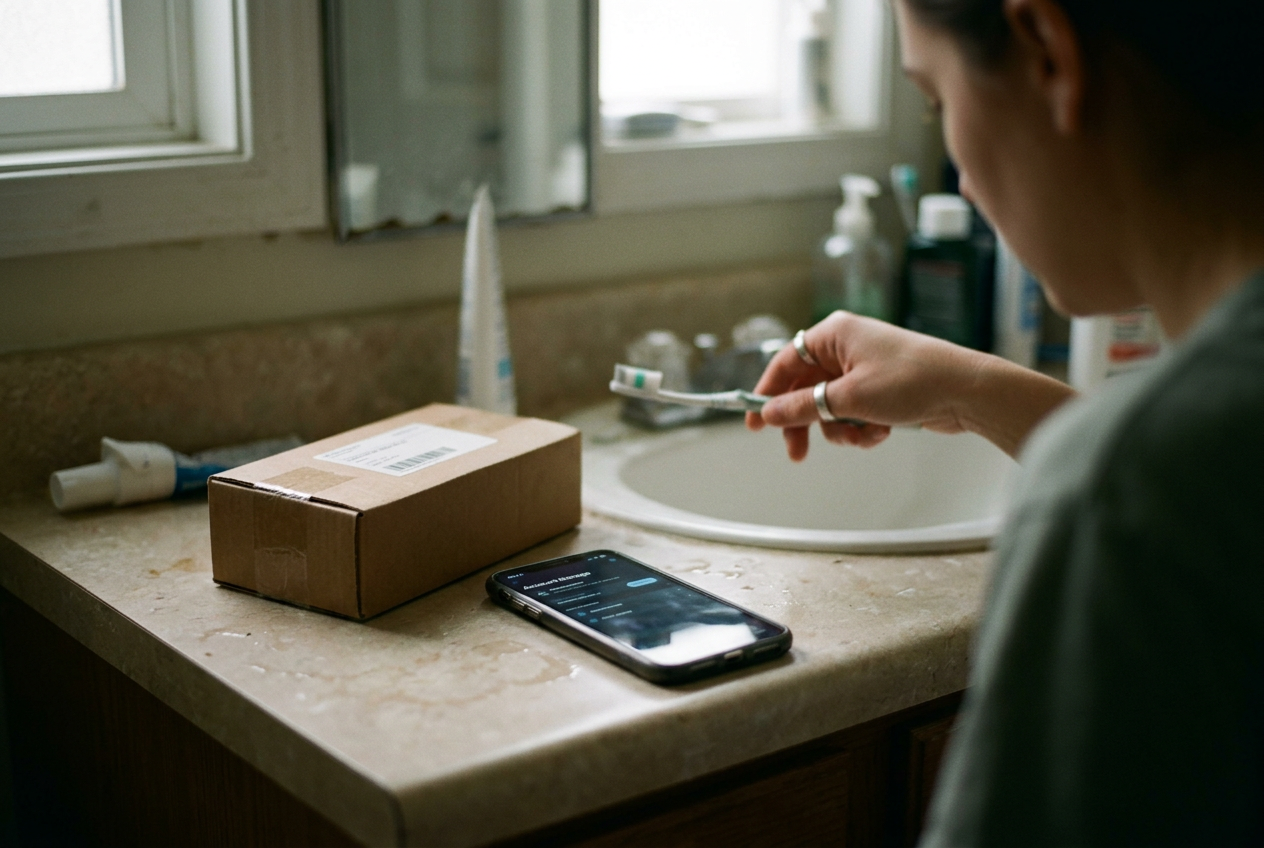
Emergency Contraception Is OTC. The Shelf Disagrees.
A locked case or pharmacist counter can make an unrestricted product feel restricted. Here is how to navigate the shelf without mistaking store friction for a rule.
August 11, 2026 · 8 min read
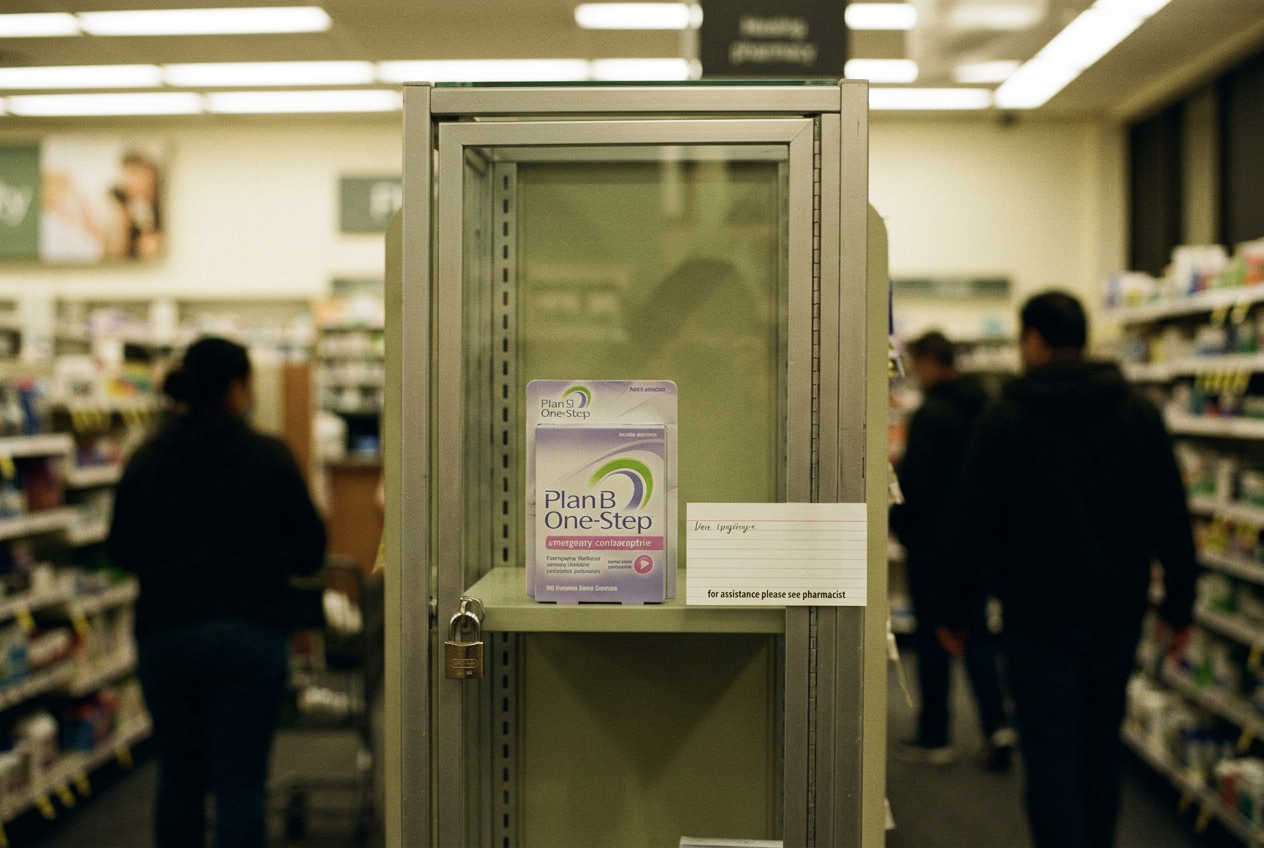
The object at the center of this is a single-tablet Plan B One-Step carton. It is ordinary retail stock. It can also spend its working life behind acrylic, inside an anti-theft keeper, at the pharmacy counter or represented by a paper card that tells the customer to find an employee.
Each arrangement changes the purchase. The medication has the same federal status, but the buyer may have to announce what they need, wait for a key, cross the store, repeat themselves and endure an identification request that should not apply. The shelf becomes a test of time, confidence, English fluency, privacy and familiarity with rules that the store has failed to explain.
This is reporting about access, not medical or legal advice. Store procedures, insurance coverage and state programs can change, while individual medical circumstances belong with a pharmacist or clinician.
The box is OTC. The route is not.
Plan B One-Step and generic versions containing levonorgestrel, a hormone used here to delay or prevent ovulation, are available over the counter in the United States without an age restriction. A customer does not need a prescription or identification merely because of age. The buyer’s gender does not change that status.
That should produce a normal transaction. Pick up the carton. Pay. Leave.
Retail design often inserts extra gates anyway. A locked case requires an employee with access to the correct key. A carton kept behind the pharmacy counter requires the pharmacy to be open, even though the product itself does not require a pharmacist consultation. An empty shelf tag may mean the stock is secured elsewhere, sold out or merely absent from a poorly updated inventory system.
Those conditions look identical to a customer standing in the aisle.
None of this converts levonorgestrel into a prescription drug. It converts a private purchase into a staffed one.
The mechanism is mundane. Pharmacies make security and placement decisions around theft risk, package size, store layout and internal loss controls. The people designing those controls are managing inventory; the person trying to prevent a pregnancy experiences the result as a delay with an audience. A security decision can function like a moral judgment even when nobody in the building intended to make one.
The Plan B carton keeps returning as the prop in that confusion. Its printed label says over the counter. Its physical location may say ask permission.
Read the active ingredient, not the shelf hierarchy
Brand placement adds another layer. Plan B One-Step may be easier to recognize because its name has become shorthand for the category, while generic cartons can sit lower, carry less familiar branding or appear only in an online inventory listing. The practical comparison starts with the active ingredient, meaning the component intended to produce the medication’s effect, and the dose printed on the package.
Generic levonorgestrel products with the same dose are alternatives to the branded carton. Prices can vary substantially by retailer and brand, so recognition carries a cost. That does not mean every box on an emergency contraception shelf is interchangeable. Read the label rather than relying on package color, shelf position or a store employee’s vague reference to “the morning-after pill.”
Timing matters. The Plan B label directs people to take it as soon as possible within 72 hours after unprotected sex or contraceptive failure; clinical guidance also discusses levonorgestrel within a five-day window, with effectiveness declining as time passes. Ulipristal acetate, sold as ella, is a different emergency contraceptive pill that requires a prescription in the United States and is labeled for use within five days. A clinician can also discuss an intrauterine device as emergency contraception.
Those distinctions matter more than the brand hierarchy on the shelf. Body weight may affect how well some emergency contraceptive pills work, although the evidence does not support treating a single disputed cutoff as a verdict. A pharmacist or clinician can explain the available options without turning the conversation into a judgment about somebody’s body.
Emergency contraception does not end an established pregnancy, and it does not protect against sexually transmitted infections. Those are basic product facts, not conditions a customer must prove they understand before buying a levonorgestrel carton.
Use the fastest route, not the most dignified-looking one
Start with the family-planning aisle, but do not let an empty hook consume the clock. Check the retailer’s website or app for the same location, then search both the brand name and “levonorgestrel emergency contraception.” Inventory pages can reveal generic options or show that the product is assigned to pickup rather than the open shelf, though a digital stock notice is not a guarantee that an employee can find the carton.
If the shelf is locked or marked with an instruction card, ask for “over-the-counter levonorgestrel emergency contraception.” That phrasing identifies the category and its status without requiring a personal explanation. If an employee directs you to the pharmacy counter, the useful question is whether the product is physically stored there or whether the store believes a pharmacist must authorize it. Those are different claims.
An age or identification request can be challenged calmly by asking for a pharmacist or manager and stating that over-the-counter levonorgestrel emergency contraception has no federal age restriction. In a time-sensitive purchase, however, proving the point to one store may be less useful than calling another pharmacy, a sexual-health clinic or a reproductive-health provider. Institutional correction is worthwhile. It is not the buyer’s unpaid emergency assignment.
Call ahead if travel, disability, work or caregiving makes a failed visit expensive. Ask whether levonorgestrel emergency contraception is in stock, whether it is accessible while the pharmacy counter is closed and whether an online order can be collected at the front register. The answer should describe a purchase route, not demand a medical history.
Delivery and curbside pickup can remove the aisle encounter, but they introduce fulfillment delays, substitutions and canceled orders. A checkout screen that accepts payment is not proof that a carton has been pulled from the shelf. For a time-sensitive product, wait for confirmation that the order is ready before treating the trip as solved.
Checkout has its own locks
The final barrier may be the register. A cashier can encounter an unexpected prompt, assume identification is required or call another employee because the anti-theft keeper needs a separate tool. Self-checkout may still summon staff. Every handoff extends the transaction and increases the number of strangers who can hear what is being purchased.
Insurance adds a different kind of friction. Some plans may cover emergency contraception, but reimbursement can depend on the product, network and whether a prescription is submitted for an otherwise over-the-counter medication. Paying directly can be faster and more private, while using coverage may reduce the cost. The tradeoff is imposed by billing systems, not by the medicine.
Privacy also extends past the people in line. Entering a loyalty number can connect the transaction to a retailer profile, and using a shared payment card can expose the merchant and amount to another account holder. Skipping a rewards account or paying with cash may reduce some records, but neither guarantees anonymity; store cameras, receipts and internal transaction logs still exist under policies the customer rarely sees.
The single-tablet Plan B carton therefore passes through two systems. One is the medication system, where federal regulators classify it as over the counter. The other is retail infrastructure, where locks, staffing, payment data and insurance rules decide whether “available” means reachable now. The second system is what the shelf teaches.
What a useful shelf would do
A competent display would put levonorgestrel products in a clearly marked location, show that no prescription or age verification is required, distinguish them from prescription-only ella and explain where secured stock can be collected without sending the customer around the building. If theft prevention requires a locked case, the unlocking method should be obvious and fast, with an employee assigned to answer it.
Age-confusing signs deserve removal, not interpretation. Language left over from older restrictions, vague instructions to “see pharmacist” and warnings that fail to distinguish store policy from law all transfer the burden to the person with the least time. A small printed correction would cost less than the branded carton. The failure is not informational scarcity.
It is that nobody with authority over the fixture has been made responsible for the whole route.
That route should be the unit of evaluation. Stock on a spreadsheet is meaningless if the pharmacy counter holding it closes early. A shelf label is meaningless if the case button goes unanswered. An online listing is meaningless if the order is canceled after the buyer has stopped searching elsewhere.
The test is not whether emergency contraception exists somewhere inside the store. The test is whether a person can identify the right carton, reach it, pay for it and leave without being asked to perform eligibility that the product does not require.
Questions people ask
Do
I need identification to buy Plan B in New Jersey?
Over-the-counter levonorgestrel emergency contraception has no federal age restriction, so identification is not required merely to prove age. A store employee may still ask because of confusion or an incorrect checkout practice. This is reporting, not legal advice; current access questions can be checked with a pharmacist or reproductive-health provider.
Can a pharmacy keep emergency contraception behind the counter?
A retailer can secure merchandise or store it behind a counter, but that placement does not make over-the-counter levonorgestrel prescription-only. The practical problem is access: if the pharmacy counter closes while the store remains open, the security arrangement can remove a product from sale during hours when customers reasonably expect to buy it.
Is generic emergency contraception different from Plan B?
Generic cartons that list the same levonorgestrel dose offer the same type of emergency contraception as Plan B One-Step, though packaging, inactive ingredients and price may differ. Check the active ingredient and dose on the label. Products containing ulipristal acetate are different and require a prescription in the United States.
What should I do if the shelf is empty or locked?
Check the retailer’s online inventory, ask specifically for over-the-counter levonorgestrel emergency contraception and confirm whether secured stock remains accessible after the pharmacy counter closes. If the store cannot produce it promptly, call another pharmacy or sexual-health provider rather than waiting on a shelf tag that may not reflect usable stock.
One update a day
Today's story, in your inbox
One story each morning — no hype, no filler, no algorithm deciding for you.