Meme Pages Sell Reposts That Barely Look Like Ads
Large meme accounts sell feed posts, Stories and reposts through public rate cards. The valuable part is not reach alone. It is an ad dressed in the page’s familiar voice.
August 25, 2026 · 7 min read
In February 2020, FuckJerry posted a screenshot of an apparently awkward Instagram direct-message exchange with Michael Bloomberg. The presidential campaign was buying memes, and the joke was that the purchase itself had become the meme. A sponsorship disclosure appeared in the caption. The ad still looked like the page.
That screenshot remains a useful specimen because it shows the paid repost market with unusually little camouflage. A buyer approaches a large account. The account converts the pitch into its house format. The resulting post enters the feed beside jokes, screenshots and unattributed debris collected from elsewhere online.
Disclosure gets attached as caption furniture, while the image, the part built to travel, carries the page’s social authority.
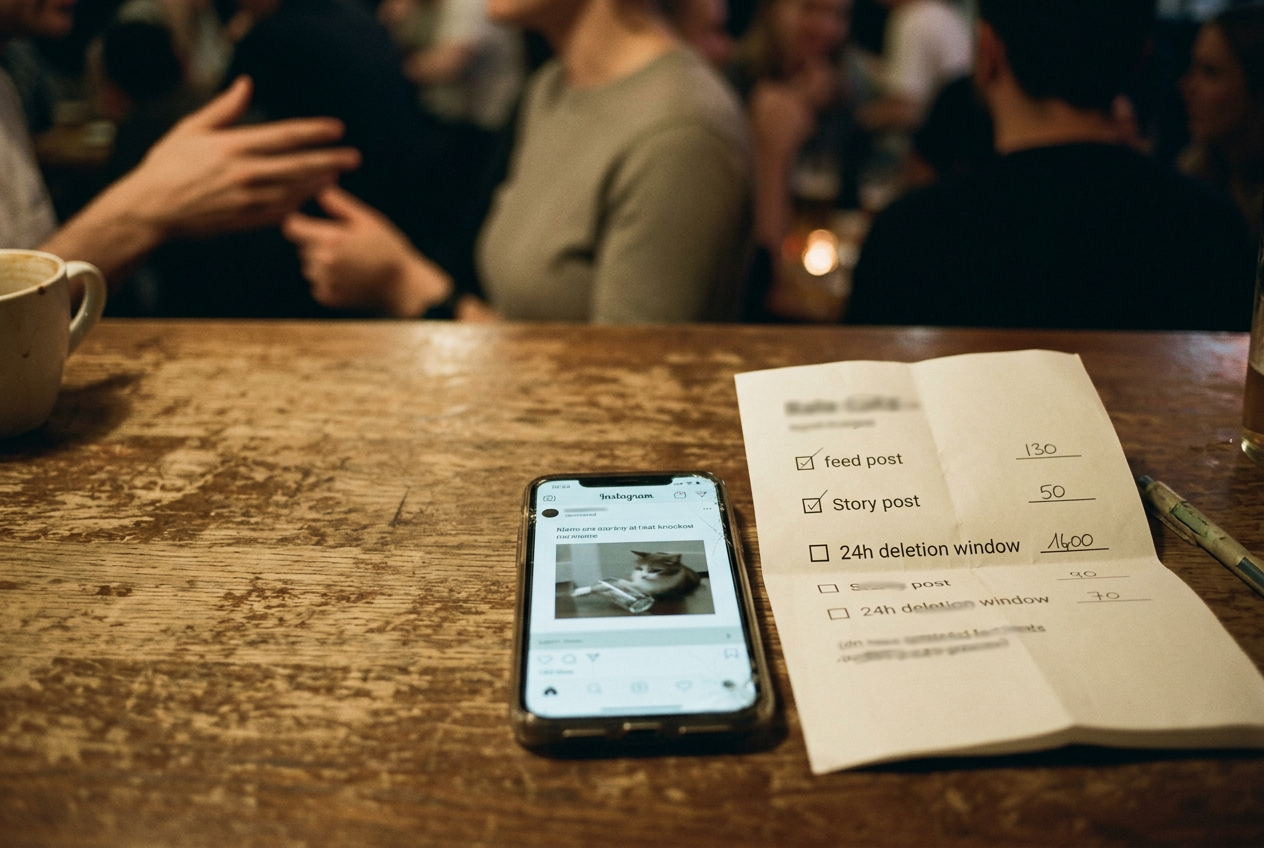
Most buyers are less eager to make the transaction the punchline. Public marketplace listings, media kits and advertising pages show the standard menu: a Story placement, a feed post, a Reel, a link in bio, or some combination of them. The buyer may provide finished creative, but pages also offer to rewrite or reformat it. Permanence costs more.
Exclusivity costs more. A post that remains in the grid has a different value from one deleted after a contracted window, even if both collect a similar first burst of attention.
The product is called a repost because that sounds casual. Operationally, it is media inventory.
The rate card sells a costume
A rate card is a public or privately circulated menu of formats and prices. Meme-page cards tend to describe the visible unit rather than the labor behind it: one feed upload, a set of Story frames, a pinned comment, a biography link, or a package spread across several accounts. Marketplace listings add audience location, engagement data and content category, often alongside turnaround time and rules about prohibited material.
The posted price is only a starting point. Brokers and page networks can bundle inventory, repeat customers negotiate, and risk changes the quote. A mainstream entertainment release is easier to place than a supplement making medical claims. Crypto, gambling, adult products and political material may command a premium, face a refusal, or move to pages with fewer concerns about account enforcement.
Traditional advertising often prices reach through CPM, the cost for one thousand impressions. A meme-page placement is murkier. The buyer may receive screenshots of post insights after publication, but public cards commonly foreground follower totals and average engagement because those numbers are legible before the post exists. Neither guarantees distribution.
Followers can be inactive, engagement can come from outside the buyer’s target market, and recommendation systems can either lift a post beyond the page’s audience or bury it without explanation.
What the buyer can evaluate is the costume. The page already has a font, caption syntax, editing style and threshold for cruelty. It has trained followers to accept abrupt changes of subject. One post is a celebrity screenshot.
The next is a relationship joke. Then comes an app, a canned drink or a musician’s new single rendered in the same visual grammar. The discontinuity does not look suspicious because discontinuity is the programming strategy.
The Bloomberg screenshot made this arrangement explicit. It borrowed the low-production look of leaked correspondence, placed the campaign inside FuckJerry’s established joke machinery and let the disclosure sit outside the image. That construction matters more than whether the caption technically contained the right word. Screenshots detach from captions.
Reposts lose labels. The costume survives.
How a paid repost moves
The route is procedural. A buyer finds an email address in the page biography, contacts a sales representative, approaches a management company, or selects a listing on a shoutout marketplace. A shoutout is paid access to another account’s audience, usually through a post or Story that names, tags or links the customer. The page responds with available formats, restrictions and a quote.
After payment or contract approval, the buyer sends an asset and caption. Sometimes the page uploads both unchanged. Sometimes an administrator edits the copy until it resembles an ordinary post, which improves the fit but also makes the commercial relationship harder to detect. The page publishes during an agreed window, leaves the material live for the contracted period, then sends performance screenshots or removes the post.
Deletion is not an incidental cleanup step. It keeps the grid from turning into a catalog, preserves space for future buyers and makes the sales volume difficult for followers to reconstruct. A Story disappears by design. A feed ad that lasts for a day can generate attention without remaining available to journalists, regulators or customers comparing claims later.
The money does not necessarily stop with the person who controls the login. Management firms sell campaigns across account networks. Sales agents take commissions. Marketplaces charge fees.
An advertiser may pay an agency, which pays a network, which allocates a portion to the page. If the post uses a meme made by someone outside that chain, the original creator may receive credit, a license fee, both or neither. The person whose joke supplied the ad’s useful texture is not automatically the person selling access to the audience.
This is where the word repost performs another small service. It collapses ownership, distribution and endorsement into one friendly gesture. A page can appear to be passing along something it enjoyed even when it received money to place it, received finished creative from a buyer and agreed on the hour of publication.
Disclosure is weakest where the joke travels
The Federal Trade Commission says a material connection between an endorser and advertiser should be disclosed clearly and conspicuously. A material connection is a relationship, including payment or free products, that could affect how an audience evaluates the endorsement. Meta also requires its branded-content label for content produced through an exchange of value.
The rules make sense on paper. The feed does not stay on paper.
A disclosure can appear after several lines of caption text, where Instagram collapses it behind a prompt. It can sit among hashtags, use vague language, or appear in a Story frame long enough to satisfy a workflow without attracting much human attention. A page may use Instagram’s Paid partnership label, a caption disclosure, both, or neither. Enforcement varies, and the platform is being asked to identify commercial speech that has been designed to resemble the account’s normal output.
Platform labels also attach to a particular upload. Meme images do not respect that boundary. When another account screenshots the Bloomberg post, the caption can vanish. When an image moves to a group chat, search result or aggregation page, the Paid partnership label does not travel inside the pixels.
The advertising asset keeps circulating after its disclosure has been stripped away by ordinary user behavior.
Peer-to-peer appearance does the rest. A conventional display ad arrives from an obvious commercial slot. A paid meme arrives through an account the user chose to follow, carrying engagement from other followers and surrounded by posts that were not purchased by the same buyer. Comments become social proof, even when they are insults.
The page supplies context that the advertiser could not buy from Meta’s standard interface alone.
This explains why a technically disclosed meme can still outperform its label. The audience encounters the page’s identity first, the joke second and the commercial connection somewhere around the caption edge. The FTC can require words. It cannot make those words inherit the distribution of the image.
The page is selling accumulated permission
Large meme accounts are often described as audience businesses. That is incomplete. They are permission businesses. Years of frequent posting teach followers to accept the account as an ambient layer of the feed, which means a commercial post does not need to win attention from a cold start.
It arrives pre-cleared by habit.
That permission was built with other people’s material as well as the page’s own work. Established aggregators have faced sustained criticism over attribution and consent, including FuckJerry during the #FuckFuckJerry campaign in 2019. Crediting practices improved in parts of the industry, but credit and payment remain separate matters. A tag can identify the maker without giving that maker any share of the advertising revenue earned around the work.
The paid repost market therefore monetizes two assets at once: distribution controlled by the page owner and cultural familiarity produced by a much larger pool of users. The buyer pays for both. Only the first one has a rate card.
The Bloomberg screenshot was unusually honest because the campaign’s purchase was visible inside the creative and acknowledged in the caption. Its deeper trick was more durable. It demonstrated that disclosure could become part of the entertainment, allowing the page and buyer to appear self-aware while preserving the commercial mechanism intact.
A better platform system would place durable disclosure inside downloadable media, retain sponsorship information when built-in repost tools are used and give users a searchable archive of paid placements. It would also distinguish between a page’s original work and material licensed from another creator. These measures would add friction. That is the point.
The current market depends on the transaction becoming harder to see as the post becomes easier to share.
Until then, the practical evidence remains the same small set of seams: an abrupt product appearance, a bio link timed to a post, unusually polished source material, disclosure after the caption fold, or an image circulating without the label attached to its original upload. None proves payment alone. Together they describe the costume listed for sale.
Questions people ask
How do meme pages get paid for reposts?
Buyers contact pages directly, hire a management network or purchase through a shoutout marketplace. The page charges for a format and publication window, then may provide performance screenshots after the post runs. Agencies, brokers and marketplaces can take a cut before the page owner is paid.
Why do sponsored memes look like ordinary posts?
The resemblance is part of what the buyer purchases. Pages adapt advertisements to their usual fonts, captions, screenshots and posting rhythm, so the commercial message inherits the familiarity of material followers already consume without much scrutiny.
Does
Instagram require meme pages to label paid posts?
Meta requires a branded-content label when content features an exchange of value, and FTC guidance requires clear disclosure of material connections. Labels still fail when they are omitted, buried in captions or detached as images move through screenshots and reposts.
Does the original meme creator receive part of the ad payment?
Not automatically. The page controls the distribution slot, while ownership of the underlying joke or image may belong to someone else. Unless the creator licensed the work, made it under an agreement or negotiated payment, a credit tag may be the only value sent back.
One update a day
Today's story, in your inbox
One story each morning — no hype, no filler, no algorithm deciding for you.