Some Podcast Guests Pay to Borrow the Host’s Credibility
Podcast booking packages sell more than airtime. They turn the visual language of an independent interview into lead generation, often without telling the listener where the transaction began.
August 21, 2026 · 8 min read
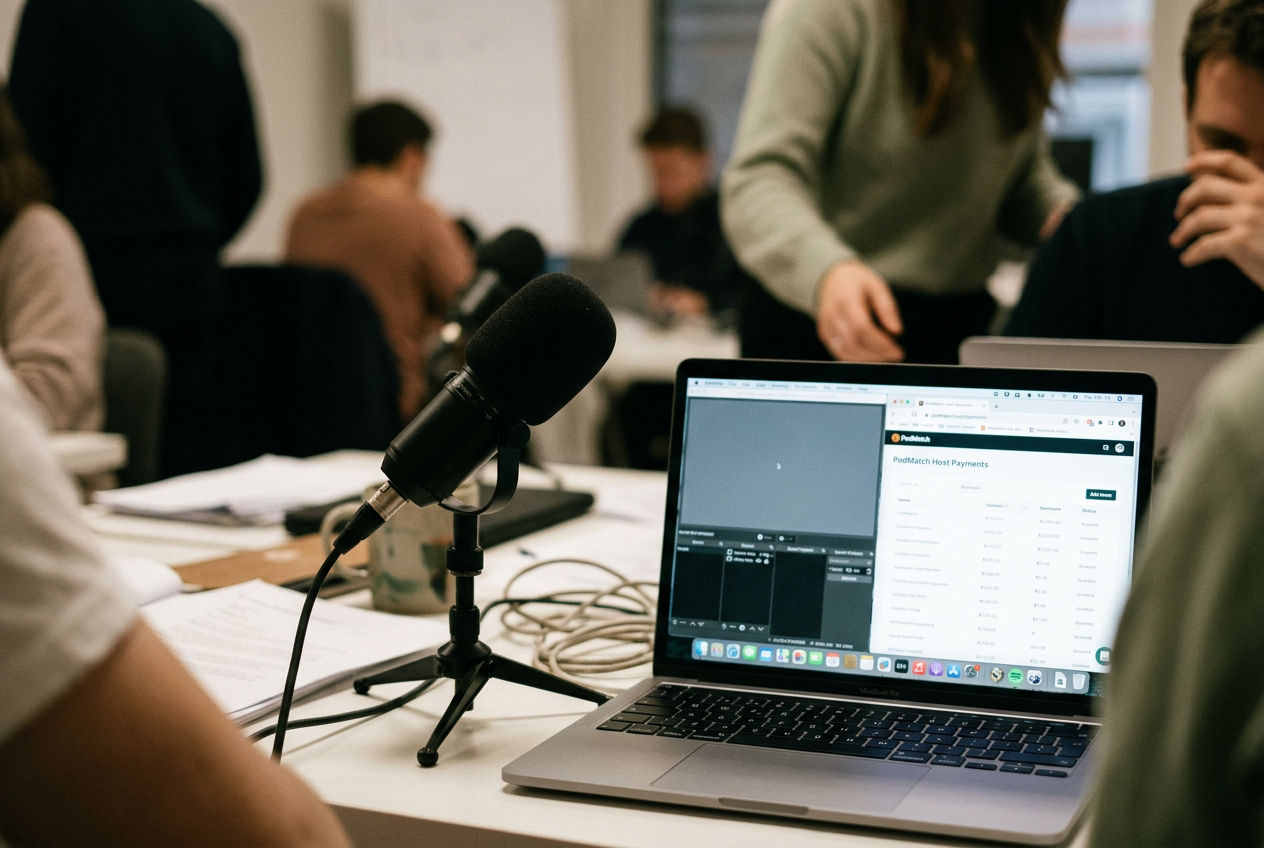
On PodMatch’s public website, a panel labeled Host Payments sits beside the more familiar promise of matching podcast hosts with potential guests. The company describes a system in which qualifying hosts can receive compensation for interviews completed through its platform, with money drawn from membership revenue rather than a plainly itemized payment from one guest to one host.
That distinction matters. It also shows how easily the transaction can disappear.
The finished episode will not look like an advertisement. It will probably show two people in separate video windows, each framed by a desk microphone, with the guest’s job title printed below a face that has been lit well enough for clips. The host introduces a problem. The guest explains that problem in a way that leads, with suspicious efficiency, toward the service they sell.
Nobody needs to read a discount code. The product is the guest’s authority.
Pay-to-appear podcasting works because it preserves the grammar of an interview after changing the economic reason the interview exists. The host still asks questions. The guest still appears to have been selected. The microphone does the rest.
The payment rarely travels in a straight line
There are several businesses hiding inside the phrase “podcast booking,” and collapsing them together lets the worst operators borrow cover from the ordinary ones.
A publicist may charge a client to research shows, write pitches, coordinate calendars, and prepare the guest. That is paid representation, not necessarily a paid appearance. Agencies including Interview Valet and Kitcaster publicly market podcast booking campaigns while describing the resulting interviews as earned placements, meaning the show retains the decision to accept or reject the pitch and does not receive a placement fee from the agency.
A marketplace such as PodMatch does something adjacent but structurally different. Hosts and guests create profiles, use matching tools, and arrange appearances through the platform. Its Host Payments program adds another flow of money: qualifying hosts can be compensated for completed interviews, with the platform describing those payments as support for the labor required to produce a show.
That labor is real. An interview consumes research, scheduling, recording, editing, artwork, hosting fees, moderation, publishing, and promotion. Most podcasts do not make enough from conventional advertising to pay properly for all of it. A host payment can cover work that audiences and aspiring guests have been trained to treat as free.
The problem begins when compensation affects access but remains absent from the episode’s editorial framing. The guest sees a membership charge or an agency invoice. The platform collects recurring revenue. The host may receive a payment.
The listener sees the two-window clip and reasonably assumes that someone behind the show decided this person was worth hearing.
PodMatch’s Host Payments panel does not establish that every interview arranged there is a purchased endorsement, nor that every host has surrendered editorial control. It exposes the underlying possibility more cleanly than the polished episode does: money can enter at the matching layer, several steps before anyone presses record, and never appear again in the audience-facing product.
Purchased access becomes earned authority
A conventional advertisement identifies its purpose through placement. It interrupts the program, carries sponsor language, or arrives with a link and a call to action. A paid interview is more valuable precisely because it can avoid those signals.
This is native advertising, an advertisement designed to resemble the editorial material around it, stretched across a conversation. The guest does not need to make a hard sell. Appearing as the person a host chose to interview can be enough, especially when the episode title places the guest beside words such as expertise, leadership, investing, health, growth, or innovation.
The package continues after publication. One recording can become vertical clips, quote cards, a biography link, an embedded player on the guest’s website, and a row of platform logos under a heading such as “featured on.” Search engines may index the episode page. Sales staff can send the interview to prospects.
The guest can describe themselves as a recurring media commentator without explaining how the bookings were obtained.
This is why the fee is often better understood as customer acquisition spending than vanity publicity. A consultant, coach, founder, broker, author, or wellness seller does not need a giant audience. They need one client whose eventual payment exceeds the cost of the booking campaign. The podcast supplies a long-form trust asset that can be reused after the show’s active listeners have moved on.
The agency gets paid for managing the funnel. The platform gets subscription revenue. The host fills the release calendar and may receive cash or access to a steady guest pool. The guest gets a credential-shaped marketing asset.
The audience pays in attention and misplaced confidence.
The microphone is doing financial work here. It signals scrutiny even when none occurred.
The show keeps the costume of journalism
Podcasting inherited many of radio and journalism’s visual and verbal cues without inheriting their institutional controls. A large microphone implies seriousness. A host introduction implies selection. A long runtime implies depth.
None of these guarantees reporting, independence, fact-checking, or even meaningful disagreement.
That ambiguity has always existed in celebrity interviews, branded podcasts, talk radio, conference panels, and business media. Pay-to-appear packages industrialize it for people who need authority in smaller, more profitable niches. The target may not be a mass audience at all. It may be a few hundred business owners, patients, landlords, recruiters, or investors who are worth more per lead.
A producer working under deadline also has practical reasons to accept a prepared guest. The biography arrives clean. The talking points are legible. The calendar link works.
The guest has a decent camera and has already been coached not to ramble. An agency removes the unpaid coordination that makes independent production exhausting, then bills the client for making themselves easy to publish.
This can leave editorial labor in a strange position. The host is performing the interview. An editor still removes pauses and repairs the audio. A producer writes copy.
Yet the person with the marketing budget has shaped the assignment before any of those workers begin, while the audience is encouraged to treat the outcome as a spontaneous meeting of informed minds.
Purchased access does not make every claim in an interview false. It changes the burden of disclosure and scrutiny. A conversation commissioned to generate leads should not receive the same presumption of independence as one commissioned because an editor judged the subject important.
Disclosure breaks at the point where it is needed
The Federal Trade Commission’s endorsement guidance centers on material connections, relationships that could affect how an audience evaluates a recommendation, and says those connections should be disclosed clearly and conspicuously. Whether a particular podcast arrangement triggers a specific obligation depends on what was paid for, who controlled the content, and what claims were made. The broader editorial failure is easier to identify.
“Sponsored” can mean that a company bought an ad around an otherwise independent episode. It can mean the guest’s company funded the production. It can mean an agency paid for access. It can mean the platform compensated the host from pooled membership revenue.
Those arrangements create different incentives, yet a vague label can flatten them into one harmless-looking word.
Disclosure also arrives too late when it sits in collapsed show notes beneath links, biographies, and platform boilerplate. The relevant fact belongs before the introduction: the guest or their representative paid for this appearance, or the host received compensation connected to the booking. Plain language would damage the authority effect. That is why plain language is necessary.
The Host Payments panel is more candid than many episodes produced through systems like it. At least the panel acknowledges that an interview has production value and that someone must fund it. The clip exported from the interview can shed that context in seconds.
An honest paid interview would look different
There is no economic law requiring independent hosts to work for free. A credible alternative would treat the payment as production financing without selling invisible editorial status. The show would disclose the arrangement in audio and text, retain the right to challenge claims, separate guest approval from final editing, and avoid promising flattering coverage.
A paid conversation could also live in a clearly labeled partner feed rather than the main editorial feed. Producers and editors could receive defined compensation instead of waiting for whatever remains after the platform and booking agency take their shares. The episode page could state who initiated the booking and who paid whom, using words a listener does not need advertising experience to decode.
Some guests would walk away. That is the test. If the package loses its value once the audience knows it was purchased, the package was selling concealment rather than production.
The ordinary desk microphone remains in the frame either way. What changes is the claim attached to it: chosen expert, or paying client.
Questions people ask
Do all podcast booking agencies pay hosts for interviews?
No. Many agencies charge guests for research, pitching, scheduling, and preparation while saying hosts receive no placement fee and keep editorial control. A guest paying a publicist is not proof that a show sold the appearance, but the relationship still deserves scrutiny when the agency guarantees access or controls the framing.
How do pay-to-appear podcast packages make money?
The guest may pay a subscription, campaign fee, or booking charge. A platform or agency keeps some of that revenue, and in certain systems a host may receive compensation tied to completed interviews. The guest hopes to recover the expense through leads, backlinks, reusable clips, and the credibility of appearing on a show.
Why are paid podcast interviews hard to recognize?
They use the same microphones, introductions, episode art, and conversational pacing as editorial interviews. Payment may occur through a membership platform or agency long before recording, so the finished episode contains no obvious transaction unless the host discloses it in plain language.
What should a paid podcast appearance disclose?
The audience should be told, before the interview begins, whether the guest or their representative paid for access and whether the host received compensation connected to the booking. “Sponsored” alone may not explain the arrangement. The clearest label is often the least decorative one: paid interview.
One update a day
Today's story, in your inbox
One story each morning — no hype, no filler, no algorithm deciding for you.