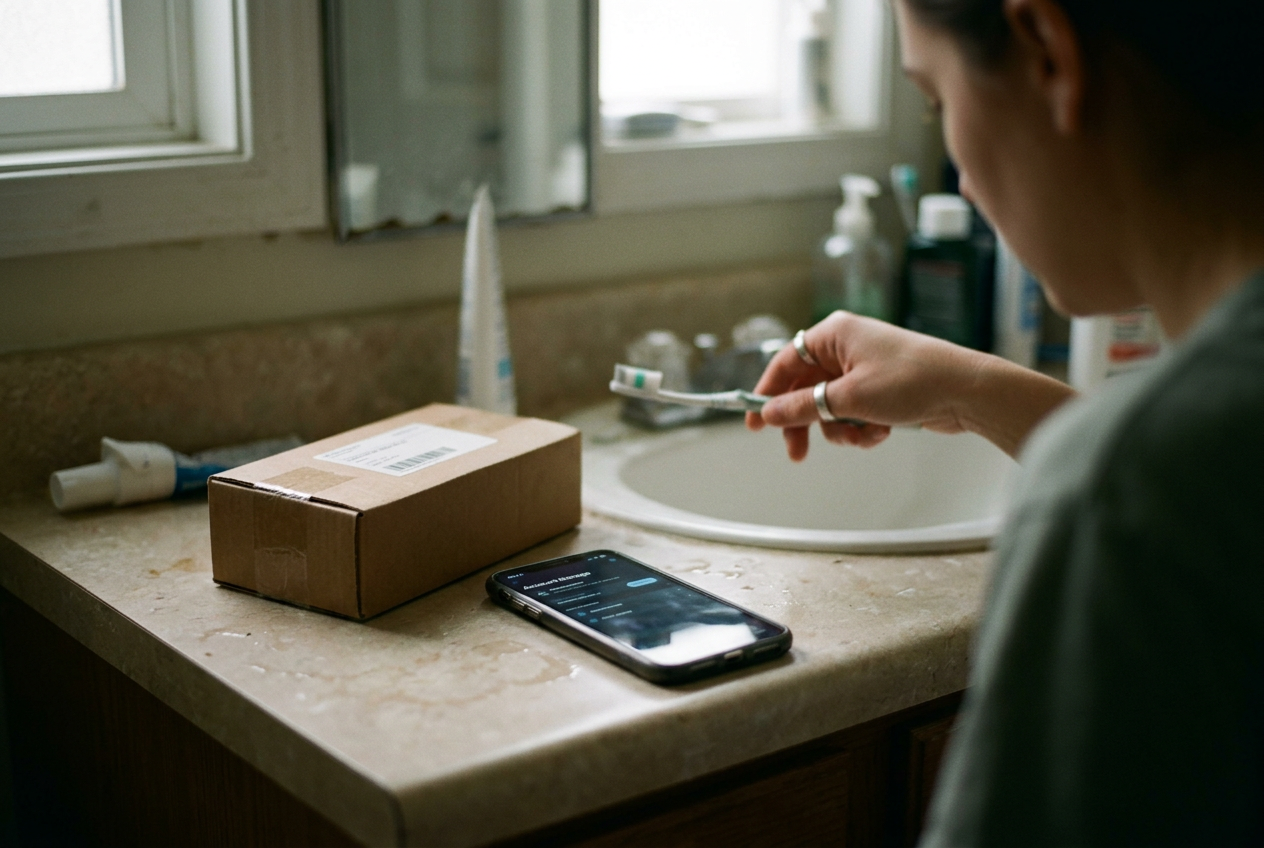
New Jersey Edibles Count Milligrams, Not the Waiting
New Jersey edible labels measure THC precisely, then reduce timing to a warning that effects may take two or more hours. That gap makes taking another serving the package’s most predictable failure.
August 21, 2026 · 8 min read
The most important text on a regulated New Jersey cannabis edible may also be the easiest to misread: “The intoxicating effects of this product may be delayed by two or more hours.”
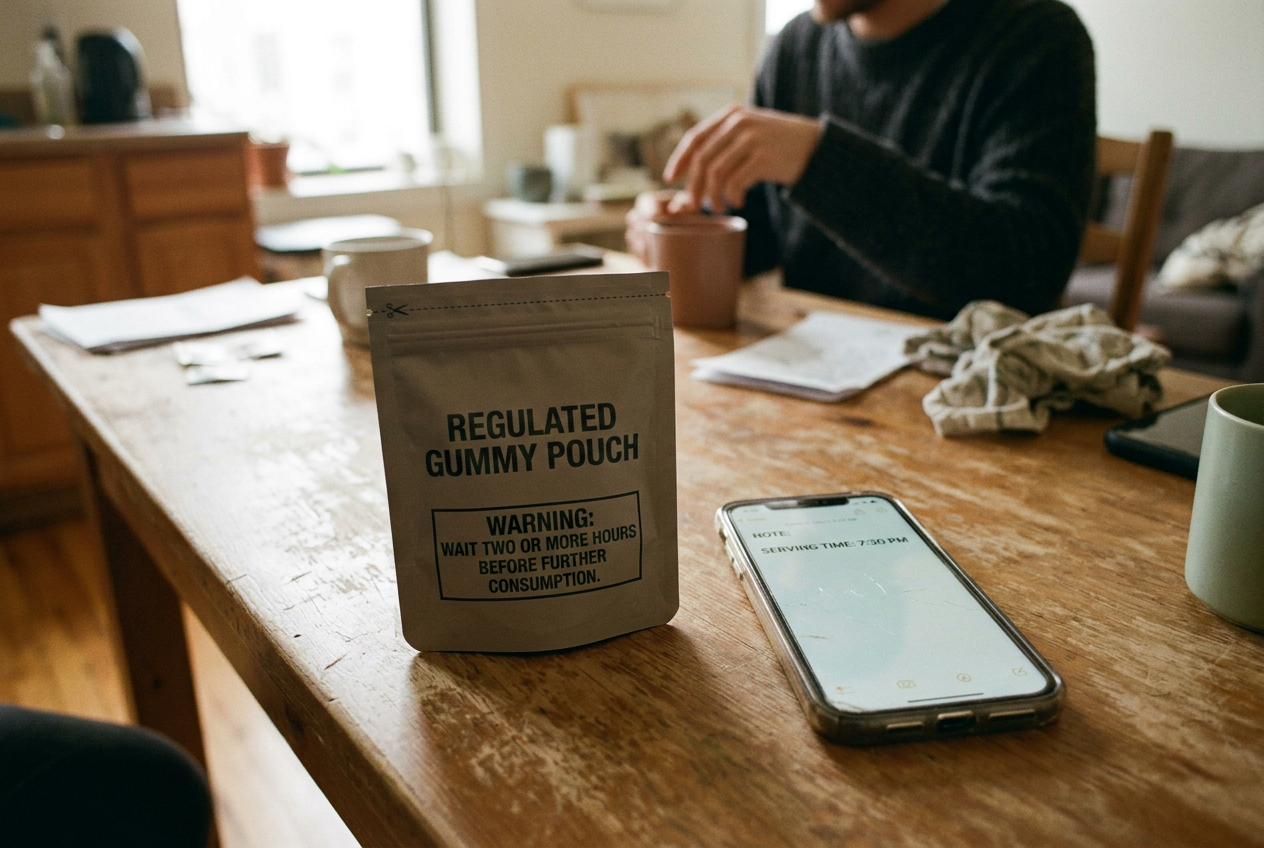
That line looks precise. It contains a number. It sits near warnings backed by regulation. On the ten-serving gummy pouch used for this supervised packaging review, however, the dose received much more useful treatment than the clock did.
The package separated the total THC content from the amount in one serving, divided the gummies into discrete units and enclosed them behind a child-resistant closure. Timing was compressed into one sentence.
No cannabis was consumed for this review. We handled the pouch, followed its opening and resealing sequence, traced the serving information across the label and compared its instructions with public guidance from the New Jersey Cannabis Regulatory Commission and federal health agencies. This is reporting, not medical or professional advice.
The central problem is not that the warning is false. Edible cannabis can take two hours or longer to become apparent, and the experience can continue developing after a person first notices it. The problem is grammatical. “Two or more hours” gives a lower boundary while many first-time users need an upper one, or at least a blunt statement that the label cannot provide one.
The dose is engineered. The wait is personal.
New Jersey’s regulated market treats THC quantity as something a manufacturer can test, divide and print. THC, short for tetrahydrocannabinol, is the principal intoxicating compound in cannabis. A package can state how many milligrams it contains and how many belong to one serving, subject to laboratory testing and state rules.
That arithmetic is valuable. On a ten-piece format, the physical gummy can correspond to the printed serving, which removes the dubious kitchen exercise of cutting a candy by eye. The package total also lets a user check whether one piece is the intended unit rather than assuming every object in the pouch counts as one serving. Those sound like basic achievements.
In an unregulated market, they are not guaranteed.
Onset does not submit to the same system. The time before an edible is felt can change with the product, the person, recent food intake and other substances, while oral THC must pass through digestion and undergo processing in the liver before much of its effect becomes apparent. A label cannot turn that variation into one dependable appointment.
Regulation handles the uncertainty by requiring a warning. Packaging design then makes the uncertainty look settled because the dose and delay appear in the same visual language: number, unit, instruction. Ten milligrams is a measured quantity. Two hours is not a promised onset time.
The pouch does not work hard enough to preserve that distinction.
Read the package in the wrong order on purpose
Most packaging wants the front panel to win. Ignore it. Before opening a cannabis edible, find the total THC in the package, the THC per serving and the manufacturer’s definition of a serving. These numbers should reconcile.
If the pouch contains ten gummies and identifies one gummy as one serving, the division is visible. If a chocolate bar relies on scored sections, inspect whether the scoring matches the stated number of servings before eating any part of it.
A score line is a manufacturing guide, not laboratory proof that every crumb contains an identical amount. The regulated product should be formulated for consistent dosing, but breaking a softened bar diagonally still defeats the package’s own serving system. Discrete pieces demand less interpretation, which is one reason the ten-gummy pouch performed better at dose communication than formats that ask the user to split a sticky or brittle object.
Then find the onset warning. Read its entire sentence, especially “or more.” The number attracts attention because people are trained to treat printed time as an instruction: bake for 20 minutes, take another tablet after a stated interval, remove the patch at noon. Here, the phrase only says the effect may arrive late.
It does not say the effect will peak at two hours, that taking more at that point is low-risk or that a person who feels little has absorbed little.
That distinction matters because redosing, taking another serving before the first has fully declared itself, stacks two uncertain timelines. The first dose is still developing while the second begins the same delayed route. By the time the combined effect becomes clear, there is no equivalent of sending the unopened gummy back into the pouch.
Public-health advice commonly uses “start low and go slow” to describe a cautious approach. The slogan is serviceable but incomplete. “Low” depends on the user and product, while “slow” requires a decision rule. For someone choosing to use an edible, the package’s printed interval should be treated as a minimum warning, and uncertainty should count against taking more, particularly for a first experience with that product.
Make the serving visible before anything happens
A useful package-reading routine takes place while everyone is sober. Remove only the intended serving. Put the remaining pieces back into the original pouch. Reseal it fully.
Move it away from ordinary food and out of reach and sight of children and pets.
This sequence sounds fussy until a gummy pouch is open on a table beside conventional candy. Cannabis packaging carries warnings and state symbols; the loose product does not carry its label with it. Once several pieces are placed in a bowl or passed around, the tested milligram count remains real but the chain between each piece and its information weakens.
The ten-serving pouch’s zipper closure therefore does more harm-reduction work than the front-panel graphics. A multi-serving package should remain child-resistant after opening, which means the closure must be engaged rather than folded over or clipped casually. Child-resistant does not mean childproof. It also does nothing to stop a pet from chewing through a pouch or an adult from mistaking the contents after they have been transferred elsewhere.
During the handling review, resealing was treated as a task with an observable end: align the closure, press it across its full width and tug once to confirm it has caught. That check costs seconds. Leaving the pouch open preserves convenience for the person using it while distributing risk to everyone else in the room.
Keep the package. The label holds the potency, ingredients, allergen information and production identifiers that become useful if the experience goes badly or the product needs to be identified. A decorative jar may look tidier. It deletes the evidence.
Use a clock as a record, not a green light
Writing down the time of the first serving is more reliable than reconstructing it after effects begin. A phone note works. The point is not to start a countdown toward another gummy. It is to preserve a fact that intoxication, conversation and ordinary distraction can blur.
The same note can record the product and labeled serving amount, especially when several legal products are present. Do not drive or operate machinery after using cannabis, and avoid combining it with alcohol or other intoxicants, which can make impairment harder to predict. A sober person can help monitor the situation during a first experience, but supervision does not make a high dose safe or convert a vague onset window into a schedule.
If effects feel stronger than intended, stop taking more. Move to a calm, safe place and avoid driving. Severe symptoms, loss of consciousness, trouble breathing or immediate danger warrant emergency help. In the United States, Poison Control can be reached at 1-800-222-1222; suspected exposure involving a child or pet should be treated promptly rather than watched in secret because the package was legal.
This is where the regulated pouch’s precision reaches its limit. It can tell another person what was taken. It cannot reverse it.
The label meets compliance, not the user’s decision
New Jersey’s system has good reasons to emphasize measurable dose. Testing and serving limits create enforceable standards. Regulators can inspect whether required warnings appear, whether a package reports THC and whether a multi-serving product uses compliant packaging. They cannot certify one onset time for every body.
Manufacturers also benefit from concise instructions. Warning panels compete with ingredients, identifiers, potency results and mandatory language on a small surface. More explanation can make a pouch harder to scan. Yet the current compromise puts the most legible precision where the system is strongest and leaves the consumer alone where the risk becomes behavioral: the moment nothing seems to be happening.
A better timing panel would preserve uncertainty rather than hide it. It could state that effects may begin after two or more hours, may continue increasing after they are first felt and should not be used as a countdown for another serving. A small space for recording the time opened or taken would connect the label to the actual decision. None of this requires pretending that onset can be guaranteed.
The line on the pouch already admits variability. It just does so in language that a hurried reader can flatten into two hours. The milligrams are a measurement. The wait is a warning.
Questions people ask
How long should
I wait before taking more of a cannabis edible?
A label stating “two or more hours” describes a minimum possible delay, not a guaranteed peak or an automatic redosing point. Effects can continue developing later. If you choose to use cannabis, follow the product warning and treat uncertainty as a reason not to add another serving. This is reporting, not individualized medical advice.
Is one gummy always one serving?
No. Check both THC per serving and the package’s definition of a serving before opening it. Some regulated products use one discrete piece per serving; others divide a larger item with score lines. Never infer the dose from the product’s shape, size or resemblance to ordinary candy.
Why should cannabis edibles stay in their original package?
The original package keeps the product attached to its potency, ingredient, allergen and production information. Its resealable child-resistant closure also adds protection that a bowl or ordinary food bag lacks, although it is not childproof. Store the closed package out of reach and sight of children and pets.
What should I do if someone has a severe reaction?
Stop further consumption, do not let the person drive and seek emergency help for trouble breathing, loss of consciousness or immediate danger. US Poison Control is available at 1-800-222-1222. Contact professionals promptly after a suspected child or pet exposure, with the original package available if possible.
One update a day
Today's story, in your inbox
One story each morning — no hype, no filler, no algorithm deciding for you.