OLLY Lovin’ Libido Lists the Herbs, Not the Interaction Risk
The bottle names ashwagandha, damiana and maca. Its broad warning does much less work, leaving customers to connect those herbs with prescriptions, health conditions and uncertain evidence.
August 26, 2026 · 8 min read
OLLY Lovin’ Libido comes with a neat proposition. Take a two-capsule serving containing ashwagandha, damiana and maca, and the blend will support desire, arousal and satisfaction. The product is widely available without a prescription. Nothing about the bottle looks clandestine, medicinal or particularly risky.
Turn it around.
The Supplement Facts panel gives each botanical a line. Elsewhere, a general warning tells people with medical conditions, people taking medication, and those who are pregnant or nursing to consult a health professional. The familiar FDA disclaimer says the claims have not been evaluated by the agency and that the product is not intended to diagnose, treat, cure or prevent disease.
That is where the useful information stops. There is no standardized interaction box beside the ingredients, no explanation that ashwagandha may matter if you take thyroid hormone, sedatives, immunosuppressants or medicines that lower blood pressure or blood sugar, and no clear account of how thin the human evidence becomes when the discussion reaches damiana. You get the nouns. You have to supply the pharmacology.
The asterisk is doing regulatory work
Dietary supplements occupy a category created by US law in which manufacturers generally do not need FDA approval before putting a product on shelves. The company is responsible for making sure its product is safe and properly labeled. Regulators can inspect, issue warnings or pursue products after problems emerge, but this is not the prescription-drug system, where a sponsor submits evidence for a specific use and regulators review the proposed labeling before sale.
The distinction shapes the language on the OLLY bottle. A company can make a structure-function claim, meaning a claim that a product supports a normal body structure or function, without claiming to treat a disease. “Supports desire” fits. “Treats sexual dysfunction” would trigger a different regulatory problem.
The FDA disclaimer signals that separation. It does not tell you whether the formula has convincing evidence, whether the finished product was tested against a placebo, or whether its ingredients are compatible with your medication list. It mainly marks the legal boundary around the claim.
The Federal Trade Commission separately requires advertising claims to have competent and reliable scientific support. Yet the retail shelf compresses every distinction. Evidence on one extract becomes atmosphere around another. A study of an ingredient can be made to lend credibility to a blend with different doses, extraction methods and accompanying compounds, although botanical preparations are not interchangeable just because the plant name matches.
The two-capsule serving therefore arrives with a strange information hierarchy. The benefits are specific enough to picture. The risks are outsourced to a conversation you must know to initiate.
Three herbs do not make one body of evidence
Ashwagandha has the strongest research profile of the three ingredients, which is not the same as having settled evidence for this product’s promised sexual effects. Small human trials have examined stress, sleep and sexual function, but study populations, extracts, doses and outcomes vary. A positive result for one standardized extract does not automatically validate every capsule carrying the word “ashwagandha.”
Public guidance from the National Center for Complementary and Integrative Health also carries less seductive details. Ashwagandha may interact with medicines for diabetes and high blood pressure, sedatives, anticonvulsants, immunosuppressants and thyroid hormone. It may be unsuitable for people with thyroid or autoimmune disorders, and rare cases of liver injury have been associated with its use. NCCIH advises avoiding it during pregnancy and breastfeeding.
These are not proof that every user will experience harm. They are reasons a generic “consult your physician” line is inadequate as consumer information, particularly when the front label translates the same ingredient into a calm promise about desire.
Maca has a long history of use and some human research on sexual function, including studies involving antidepressant-associated sexual difficulties. Reviews have repeatedly found the evidence limited by small samples and inconsistent methods. The gap matters because “some trials reported improvement” and “this retail formula reliably improves libido” are different statements. The bottle has room for only the more marketable mood.
Damiana is foggier. Its traditional reputation as an aphrodisiac is stronger than the clinical evidence supporting it as a standalone treatment for low desire. Laboratory and animal research has raised the possibility of effects on blood sugar, but robust human interaction data are lacking. That absence is not reassurance.
It means the customer and clinician have less information with which to judge the risk.
Combination products deepen the problem. Even if each ingredient has been studied separately, the finished blend may not have been tested for the advertised outcome or for interactions among its components. Extracts can differ in chemical composition, and supplements may also vary by batch or supplier. Reading the panel is necessary.
It cannot turn ingredient-level fragments into product-level proof.
Interaction risk is not a hidden side effect
A drug interaction occurs when one substance changes another substance’s effect or handling in the body. Sometimes the mechanism is pharmacodynamic, meaning two substances push the same bodily system in the same direction. A supplement that may lower blood sugar can compound the effect of diabetes medication. One with sedating properties can add to medicines that already cause drowsiness.
Other interactions are pharmacokinetic, meaning a substance changes how the body absorbs, breaks down or clears another one. Botanical products can affect liver enzymes in laboratory studies, but laboratory findings do not always translate into clinically important effects in humans. The honest answer is often that the interaction has not been adequately studied. That uncertainty should appear near the sale, not materialize after checkout.
The people most likely to be shopping for libido support may already have complicated medication histories. Antidepressants can affect desire and orgasm. Blood-pressure drugs, hormonal treatments and other prescriptions can alter sexual function, while pain, menopause, depression, fatigue and endocrine conditions can sit underneath the same complaint. Adding a supplement without reviewing the cause can create a second variable while leaving the first one untouched.
This is also why “natural” is useless as a safety category. A plant extract can have a biological effect, which is the entire premise of selling it, and the same capacity can produce an interaction or adverse effect. The industry wants efficacy to sound active and risk to sound hypothetical. The body does not honor that marketing split.
The sexual-enhancement aisle has another problem
OLLY Lovin’ Libido should not be confused with products that regulators have found to contain undeclared prescription-drug ingredients. There is no basis here to allege that this bottle is adulterated. The wider sexual-enhancement market still makes the regulatory weakness easier to see.
FDA notifications have repeatedly identified products marketed for sexual enhancement that contained undeclared sildenafil, tadalafil or related compounds. These are active pharmaceutical ingredients used in prescription erectile-dysfunction drugs, and they can cause dangerous drops in blood pressure when combined with nitrates. Products named in those notices often circulate through online sellers, convenience channels or shifting storefronts before enforcement catches up.
The mechanism is post-market whack-a-mole. A product can enter commerce without the preapproval required for a drug, regulators test or investigate some fraction of the market, and warnings follow when an undeclared ingredient is found. A disclaimer cannot protect a buyer from a substance missing from the label. Nor does retail availability prove that anyone outside the company reviewed the product before it reached the shelf.
That extreme end of the category should not erase the quieter issue on the OLLY panel. A correctly disclosed herb can still matter clinically. Legal sale is not evidence of compatibility with your prescriptions.
The missing labor belongs to the customer
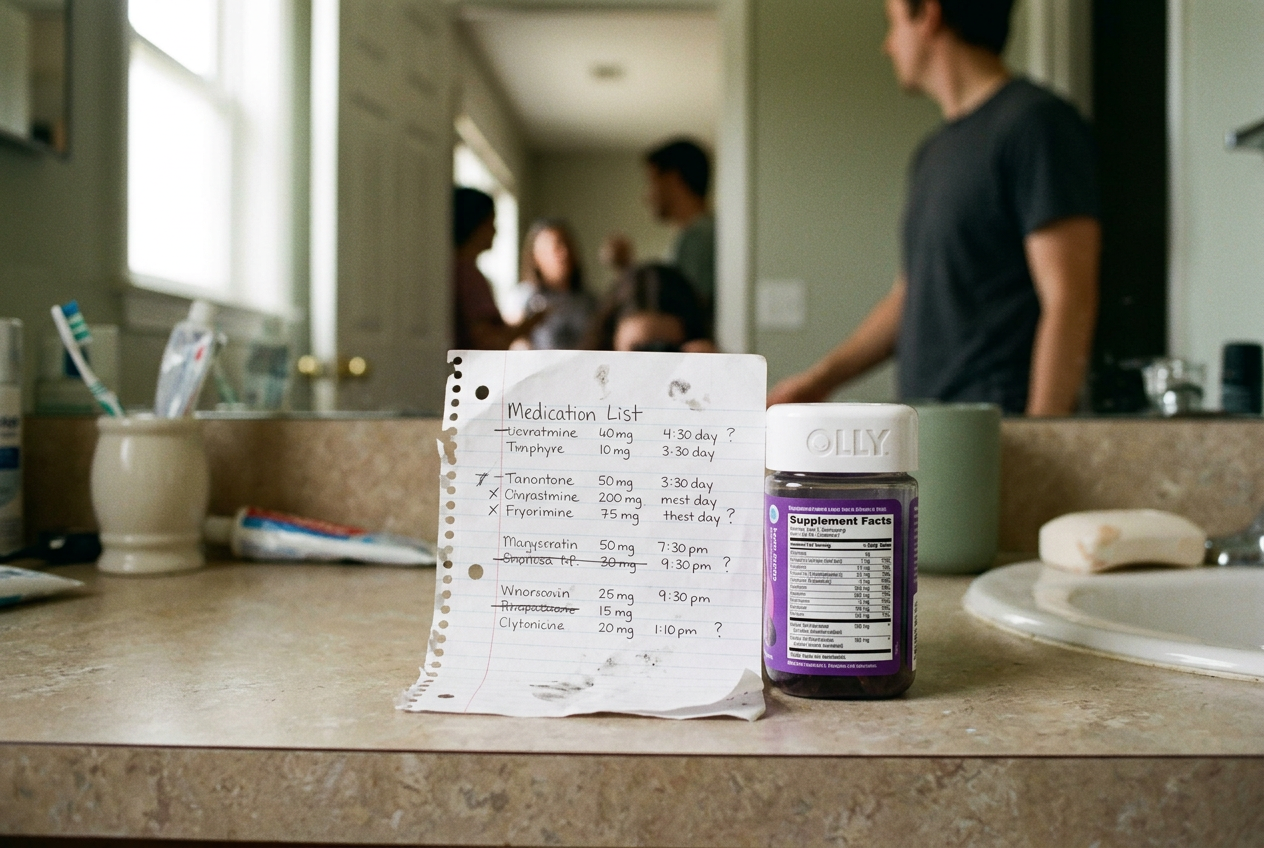
The front of the bottle converts a complicated sexual concern into a recurring purchase. The back transfers the harder work to you. You must photograph the panel, remember every medication and supplement you use, identify health conditions that may be relevant, find a pharmacist or clinician who understands botanicals, and tolerate the possibility that the most accurate answer is “the evidence is limited.”
That review costs time and sometimes money. It also cuts against the emotional design of the product, which offers privacy and speed for a concern many people find difficult to raise in a medical appointment. The supplement aisle works because it removes the gatekeeper. It also removes the person most likely to catch the interaction.
A better label would not need to resemble a pharmacology textbook. It could name major categories of concern beside each ingredient, state whether the finished formula has been tested for its advertised outcome, identify the extract used, and distinguish human evidence from traditional use or laboratory research. A scannable link could carry updated interaction information without forcing all of it onto a small bottle.
The current two-capsule serving is easier to sell without that context. Specific warnings make friction. Friction interrupts checkout.
Questions people ask
Are over-the-counter libido supplements FDA-approved?
Dietary supplements generally do not receive FDA approval for safety or effectiveness before sale. Manufacturers remain responsible for safety and labeling, while the FDA can take action after adulteration, misbranding or other violations come to light. The standard disclaimer is not an approval badge.
Can ashwagandha interact with prescription medication?
Yes, potential interactions include thyroid hormone, sedatives, anticonvulsants, immunosuppressants and medicines that lower blood pressure or blood sugar. The relevance depends on the person, dose, extract and medication, so the useful object to show a pharmacist is the complete Supplement Facts panel rather than the product name alone.
Does evidence for maca or ashwagandha prove a blend works?
No. Research on one ingredient, dose or standardized extract does not establish that a multi-ingredient retail formula produces the same result. Product-level evidence requires testing the finished blend for the claimed outcome, not arranging separate ingredient studies around a marketing sentence.
What information should
I bring when asking about an interaction?
Bring the product bottle or a clear photo of the entire label, including serving size, ingredient amounts and warnings, along with a current list of prescriptions, over-the-counter drugs and other supplements. “Libido supplement” is too vague; the two-capsule panel is the part a pharmacist can inspect.
One update a day
Today's story, in your inbox
One story each morning — no hype, no filler, no algorithm deciding for you.