Online Ketamine Care Gets Thin Once the Dose Is Delivered
Joyous, Mindbloom and Better U describe substantial support around at-home ketamine. Their documents are much clearer about check-ins and eligibility than care after a frightening session.
August 14, 2026 · 8 min read

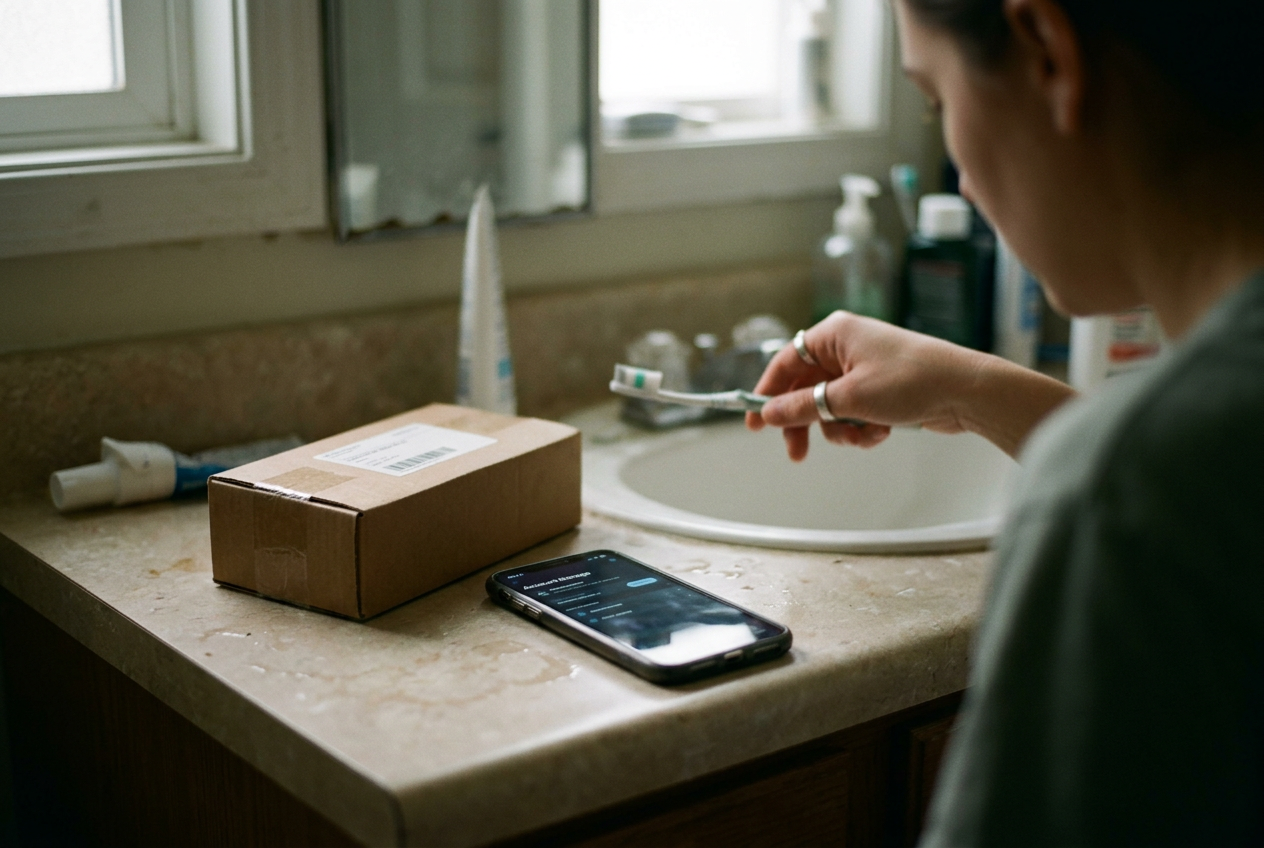
The concrete object I kept returning to was a Joyous daily check-in link, the small piece of infrastructure its public materials say arrives by text as part of ongoing low-dose ketamine care. It looks like continuity. You take a prescribed dose, report back, and remain connected to the service through a recurring prompt rather than disappearing with a package at the door.
That link also exposes the central ambiguity of online ketamine care. A check-in can collect mood or side-effect information and give a clinician material to review. It can help a company decide whether a prescription remains appropriate. It cannot, by its mere existence, tell a patient who will respond to a frightening experience, how quickly that person will respond, or whether the subscription includes therapy with someone trained to help make sense of what happened.
I compared the public documentation of Joyous, Mindbloom and Better U, three brands offering remotely supervised access to prescribed ketamine for eligible patients. I read their main treatment pages alongside FAQs, safety language, terms and descriptions of follow-up or integration support. This was a test of the promise visible before purchase, not an evaluation of individual clinicians or patient outcomes.
The documents reveal a business category that has become skilled at describing the route to a dose. The route back is less legible.
The check-in is doing two jobs
Joyous puts frequent check-ins near the center of its model. Its public materials describe low-dose ketamine treatment supported by regular digital reporting and provider oversight, with the service using patient responses to inform care. This is asynchronous contact, meaning the patient and clinician do not have to be present at the same time.
That format is convenient and potentially useful. It also allows one interface to perform two jobs that should not be confused. The daily check-in can support a patient, while producing telemetry, the information sent back to the service about treatment, side effects and engagement. That information helps the company operate a recurring prescribing program.
It shows who is responding, who needs review and who may remain eligible for another shipment.
The distinction matters after the dose. A patient experiencing ordinary uncertainty may be well served by a message and a later response. Someone who becomes intensely distressed needs a clear escalation route, including the expected response time and the kind of professional who will take over. Joyous describes routine access to its care team and medical follow-up, while emergency language directs people toward outside emergency systems.
What remains harder to establish from the public pages is the middle layer between those poles: too serious for a form, not yet recognizable to the patient as a 911 emergency.
The daily check-in link feels substantial because it appears often. Frequency is not the same as clinical depth. A form can arrive every day while live care remains conditional, scheduled or routed through a queue.
This is not a peculiar failure of one company. It is the operating logic of asynchronous health subscriptions. Structured prompts scale well because the company can standardize them, clinicians can review information without holding a full appointment each time, and the record helps document continued supervision. Open-ended human attention scales badly.
It requires calendars, licensed labor and enough unused capacity for a person who needs help at an inconvenient moment.
Mindbloom makes the session a program
Mindbloom documents a more visibly choreographed experience. Its public materials place clinician consultations alongside guides, preparation, integration resources and group support. Integration is the work of reflecting on an altered-state experience and carrying useful material into ordinary life. The company also describes a peer treatment monitor, a trusted adult who is present for a remote session but does not replace a clinician.
This architecture acknowledges something the daily check-in can flatten: ketamine care has a before, a during and an after. Preparation changes what a patient expects. A monitor adds immediate physical presence. A guide or integration circle gives the experience somewhere to go once the acute effects have passed.
Still, the documentation separates roles in ways a glossy overview can blur. The prescribing clinician handles medical suitability and treatment oversight. A guide may support preparation and integration without functioning as the patient’s psychotherapist. A peer monitor is nearby, but is not medical staff.
Group integration creates access to human conversation, although group availability does not guarantee private, immediate help after a difficult session.
Mindbloom’s program language makes continuing care easier to see than a prescription-only frame would. It also turns support into a sequence of defined encounters. That can be honest and useful. The problem arrives when a reader converts the emotional warmth of words such as guide, circle and support into a broader clinical entitlement than the plan documents.
Here the anchor changes shape but not function. Joyous has the daily link. Mindbloom has a scheduled pathway with named roles. Both can demonstrate that contact continues.
Neither form of documentation, on its own, guarantees that the person answering after distress will be a licensed therapist, the original prescriber or anyone available in real time.
Better U sells support through the package
Better U’s public materials also frame at-home ketamine through a broader program, combining clinician evaluation with an app and preparation or integration resources. Its plan descriptions make support visible through package components, including coaching or integration access where offered.
The package is the mechanism. It converts continuing care into units that can be displayed before checkout: appointments, sessions, messaging routes and a digital library. A prospective patient can see that the service contains more than medication, but must still decode which parts involve a licensed medical professional, which involve a coach, which are self-directed and which depend on the selected program.
That decoding labor is consequential. “Provider support” can describe a medical follow-up. “Integration support” may refer to live individual help, a group session or material inside an app. Each can have value.
They are not interchangeable after a destabilizing experience, and the broadest phrase on a sales page rarely carries the operational detail a distressed person would need.
Better U is not unusual here. Across the three brands, the strongest documentation explains entry: assessment, contraindication screening, prescription eligibility, preparation and delivery. Follow-up appears as a benefit. Emergency care appears as a boundary.
The emergency instruction sits outside the product
When online ketamine providers discuss emergencies, their documents generally direct patients to emergency services, a crisis line or the nearest emergency department rather than presenting the subscription as crisis care. That boundary is reasonable. A remote prescribing platform should not pretend to be an ambulance, and a coach should not be mistaken for emergency medical staff.
The trouble is not the existence of the boundary. It is how abruptly the documentation reaches it.
Brand safety materials commonly identify risks and advise patients to follow dosing instructions, avoid prohibited combinations, use required monitoring arrangements and seek emergency help for severe symptoms. Those statements cover the obvious endpoint. They often tell a reader less about escalation inside the service: what happens when a check-in suggests trouble, whether a clinician calls, how quickly routine messages are reviewed, and when a support worker transfers the case to medical staff.
A phone number for 911 is clear. The distance between a daily check-in and that number is not.
This gap works for the subscription model because eligibility can be standardized more readily than recovery. The provider can document an intake, record responses, schedule periodic reviews and decide whether prescribing should continue. Therapy requires a different labor model, while urgent assessment requires staffing that cannot wait for the next available appointment. The public language stretches the word “support” across these different functions, giving the plan a feeling of continuity without making every form of continuity contractual.
That does not make the services fake. It makes the sale easy to misread. A patient may be buying continued access to evaluation, medication and defined program features. The emotional impression is that someone remains alongside them.
The paperwork is often narrower.
Read the nouns, then find the verbs
The most useful comparison is not which brand says “support” most often. It is what the documentation says a particular person will do after a patient reports distress.
A clinician reviews. A care team responds. A guide helps integrate. A peer monitor stays present.
Emergency services take over. Those verbs establish the real care pathway, especially when the documents also state the channel, timing and limits.
Where the language stops at access, resources or community, the patient still has work to do. They must determine whether the contact is live, whether it is clinical and whether it belongs to the plan already purchased. That work costs attention at the moment attention may be hardest to supply.
The Joyous check-in link remains a useful artifact because it is neither meaningless nor sufficient. It creates a recurring point of contact and a stream of information. It may support safer prescribing. Yet if the public documentation does not specify what action follows a concerning answer, the link proves that the system can hear a patient more readily than it proves the system will care for them.
This analysis is not medical advice, and it does not establish whether at-home ketamine is appropriate for any person. It establishes a narrower point about the wellness industry’s favorite elastic noun. “Support” should be read as a claim that needs an actor, a response time and a scope of practice attached.
Without those details, the subscription sells continued eligibility with care arranged around it. The daily text arrives either way.
Questions people ask
Does an online ketamine subscription include therapy?
Not necessarily. Brand documentation may describe integration, coaching, groups, guides or digital exercises, while psychotherapy with a licensed therapist can be a separate service or absent from the plan. The relevant documents should identify who provides each form of support and whether individual sessions are included.
Who responds if a ketamine session becomes frightening?
That depends on the provider, the plan and the severity of the situation. Public documents distinguish routine care teams, prescribing clinicians, guides and emergency services, but they do not always explain the handoff between them. Emergency instructions generally direct patients outside the platform rather than promising an immediate company clinician.
Are daily check-ins the same as medical follow-up?
No. A check-in can collect symptoms, mood reports and side effects for later review, while medical follow-up requires clinical judgment from an appropriately licensed provider. The useful questions concern who reviews the submission, what triggers contact and how long a nonemergency response may take.
What should provider documentation make clear before payment?
It should name the person responsible after a difficult session, the available contact channel, likely response window and point at which outside emergency care takes over. It should also separate medical follow-up from coaching, group integration and self-directed app content, rather than placing all of them under “support.”
One update a day
Today's story, in your inbox
One story each morning — no hype, no filler, no algorithm deciding for you.