The Fake Pentagon Explosion Outran Community Notes
Community Notes can reach consensus and still lose the correction race. The fake Pentagon explosion showed how timing, ranking and copied posts split a claim from its fact-check.
August 26, 2026 · 8 min read
The smoke arrives first
In May 2023, an image showing a dark plume of smoke near the Pentagon moved across X, then still called Twitter. A verified account styled as a Bloomberg news feed posted it. Other accounts repeated it. Financial markets dipped briefly before officials confirmed there had been no explosion, while public reporting found signs that the image had been generated or manipulated with AI.
The picture was crude on inspection. The fence warped. Parts of the building failed to resolve. None of that mattered much in the feed, where the image arrived compressed, framed as breaking news and backed by the blue badge beside one prominent account.
It needed only to hold together for the length of a glance.
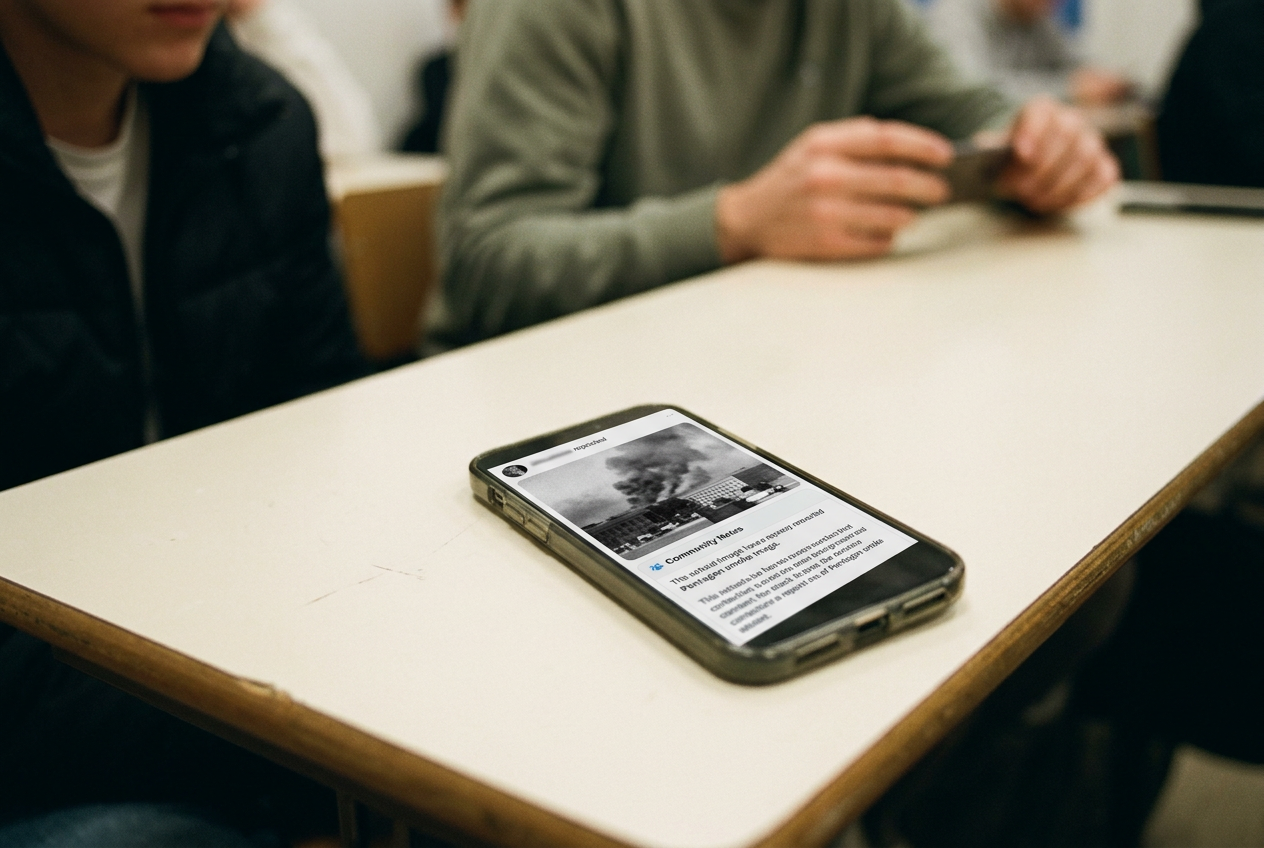
Community Notes appeared on some posts carrying the fake Pentagon image, identifying the scene as fabricated and pointing readers toward official denials. Those notes were useful. They were also entering a distribution system that had already performed its main task: selecting the alarming image, placing it in front of people and letting those people carry it elsewhere.
That distinction tends to disappear when platforms describe fact-checking. A published note looks like a completed correction. The visible artifact is there under the post, evidence that the machinery worked. The real test is less flattering.
It concerns how many viewers saw the Pentagon image before the note, how many encountered a copied version without one, and whether the correction received anything close to the distribution already granted to the claim.
Winning is not a simple vote
Community Notes lets approved contributors propose context for posts and rate notes written by others. A note does not become public because a raw majority likes it. X uses a bridging algorithm, a ranking method that looks for agreement among contributors whose previous ratings suggest they often approach disputed posts from different viewpoints.
The design aims to prevent one political bloc from taking over the label underneath a post. A note supported only by contributors who tend to agree with one another may remain hidden, even if that group is large. A note that draws support across rating patterns can receive the status “Currently Rated Helpful” and appear publicly.
That is a sensible defense against coordinated pile-ons. It is also a clock.
Before the note appears, someone must recognize the claim, write a concise correction, provide sources and attract enough ratings from the right mix of contributors. Breaking news is the hardest environment for this model because reliable information is still arriving, contributors may disagree over wording, and the recommendation system does not pause while the jury assembles.
The Pentagon image did not need cross-group agreement. It needed a dramatic visual, a plausible news frame and accounts willing to pass it on. The correction had a higher evidentiary burden than the lie, then had to clear a consensus threshold the lie never faced. This asymmetry is not unique to Community Notes.
The system makes it measurable.
Researchers studying notes around the moment they become publicly visible have found that they can reduce subsequent engagement and sharing. That matters. Community Notes is not decorative. The problem sits inside the word “subsequent,” because a post that receives most of its attention before the status change can be corrected successfully in the database while remaining largely uncorrected in lived use.
The audience has already left
A post’s public view count bundles together different experiences. One person saw the claim alone. Another arrived later and saw the note directly beneath it. A third saw a screenshot on another account, stripped of replies, labels and provenance.
Treating all three as viewers of a “noted post” hides the distribution failure.
X has said it notifies some people who liked, reposted or replied to content that later receives a note. That creates a limited recall mechanism, but engagement is not the same as exposure. Many people read without touching the buttons. Others encounter the claim through a screenshot, a downloaded image, a group chat or another platform.
The correction cannot notify an impression it cannot identify.
Recommendation ranking adds another gate. X’s For You feed decides which posts receive attention, but the company does not provide a complete public account of how a pending note affects distribution, or whether a published note receives enough new circulation to catch the people who saw the original claim. The platform can show the correction beneath future impressions. It cannot make those future impressions equal the earlier ones.
This is where the fake Pentagon image remains useful. Once officials had denied an explosion and notes had appeared, the image became less effective as breaking news. The people most likely to see the correction were also arriving at a later, calmer stage of the event. The high-value audience for the falsehood had already received the version with smoke and urgency.
A correction system should therefore be judged by an audience-weighted correction rate, meaning the share of a claim’s impressions delivered with reliable context attached. X foregrounds whether a note reached helpful status. Researchers can inspect public Community Notes data and estimate delays, but outsiders do not receive the impression-level data needed to calculate how much of the audience escaped before publication. The platform holds the decisive number.
Reposts split the object
A native repost generally points back to the same underlying post, allowing a published note to travel with that object. The trouble begins when users download the Pentagon image, upload it again, crop it, place it inside a video or turn the claim into text. Each version can become a new moderation problem with its own velocity.
X has expanded Community Notes so notes attached to media can appear on other posts using matching media. That addresses the most obvious copy-and-paste route. Matching systems still need enough visual continuity to recognize the asset, while an altered crop, overlaid caption, screen recording or edited clip may create a fresh branch. The claim keeps reproducing; consensus has to find the branches.
Quote posts create another mismatch. Even when the original note remains visible inside an embedded post, the surrounding commentary may redirect attention or restate the claim in a new form. A correction attached to the source does not automatically evaluate every assertion added above it. Screenshots are worse.
They turn a live, updateable post into a flat image whose missing note looks like proof that no correction existed.
This is not an edge case. Reposting is the feed’s copying mechanism, and the recommendation system rewards versions that generate fresh engagement. Community Notes works most cleanly when everyone keeps pointing to one stable object. Viral culture does the opposite.
Cheap consensus, expensive speed
Community Notes relies heavily on unpaid contributors. X supplies the software, status rules and distribution layer; volunteers supply much of the detection, sourcing and judgment. The arrangement gives the company a moderation system that can be described as participatory and politically diverse without funding an editorial operation large enough to review every fast-moving claim before it peaks.
X has also said that posts corrected by Community Notes can become ineligible for creator revenue sharing. That is a financial brake applied after the note publishes. If the post accumulated attention before the correction, the incentive system still helped produce the reach, even if the final accounting later withholds a payout. Attention is valuable beyond direct revenue anyway.
It brings followers, influence and screenshots that travel outside X.
A faster system would cost more. X could staff rapid-response teams for high-reach claims, temporarily reduce recommendations when credible institutions dispute a breaking-news post, broaden media matching and send corrections to people who merely viewed a claim rather than engaged with it. Each measure creates privacy, abuse or editorial-control problems. None is free.
The current design pushes much of that cost onto users who must revisit a claim after the platform has moved on.
Community Notes should remain. Cross-viewpoint agreement can produce context that people trust more than a platform label, and public contribution data permits scrutiny that conventional moderation rarely offers. The mistake is treating publication as the finish line. For the Pentagon image, the meaningful event was not the moment a note finally appeared beneath a copy.
It was the interval when the smoke had distribution and the correction did not.
Questions people ask
How does a Community Note become public?
Contributors write and rate notes, but a simple majority is not enough. X’s bridging algorithm looks for support among contributors with different rating histories. A note appears after it reaches “Currently Rated Helpful” status, which makes cross-group agreement a publication requirement and can add time during fast-moving events.
Do
Community Notes stop misinformation from spreading?
They can reduce later engagement once viewers see them, according to public research on status changes. They do not reverse impressions delivered before publication, and they cannot reliably follow a claim into every screenshot, edited image, copied caption or off-platform repost.
Does everyone who saw a false post receive the correction?
No. X has described notifications for some users who engaged with a post that later received a note, but passive viewers may receive nothing. People who saw the claim through a copied post, group chat or another platform also sit outside that recall path.
Why did the fake
Pentagon image spread faster than its correction?
The image could circulate as soon as an account uploaded it. A note needed evidence, contributor ratings and cross-viewpoint agreement before publication, while copied versions created additional targets. By the time reliable context appeared under some posts, the image had already traveled through news-shaped accounts and recommendation feeds.
One update a day
Today's story, in your inbox
One story each morning — no hype, no filler, no algorithm deciding for you.