The Newsletter Looks Solo. The Labor Bill Isn't.
Lenny’s Newsletter is sold through one recognizable writer, but the finished product extends through editing, graphics, audio, community work and administration. Here is the bill the byline cannot show.
August 11, 2026 · 8 min read
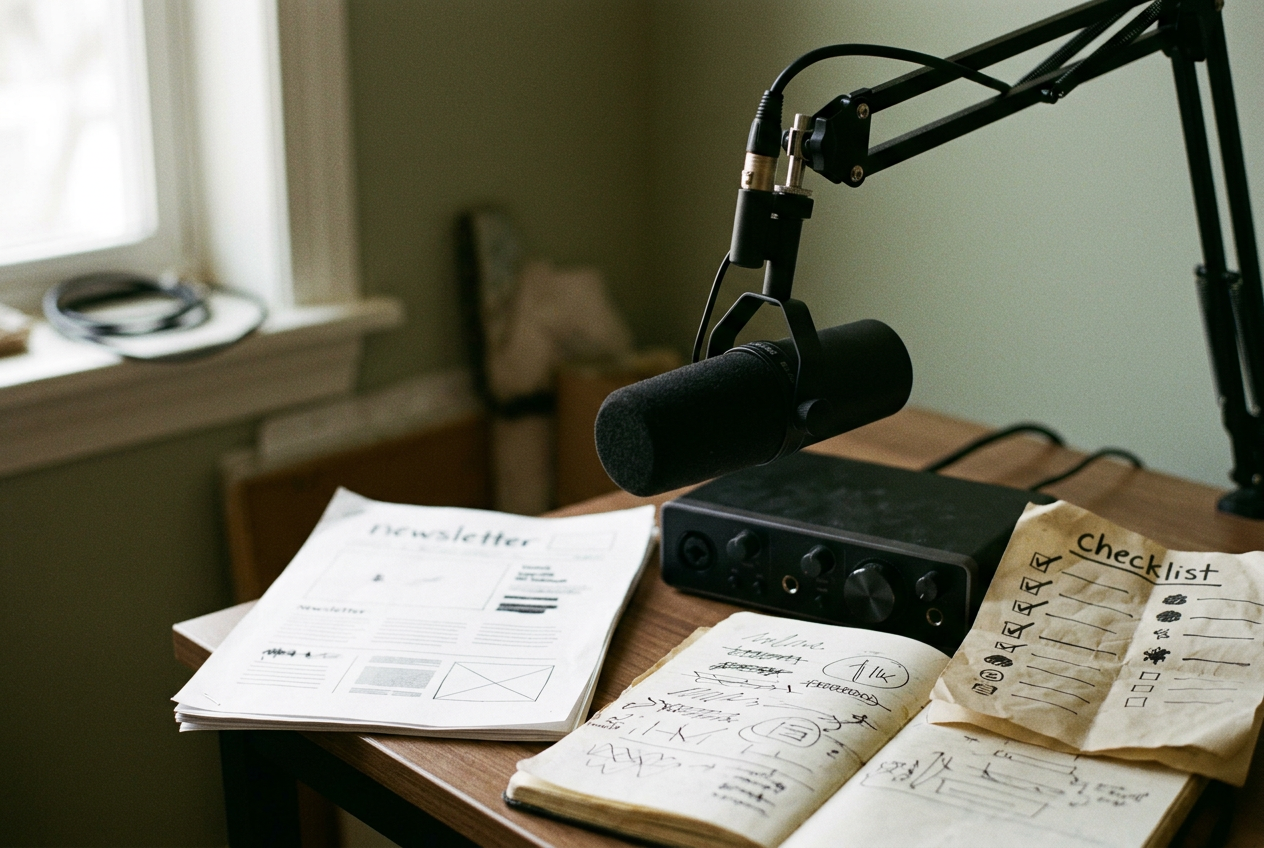
The Shure SM7B microphone in videos for Lenny’s Podcast is a useful piece of evidence. Black body. Foam windscreen. Metal yoke holding it close to Lenny Rachitsky’s mouth.
It is familiar enough to function as creator-economy furniture, another object that says a person left a company and built a media business from a desk.
The microphone also refuses the solo-founder story. It uses an XLR connection rather than plugging straight into a laptop, and its relatively low output usually demands an audio interface with enough clean gain. Someone must set levels, record separate tracks, cut mistakes, process the sound, export the episode, prepare video and publish the files. The SM7B is sold as one object.
Working audio is a chain.
So is Lenny’s Newsletter.
Rachitsky’s product is a strong case because the newsletter remains attached to one name while operating across written posts, a podcast, sponsorships and a subscriber community. Its public pages acknowledge collaborators and production help. This is not a claim that workers have been concealed in a locked room. The concealment is structural: the brand trains readers to see one creator, while credits, support roles and recurring labor sit around the edges.
That difference matters. A reader may be buying access to one writer’s judgment, but the reliable delivery of that judgment has become a small media operation. The creator owns the audience relationship and receives the reputational return. Everyone else makes the product arrive on time.
One byline, several production lines
Start with a newsletter issue. The writer chooses the subject, reports or researches it, drafts the piece and approves the final version. Around that core sits editing, which can mean developmental work on the argument, line editing for structure and tone, copy editing for errors, checking links and verifying claims. One person may perform several of those jobs.
The work does not disappear when the same person does it.
Visual production adds another layer. Charts need legible labels. Screenshots need cropping and permission checks. Illustrations, thumbnails and social cards need dimensions suited to each publishing surface.
The email itself must be formatted and tested because an issue that looks fine in a browser can break inside an inbox, where dark mode, clipped messages and inconsistent email clients punish optimism.
Then there is the podcast attached to the newsletter. Booking a guest means research, outreach, scheduling across time zones, release forms or appearance terms, calendar management and pre-interview preparation before the SM7B records anything. Afterward, audio must be edited, mixed and checked. Video creates more files and more failure points.
A transcript needs generation and correction, because automated transcription still turns product names and technical language into debris.
The subscriber community is labor too. Lenny’s paid product includes access to a private Slack community, a feature that raises the value of membership while creating a continuing obligation. Someone admits members, handles access problems, enforces rules, responds to reports, organizes channels and deals with people who believe a subscription bought them unlimited personal attention. Content moderation means deciding what stays, what goes and who loses access under a set of community rules.
It is operations with a social temperature.
Administration catches whatever remains: invoices, contractor agreements, subscription support, refunds, sponsorship logistics, tax records, analytics, software permissions and the tedious reconciliation of who has been paid. None of it produces the sentence that convinces somebody to subscribe. All of it determines whether the business survives that sentence.
Put a price on the missing hours
Public credits do not reveal a full payroll, and they should not be stretched into one. A useful model can still show the order of magnitude, provided its assumptions remain visible.
Take a weekly newsletter-plus-podcast operation and assign 12 hours to the writer, four to editing and verification, two to visuals and publishing, eight to podcast production, and four to community and administration. That is 30 hours. It is not a claim about Rachitsky’s schedule or contracts. It is a restrained production model that excludes sales calls, major technical failures, travel and weeks when a reported piece refuses to cooperate.
At a blended labor rate of $50 an hour, the weekly bill is $1,500. Across 48 publishing weeks, it reaches $72,000. Remove the writer’s 12 hours to isolate surrounding labor and the model still produces $43,200 a year. Raise the blended rate to $75, which is plausible for experienced specialist contractors without employee benefits, and those 18 support hours cost $64,800.
That is the clean version. Contractor rates must cover unpaid leave, equipment, health insurance, downtime and self-employment taxes. Employee labor adds payroll taxes and benefits instead. The business also pays for software, storage, transcription, accounting and hardware, including the interface sitting between the SM7B and the computer.
Cheap labor does not make the work cheaper. It moves the cost onto the worker.
The writer’s own unpaid hours deserve equal suspicion. Early newsletters often survive because the founder handles editing, formatting, customer service and bookkeeping after finishing the piece. Conventional accounting may record little or no labor expense because no invoice changes hands. Economically, the founder has invested time and accepted the risk that future subscriptions will compensate for it.
That is unpaid self-employment, not free production. The distinction becomes convenient when successful creators teach aspiring writers that consistency and a niche are the main ingredients. Consistency often means performing five jobs under one byline until revenue can support help. The people selling courses tend to place that sentence in a later module.
The platform gets paid before the editor
Substack’s standard publishing model takes 10 percent of paid subscription revenue. Payment processing adds another charge; Stripe’s standard US online-card pricing commonly includes a percentage plus a fixed amount per transaction, though rates and payment methods vary. Those deductions happen near the top of the waterfall.
On an illustrative $100 annual card payment, a 10 percent platform fee removes $10. Applying a 2.9 percent processing fee plus 30 cents removes another $3.20, leaving $86.
80 before refunds, taxes, software and labor. That is not Lenny’s subscription price or private account. It is arithmetic using publicly posted standard fees.
The fixed processing charge also makes smaller recurring payments less efficient. Twelve $10 payments produce $120 in gross revenue, but the 30-cent charge lands 12 times rather than once. After a 10 percent platform fee and the illustrative processing charges, roughly $100.92 remains.
One annual $120 payment would leave about $104.22 under the same assumptions. The difference is only a few dollars per subscriber, but multiplied across a large list it can fund real production hours.
Notice the order. Substack and the payment processor collect according to revenue. Editors, producers and moderators are paid according to contracts, hours or projects, if they are paid separately at all. The platform participates automatically in growth.
A contractor usually does not.
Credit is not ownership
Lenny’s public operation is more transparent than many personality-led newsletters. Collaborators appear in credits, acknowledgments and team material. Transparency does not settle the ownership question.
A contractor can receive a fair project fee and still build an asset owned by somebody else. Each polished issue may reduce cancellations. Each clean podcast episode expands sponsorship inventory. Each well-run Slack exchange makes membership harder to abandon.
Those gains accumulate in the newsletter’s list, archives, brand and commercial relationships, which generally remain with the publisher rather than being divided among everyone who improved them.
This is normal media ownership in miniature. The difference is presentation. A magazine displays a masthead because institutional production is part of its identity. A creator business foregrounds intimacy, and intimacy sells better when the machinery remains visually quiet.
The subscriber feels close to the named writer rather than enrolled in a media company, even after the operation develops the workload of one.
The model works for senior creators because concentrated ownership preserves speed and voice. It also works for platforms because the individual brand supplies customer acquisition and bears production risk. Contractors gain paid assignments without having to finance the publication, but they can remain interchangeable in the public imagination even when the product depends on specialist judgment.
The right conclusion is not that a successful newsletter with help is fake. That would punish people for hiring. The stronger conclusion is that “independent” describes who controls the publication, not how many people labor on it. A solo byline can sit above a distributed workforce, while independence for the owner is purchased partly through dependence on contractors and partly through the founder’s own unbilled time.
Return to the SM7B. The microphone is several hundred dollars of visible capital, mounted neatly in the frame. The gain staging, edit decisions, transcript corrections, upload checks and invoice behind it are harder to photograph. That is why the object reads as creator independence while the labor chain disappears.
Questions people ask
How much does it cost to run a successful Substack?
There is no standard bill, but a weekly newsletter with editing, visual production, podcast work, moderation and administration can create tens of thousands of dollars in annual support labor. Platform fees, payment processing, software and the writer’s own unpaid hours sit on top of that.
Does
Substack pay newsletter editors and podcast producers?
Usually the publisher pays those workers directly as employees or contractors. Substack supplies publishing, payment and network tools, then takes its platform fee from paid subscription revenue; it does not function as the newsroom payroll for each publication.
Is a newsletter still independent if it has a team?
Yes, if the publisher controls the product and ownership. “Independent” does not mean one person performed every task, though creator branding often encourages that reading because a named individual creates a stronger feeling of access than a small company does.
Who owns the value created by newsletter contractors?
Contract terms vary, but contractors commonly receive an agreed fee while the publisher retains the subscriber list, archives, brand and future revenue. The last concrete record of the arrangement is often an invoice for labor that improved an asset the worker does not own.
One update a day
Today's story, in your inbox
One story each morning — no hype, no filler, no algorithm deciding for you.