TikTok Autocomplete Can Attach a Scandal Before the Surname
A logged-in account and a clean one did not see identical searches. The durable scandal terms came from TikTok’s wider demand signals, while personalization changed their order and flavor.
August 18, 2026 · 7 min read
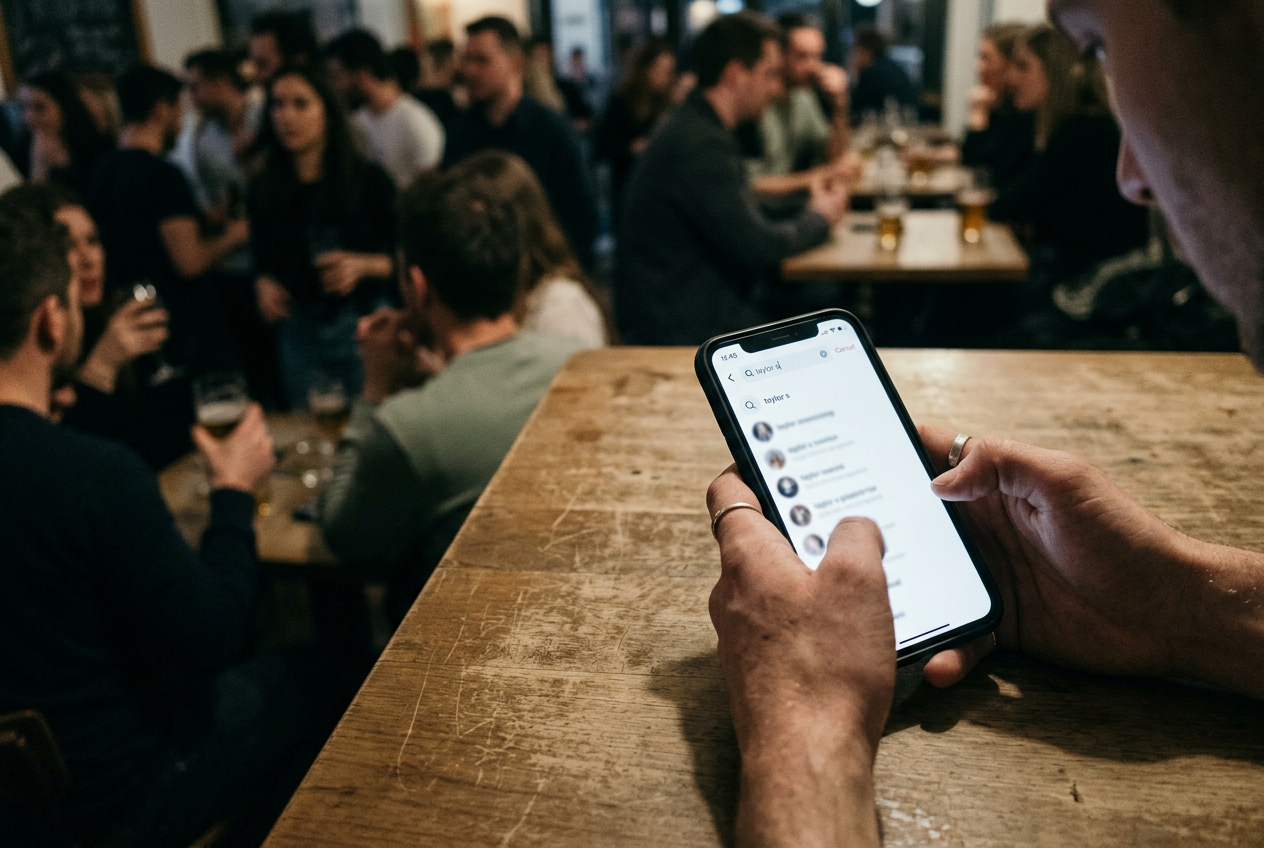
The fragment was “taylor s.” Eight letters and a space, entered slowly into TikTok’s search bar. Before the surname was complete, the interface had already started proposing what the search ought to become.
That half-written name became the fixed point for a side-by-side test using a long-running logged-in account and a clean account with no follows, searches or watch history. The same procedure was repeated with Beyoncé, Drake, Ariana Grande, Selena Gomez and MrBeast, all public figures surrounded by enough fandom activity to make TikTok’s search machinery work hard. Suggestions were recorded as categories rather than republished beside each person, because autocomplete can surface unsupported allegations and repeating the pairing would perform the same reputational work under examination.
The result was less dramatic than the usual algorithm horror story and more useful. The accounts did not produce identical lists. They did, however, share a durable layer of relationship queries, old disputes and generic controversy language, including terms shaped like “exposed” or “controversy.” Personalization changed the ranking, added fandom vocabulary and favored topics adjacent to earlier viewing.
It did not build the entire scandal from private knowledge of one user.
That distinction matters. TikTok search autocomplete, the menu of queries offered while someone types, is best understood as a ranking system for anticipated demand. It does not need to decide that an allegation is true. It needs to estimate which completed query will keep the user searching.
The clean account was never clean
A clean account is useful for comparison, but the phrase flatters the experiment. No follows and no watch history remove obvious behavioral inputs. They do not remove language, region, device information, current platform-wide activity or whatever aggregate search patterns TikTok uses to shape predictions.
Nor does a new account arrive outside culture. Search demand has already been produced by news coverage, fan campaigns, gossip channels, reaction videos, coordinated hostility and people checking whether a rumor is real. Autocomplete inherits that demand after the fact, then presents it before the next person has finished asking. The system turns accumulated curiosity into an editorial prompt without calling it one.
This is why “taylor s” mattered more than any single completed suggestion. At that point, the user had supplied little intent beyond a famous first name and the opening letter of a surname. TikTok supplied the direction. A relationship query might be harmless celebrity utility.
A modifier such as “exposed” carries a ready-made conclusion, inviting the searcher to look for evidence of wrongdoing rather than information about whether wrongdoing occurred.
The clean account retained more of that shared layer than a personalization-only explanation would predict. Its suggestions were plainer and less fluent in fan terminology, but they still reflected public attention around the names. What persisted was not proof of a secret profile. It was evidence that aggregate behavior can become difficult to distinguish from platform judgment once TikTok prints it directly beneath the search box.
Clean-account testing also has a practical weakness. A genuinely isolated comparison would need control over device identity, location, app version, language and time, while ensuring that the test itself did not train either account. Change too many conditions and the two interfaces are no longer comparable. Keep the same device and some shared signals may remain.
The label “clean” should mean low-history, not neutral.
Personalization edits the script
The logged-in account’s influence showed up most clearly in ordering and vocabulary. Topics adjacent to its previous viewing appeared higher. Fandom shorthand surfaced more readily. Search wording resembled the language used inside the account’s existing content neighborhood, the loose cluster of creators, sounds and subjects produced by repeated viewing.
This is personalization as reranking: TikTok takes a pool of plausible queries and changes their position for a particular user or context. The mechanism is less cinematic than an algorithm inventing a bespoke lie. It can still be consequential, because the first completion is easiest to tap and the first few words establish what kind of story the platform thinks belongs to the person.
The logged-in account did not need a history of searching for a named scandal. Watching fan edits, celebrity commentary or adversarial reaction videos could be enough to place the account near users who do. TikTok does not publish the precise weighting of signals behind each autocomplete result, so a side-by-side test can show a difference without identifying which input caused it. Anyone claiming to have reverse-engineered the recipe from two phones is selling confidence they have not earned.
The overlap between accounts was the stronger finding. Personalization sharpened the route, while population-level demand supplied much of the map. That helps explain why clearing personal history may remove a recent obsession but fail to detach a durable controversy from a public figure’s name.
It also explains why fandom fights are unusually compatible with autocomplete. Fans and anti-fans both search, watch and post around the same person. Their motives differ. Their behavioral output can look similar to a ranking system built to detect attention.
A defensive search for an allegation, a hostile search for confirming clips and an ordinary user checking context all register as demand for the association.
The system does not have to understand the disagreement. It only has to notice the traffic.
Prediction becomes distribution
Autocomplete sits upstream of the video results. A suggested phrase creates a search-results page, which rewards creators whose captions, on-screen text or spoken words match the query. Search optimization follows, with accounts packaging clips around whatever wording TikTok has made legible as demand.
Money enters through attention rather than a direct payment for a defamatory phrase. TikTok benefits when search opens another viewing session and gives the platform more opportunities to serve commercial material. Creators benefit unevenly when controversy pulls viewers into their videos, accounts or off-platform offers. Nobody needs to coordinate the cycle.
The incentive is already aligned around searchable conflict.
This creates a feedback risk. People tap a scandal-shaped suggestion because it is visible. Videos target the phrase because people search it. The growing body of matching material makes the query look more useful to retain.
That loop, a system whose output becomes part of its next input, does not prove that every suggestion is self-generated. It shows why an association can survive after the original event has gone stale or the underlying claim has been disputed.
Returning to “taylor s” makes the editorial intervention easier to see. TikTok could wait for a complete query. It chooses to predict. That choice reduces typing friction, but it also gives the platform control over the small menu of plausible intentions shown at a moment when the user has barely expressed one.
A search company can describe this as relevance. For the person named, it can function as an accusation attached to identity at scale.
Correction is mostly indirect
Users can remove their own recent searches, and TikTok offers broader controls for reporting problems, managing activity and changing some personalization settings. Those tools do different jobs. Deleting search history may reduce one personal signal. Refreshing or retraining the For You feed concerns recommendations and should not be treated as a guaranteed reset for autocomplete.
Clearing an app cache removes stored files, not the public demand behind a suggestion.
Reporting is the closest thing to correction, although the route and available options can vary by app version and region. A user may be able to flag a suggestion from the search interface; otherwise TikTok’s in-app “Report a problem” channel is the fallback. Neither route explains the evidence threshold, the review process or whether removal applies globally, locally or only to one surface.
Public figures and their representatives face the larger gap. TikTok does not provide a visible autocomplete dashboard where a subject can inspect associations, submit context and track a correction through review. Removing videos that violate policy may reduce the material feeding a query over time, but moderation of individual posts and correction of a search prediction are separate acts. A false association can remain useful to the system even when no single clip appears decisive enough to remove.
The reasonable alternative is not to ban uncomfortable searches. TikTok could distinguish navigational predictions from allegation-led ones, require stronger evidence before displaying sensitive modifiers beside a person’s name and publish a correction route with status updates. It could also add friction when a predicted query implies criminal, sexual or medical conduct, rather than treating that wording like a song title.
None of this requires TikTok to become an arbiter of celebrity innocence. It requires the company to admit that ranking a phrase is an intervention, especially when the user has typed only “taylor s” and the platform supplies the rest.
Questions people ask
Does
TikTok autocomplete show what people are searching for?
It appears to draw on search demand, available content and contextual signals, but TikTok does not publish the exact formula or weighting. A suggestion means the system predicts that a query will be useful or engaging. It does not establish that the associated claim is common, current or true.
Why do a clean account and a logged-in account share suggestions?
Both accounts still encounter platform-wide signals such as regional interest, language and aggregate activity around a public figure. Personalization can reorder that shared pool and add vocabulary linked to prior viewing, while the underlying association persists because it is circulating beyond one account.
Can clearing
TikTok history remove a scandal suggestion?
Clearing search history can reduce information tied to your own past queries, but it cannot erase aggregate demand or matching videos across TikTok. Feed-refresh tools and cache clearing address other parts of the product, so none should be presented as a reliable correction for public autocomplete.
Can a public figure correct TikTok autocomplete?
There is no clear public dashboard for editing or formally contesting autocomplete associations. A subject can report suggestions or underlying content through TikTok’s available channels, but the platform offers little visibility into how a prediction is reviewed, how long a change lasts or which users will see it.
One update a day
Today's story, in your inbox
One story each morning — no hype, no filler, no algorithm deciding for you.