Your Wearable’s Stress Score Is a Heart-Rate Guess
Garmin, Fitbit, Samsung and Oura could spot bodily strain. They were much worse at explaining it, especially when coffee, exercise and ordinary anticipation looked alike.
September 5, 2026 · 8 min read
The most honest object in this test was the red mark above my left wrist bone.
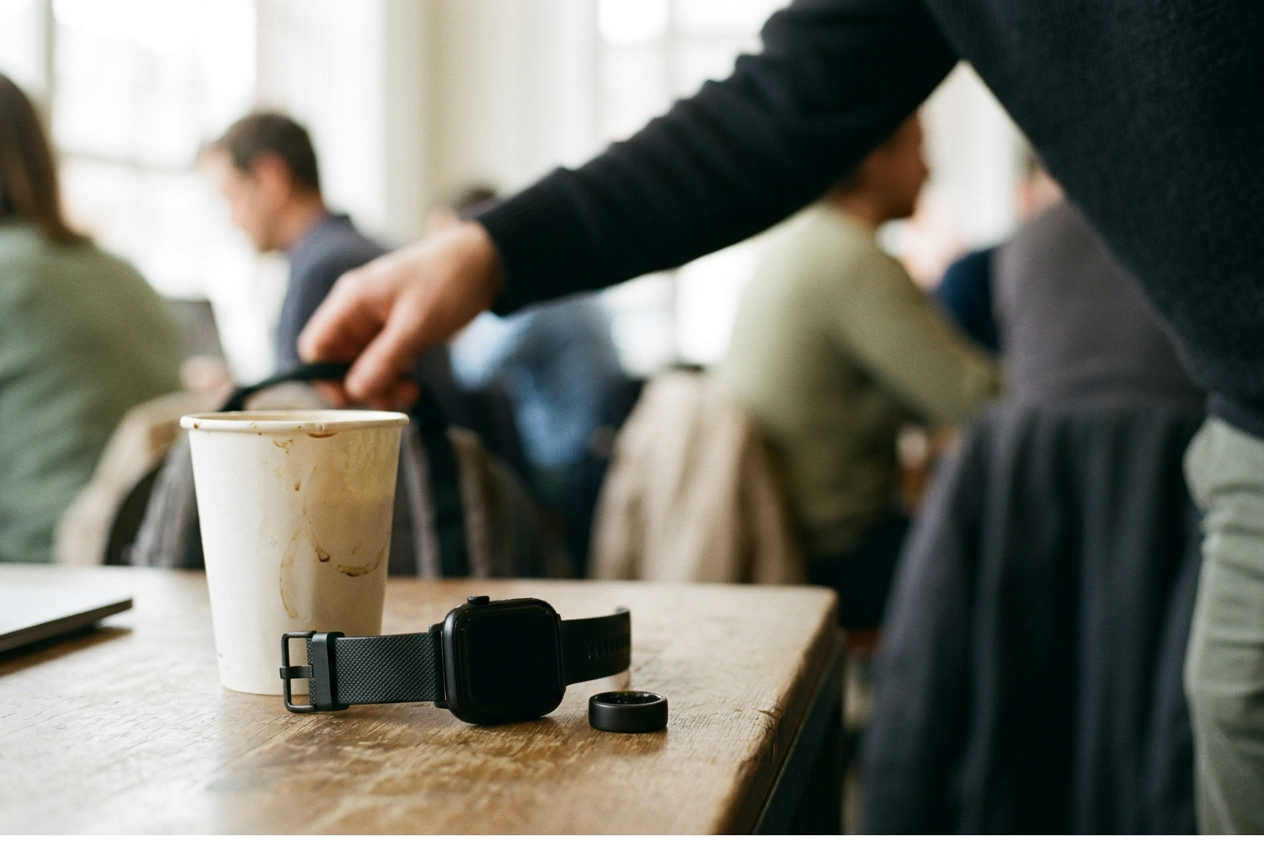
It came from tightening a black silicone watch strap one hole past comfortable, which gave the optical sensor steadier contact with my skin and made its readings less vulnerable to movement. Across ordinary days, I wore Garmin, Fitbit and Samsung watches in rotation, alongside an Oura ring on my right index finger, through crowded commuting, desk work, coffee, exercise and deliberate attempts to rest.
The strap mark mattered because the devices were not reading stress itself. They were reading a body through skin, light, movement and software assumptions, then presenting the result in the emotionally loaded language of stress, recovery and resilience. Better contact could improve the signal. It could not tell the algorithm why my heart behaved as it did.
That gap was the whole test.
The score begins with the space between heartbeats
Most wearable stress systems lean heavily on heart-rate variability, or HRV, the changing interval between one heartbeat and the next. A heart beating 60 times per minute does not usually fire at perfectly uniform one-second intervals; the variation contains information about how the autonomic nervous system, which handles functions outside conscious control, is regulating the body.
Higher HRV at rest is often associated with recovery and greater parasympathetic activity, the branch involved in rest and digestion. Lower HRV can accompany exertion, illness, poor sleep, alcohol, dehydration, caffeine or psychological strain. It can also reflect age, medication, individual physiology and measurement conditions. A low reading is therefore a clue with a large suspect list.
Wrist devices estimate pulse timing by shining light into the skin and detecting blood-volume changes. This technique, called photoplethysmography, works best when the sensor sits still and snug. Rings use a similar method at the finger, where the signal can be cleaner for some wearers. Movement, loose fit, cold hands, sweat, tattoos and skin contact can all interfere.
Manufacturers then combine those signals with some selection of heart rate, motion, sleep, temperature and personal baselines. The exact recipe differs by company and can change with software updates. Garmin and Samsung offer relatively immediate stress displays. Oura frames daytime stress against an individual baseline and broader physiological context.
Fitbit’s Stress Management Score is more explicitly composite, drawing together bodily responsiveness, exertion and sleep rather than claiming to show one live emotional state.
None has access to the argument in your group chat.
The commute produced the easiest agreement
The devices agreed most readily during a crowded commute. My pulse rose while I stood mostly still, and HRV appeared to fall relative to quieter periods. A watch could treat that combination as stress because there was limited movement to explain the cardiovascular change.
That matched lived experience well enough. The carriage was hot, personal space had collapsed and I was watching the connection time shrink. Garmin’s continuous presentation was the bluntest, turning the period into a visible run of elevated stress. Samsung also registered physiological activation.
Oura later placed the episode within a broader daytime pattern, while Fitbit’s daily score absorbed it into a less immediate assessment.
The agreement felt persuasive because the label and the feeling lined up. Yet even here, the score did not identify mental stress. Heat, standing, rushing for the train and the coffee I had already started were all plausible contributors. The algorithm had detected activation.
I supplied the story.
That distinction becomes easy to lose once an app colors a timeline, names a state and places it beside sleep stages and resting heart rate. The visual grammar says measurement. The underlying inference remains conditional.
The black strap was still pulled tight. Signal quality was not the obvious problem.
Exercise confused the language, not always the software
Exercise raises heart rate and changes HRV for reasons a device can often classify through movement and workout detection. When I recorded exercise formally, the systems generally treated it as activity rather than an inexplicable outbreak of distress. Context saved them from their own terminology.
The messier period came afterward. I had stopped moving, but my heart rate had not returned to baseline. Body temperature remained elevated, sweat disrupted wrist contact and the nervous system was still handling exertion. Depending on the device and timing, that recovery window could appear as stress, incomplete recovery or an unremarkable extension of the workout.
Calling it stress is physiologically defensible in the broadest sense. Exercise is a stressor. It is also a terrible use of ordinary language when the person opening the app wants to know whether a hostile email ruined their afternoon. The same label is being asked to cover emotional distress, useful training load, digestion, illness and a second espresso.
That is not precision. It is category compression.
Oura’s baseline-led approach was more useful here because it encouraged comparison with my own usual pattern rather than treating one isolated reading as a verdict. Fitbit’s broader daily score also avoided some minute-by-minute melodrama, though aggregation creates a different frustration: once several inputs become one number, it can be hard to know what moved it.
Garmin’s immediacy was better for spotting a transition. Samsung’s live measurement was easy to check. Both also made checking tempting, which is not the same as making the result useful.
Coffee exposed the central mistake
The paper cup beside my keyboard became the test’s clearest anchor. I drank coffee while doing work that felt routine, with no confrontation, deadline panic or conscious anxiety. The devices could still register the resulting cardiovascular activation as stress or reduced calm, particularly while I sat still.
They were not malfunctioning. Caffeine can change heart rate and autonomic activity, and the sensors were reporting patterns that resembled the patterns used to infer strain. The failure sat in the leap from pattern to meaning.
This is why a wearable can mark a pleasant dinner as stressful, miss a quietly miserable hour or congratulate someone for resting while they are frozen with dread. Emotional experience does not map neatly onto heart rate. Some people become activated under pressure. Others go still.
A device trained to recognize physiological deviation can notice the body changing without knowing whether the wearer is excited, frightened, sick, aroused, concentrating or digesting lunch.
The coffee also showed why personalization only partly solves the problem. A baseline helps software learn what is normal for one body, and repeated context can make deviations more legible, but no amount of wrist data turns pulse intervals into direct access to thought. Better prediction does not erase the boundary between physiology and interpretation.
Deliberate rest made the score feel bossy
I then tried the activity these products quietly train users to perform: resting for the metric.
I sat still, slowed my breathing and left the phone alone. Sometimes the devices recognized a calmer pattern. At other points, the displayed state lagged behind how I felt, or a recent coffee, meal or workout seemed to remain in the data. Watching for the score to fall made the exercise less restful.
The body had become a customer-service ticket.
Breathing can influence heart rhythm, which means a guided session may produce a measurable change even if it does not address whatever made the day difficult. That can still be useful. A prompt to pause, unclench or leave the desk has value without becoming a diagnosis.
Trouble starts when the prompt acquires authority. A calm score can invalidate distress that lacks a convenient cardiac signature. A high score can make an ordinary bodily response feel ominous. For people prone to health anxiety or compulsive checking, a continuous stream of ambiguous physiological judgments may create another condition to monitor rather than useful self-knowledge.
The red strap mark returned here as a small absurdity. I had tightened a wellness device until it hurt slightly so the machine could tell me whether I was relaxed.
Which approach was useful
Garmin’s continuous stress timeline worked best as a rough detector of transitions. It made commutes, post-exercise recovery and quiet periods easy to compare. Its weakness was semantic confidence: a granular chart can make a broad inference look settled.
Samsung offered accessible spot checks and continuous monitoring, depending on settings and device support. It was useful for seeing whether stillness changed the immediate pattern, but a live gauge invites repeated inspection, especially when the number refuses to match the mood.
Fitbit’s composite approach was less likely to turn one caffeinated hour into a miniature crisis. The tradeoff was opacity. A daily score that blends responsiveness, activity and sleep may be directionally useful while remaining difficult to audit from the outside.
Oura gave the strongest emphasis to personal baseline and recovery context. Its ring form also avoided the increasingly uncomfortable watch stack. Yet its polished language and app presentation could still lend medical weight to an inference, and the slower, contextual view did not solve the basic problem of cause.
The worthwhile feature across all four was pattern recognition over time. A repeated change that follows poor sleep, drinking, illness, overtraining or a punishing commute can prompt a useful review of routine. The least worthwhile feature was the isolated stress number, especially when checked without context.
Certainty is part of the product
Wearable companies do not need to prove that a stress label captures your inner life for the feature to work commercially. They need the score to feel personal enough that you return tomorrow.
Daily timelines, readiness judgments and recovery trends create recurring reasons to open the app, keep the device charged and remain inside a company’s account system. Some brands place deeper interpretation, longer history or coaching around subscription products. Even when the stress feature itself is included with the hardware, it supports retention by turning an intermittent concern into a daily measurement habit.
Medical-looking design helps. Numerical scores, colored zones and longitudinal graphs borrow the authority of clinical monitoring without offering the same controlled measurement conditions or diagnostic purpose. The companies generally include caveats. The interface does the louder work.
The practical answer is to read the output one level down from its label. “Stress” means the device noticed a heart-rate pattern, often adjusted by movement and your baseline, that its model associates with physiological load. It does not mean the device knows what happened, how you felt or what should happen next.
By the end of the test, the coffee cup told me more than the red zone did. I knew what I had consumed, what I was doing and whether the moment felt difficult. The wearable contributed one additional fact: my body’s pattern had shifted. That was useful.
The rest was branding.
Questions people ask
Can a wearable tell if I am emotionally stressed?
Not directly. It can detect physiological patterns associated with strain, especially changes in heart rate and HRV, but similar patterns can come from exercise, caffeine, heat, illness, digestion or excitement. Emotional meaning still requires context from the wearer.
Why does my watch say I am stressed when I feel calm?
Your body may be activated without conscious distress, or the sensor may have a poor signal because of movement, fit, temperature or skin contact. Recent exercise, coffee, a meal and inadequate sleep can also shift the inputs that the software labels as stress.
Are wearable stress scores medically reliable?
They should not be treated as diagnoses. Consumer wearables can reveal repeated personal patterns, but their stress labels depend on proprietary models, imperfect sensors and indirect signals. Persistent symptoms or distress cannot be confirmed or dismissed by a watch score.
Which wearable stress feature is most useful?
The most useful approach compares trends with your own baseline and shows enough context to connect changes with sleep, activity or routine. Continuous live scores offer immediacy, but they also encourage checking. In this test, patterns across several days mattered more than any isolated number.
One update a day
Today's story, in your inbox
One story each morning — no hype, no filler, no algorithm deciding for you.