A Background Actor’s Body Scan Can Outlive the Day Rate
The day rate buys labor. The scan consent can create a reusable asset, with a longer life and a murkier payment trail than the shift that produced it.
August 17, 2026 · 8 min read
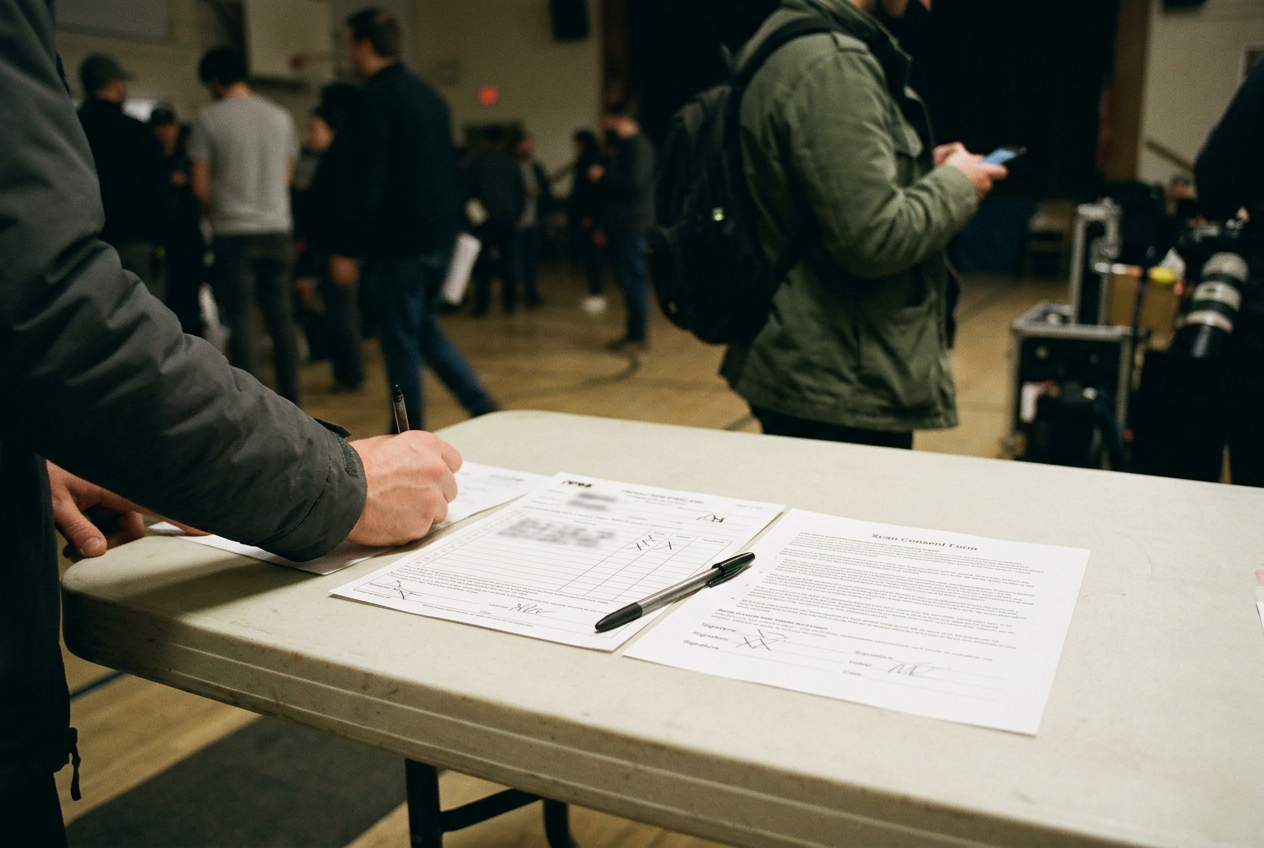
The useful object here is not a robot extra. It is a separately initialed box on a form.
In public reporting published during the 2023 Hollywood strikes, background actor Alexandrea Rubalcaba described being sent to a scanning trailer while working on Marvel’s WandaVision. A camera rig captured her body so a digital model could be made. She received her ordinary background pay for the workday, according to that reporting, but left without a clear account of how the resulting model might be used.
That scan did not merely record attendance. It produced an asset.
The distinction matters because a day rate answers one narrow question: what does the production owe for the performer’s time today? The scan paperwork answers several larger ones, including what the producer may create from that time, how long it may keep the result, and whether someone can call the model back to set without calling the person.
The industry spent much of 2023 arguing in public about a crude version of this deal: one day’s pay, one full-body scan, endless reuse. Studios disputed the union’s characterization of their proposal. The eventual SAG-AFTRA agreement imposed more specific consent and compensation rules for covered productions. The underlying incentive survived.
A reusable crowd body costs more to create than a photograph, but it can become cheaper than booking a person again.
One shift produces two things
A background actor usually encounters a stack of documents rather than one grand contract. The voucher or timecard records the booking, hours, adjustments and pay. A personal release may authorize photography and publicity. A digital-replica consent covers the creation or use of a computer-generated version of the performer.
A privacy notice may address biometric information, meaning measurements derived from physical characteristics such as face or body geometry.
Those papers do different jobs, even when a production hands them over together on a crowded day.
The voucher buys labor. The replica consent licenses an output. The privacy notice governs data handling, at least to the extent that applicable law gives it teeth. A collective bargaining agreement sits above the stack when the employer is a union signatory, setting minimum terms that an individual form cannot quietly erase.
This is why the separately initialed box matters. Signing a timecard should not automatically mean consenting to every possible digital use, yet a production benefits when the whole transaction feels like routine intake: tax form, wardrobe form, release, scan approval, lunch. The performer is already on location, often after an early call and before learning whether refusal will complicate the booking. Formally separate does not always mean meaningfully negotiable.
A scan also creates several layers. There is raw capture data from the cameras or sensors. There may be a three-dimensional mesh, which is the digital surface defining the body’s shape, plus texture files, movement data and a finished model prepared for visual-effects software. Copies can sit with the producer, a visual-effects house, a scanning vendor or a storage provider.
Deleting one file from one system does not establish that the asset is gone.
Rubalcaba’s visit to the scanning trailer therefore contained two transactions. Her physical presence helped make the episode. Her measured body could help make something later.
Consent has a specification problem
A useful consent identifies the intended use with enough detail that the performer can understand the bargain. “Digital purposes” does not do that. Neither does language covering all media, throughout the universe, forever, particularly when the model can be altered, combined with other data or transferred through the companies financing and distributing a production.
SAG-AFTRA’s 2023 television and theatrical agreement treats an employment-based digital replica as one created with a performer’s physical participation while working for a producer. The agreement requires informed consent for covered creation and use, with the intended use described in reasonably specific terms. Its published summaries also state that background performers must be paid for the time spent creating a replica and compensated when a covered production uses it under the agreement’s rules.
That is better than burying a body license in the release. It is not universal.
The protections depend on who signed the union agreement, what production the work belongs to, whether the person is working under union coverage and how a later use is classified. Nonunion productions may present broader releases. Student projects, low-budget shoots, promotional work, game production and scanning performed outside a covered employment relationship can carry different terms. A model created for one project may also become the subject of a later request, which means the paper trail matters more than the producer’s reassuring description on scan day.
The key word is “use.” Creating a replica, storing it, testing it and placing it in a finished scene are not identical acts. A consent may permit creation but reserve approval for later deployment. Another may authorize use only in the production named on the page.
A broader form may claim sequels, advertising, derivative works or any media now known or later devised, language whose main achievement is making future exploitation sound like office filing.
The 2023 agreement does not make all digital doubles suspect. Productions have long used them for dangerous shots, impossible camera moves and crowd expansion. The issue is substitution. If the model performs work that would otherwise require a new booking, the economic value comes from avoiding another person’s paid day, another fitting and another trip through payroll.
That avoided booking is the asset’s yield.
Retention is where the license becomes infrastructure
Consent to appear in a particular scene does not answer how long the underlying scan remains on a server. Retention does.
A narrow arrangement would keep the necessary files for a stated production period, restrict access to named vendors, prohibit unrelated model training and require deletion when the authorized purpose ends, subject to legitimate archival or legal obligations. Broad paperwork often leaves those points vague or grants the producer discretion. The replica then remains available for a future production manager, corporate successor or vendor whose security standards the performer never assessed.
Union rules and privacy laws can constrain that discretion, but they operate through different mechanisms. The SAG-AFTRA agreement addresses consent, compensation and protections around digital replicas on covered work. State biometric privacy statutes may require notice, written consent, security measures or a retention schedule. Illinois’s Biometric Information Privacy Act is the best-known example, though its application depends on the data collected, the location, the parties and statutory exclusions.
California treats biometric information as sensitive personal information under its consumer privacy framework, while employment and production records can trigger exceptions that make deletion less straightforward than checking a box.
California also enacted a law effective in 2025 that can make certain contract provisions involving digital replicas unenforceable when they lack a reasonably specific description of intended uses and the performer lacked union or legal representation during the negotiation. That rule targets vague licensing. It does not create a universal day rate, guarantee that every stored scan will be erased or convert a nonunion set into a union one.
There is no single federal statute that neatly settles a living performer’s scan consent, payment terms, publicity rights, biometric retention and AI reuse. Copyright may cover parts of the resulting model or production, but copyright ownership does not answer every question about using a person’s likeness. State right-of-publicity laws, which govern commercial exploitation of identity, vary. Contracts fill the gaps, usually on paper drafted by the party purchasing the rights.
The scanning trailer looks technical. The durable machinery is contractual.
The price is hidden in the work that never happens
Studios and producers can value a scan even if it never appears on screen. Keeping it creates an option: the ability to use a known body later if the rights allow, without guaranteeing another paid engagement now. A library containing many bodies offers more flexibility because crowd scenes need variation, and variation can be assembled from stored assets rather than a fresh holding area full of people.
The performer’s compensation rarely captures that option value at creation. The day rate measures hours spent waiting, moving and repeating action. It does not naturally price the number of future shots the replica might enter, the productions that might request it or the years during which the file remains usable. Those terms must come from the union agreement or the individual license.
If the paperwork is silent, the silence tends to benefit whoever holds the file.
The better comparison is not between a scanned extra and an animated character. It is between two production schedules. In one, a coordinator books a person, payroll pays them, wardrobe fits them and the set accommodates them. In the other, a visual-effects team retrieves an approved asset and places it into a shot.
The second schedule transfers money away from performers and on-set departments toward asset management and postproduction, while the production retains control over timing.
This is why “you were paid for the scan” is an incomplete defense. Payment confirms that labor occurred. It does not establish that the reuse price was fair, that the scope was narrow or that retention ends.
Return to Rubalcaba’s trailer. The camera rig was visible. The consequential object was the permission attached to what it captured, especially the line stating which production could use the replica and the separately initialed box showing whether that permission extended beyond the current job.
Questions people ask
Can a production scan a background actor without separate consent?
On a SAG-AFTRA-covered television or theatrical production, the 2023 agreement requires informed consent for creating and using an employment-based digital replica, with specific rules for background performers. Outside covered work, the answer depends on the contract and applicable state law; a general appearance release may be drafted broadly, but broad language is not automatically enforceable everywhere.
Does a day rate pay for every later use of the scan?
No general rule makes an ordinary day rate payment for unlimited reuse. Union agreements can require additional compensation for covered uses, while nonunion compensation depends heavily on the signed license. The practical distinction is between payment for time spent being scanned and payment for the replica replacing work on a later day.
Can a performer make the producer delete the body scan?
Sometimes, but not by default. Deletion rights depend on the contract, the collective bargaining agreement, the privacy law that applies and any archival or legal exception. A complete request may also need to reach the producer and outside vendors because raw capture data, working files and finished models can live in separate systems.
What language reveals that the consent is broader than one production?
Terms covering future productions, sequels, advertising, derivative works, sublicensing, all media, perpetual use or model training expand the transaction beyond the booked day. The concrete test is whether the form names the project, permitted use, compensation trigger, storage period and deletion procedure, rather than leaving those decisions to the company holding the scan.
One update a day
Today's story, in your inbox
One story each morning — no hype, no filler, no algorithm deciding for you.