Your Video Selfie Is Becoming an Age Gate
Platforms can estimate age without identifying you. That narrower claim sounds reassuring until a model’s guess decides access and your face enters someone else’s system.
August 17, 2026 · 7 min read
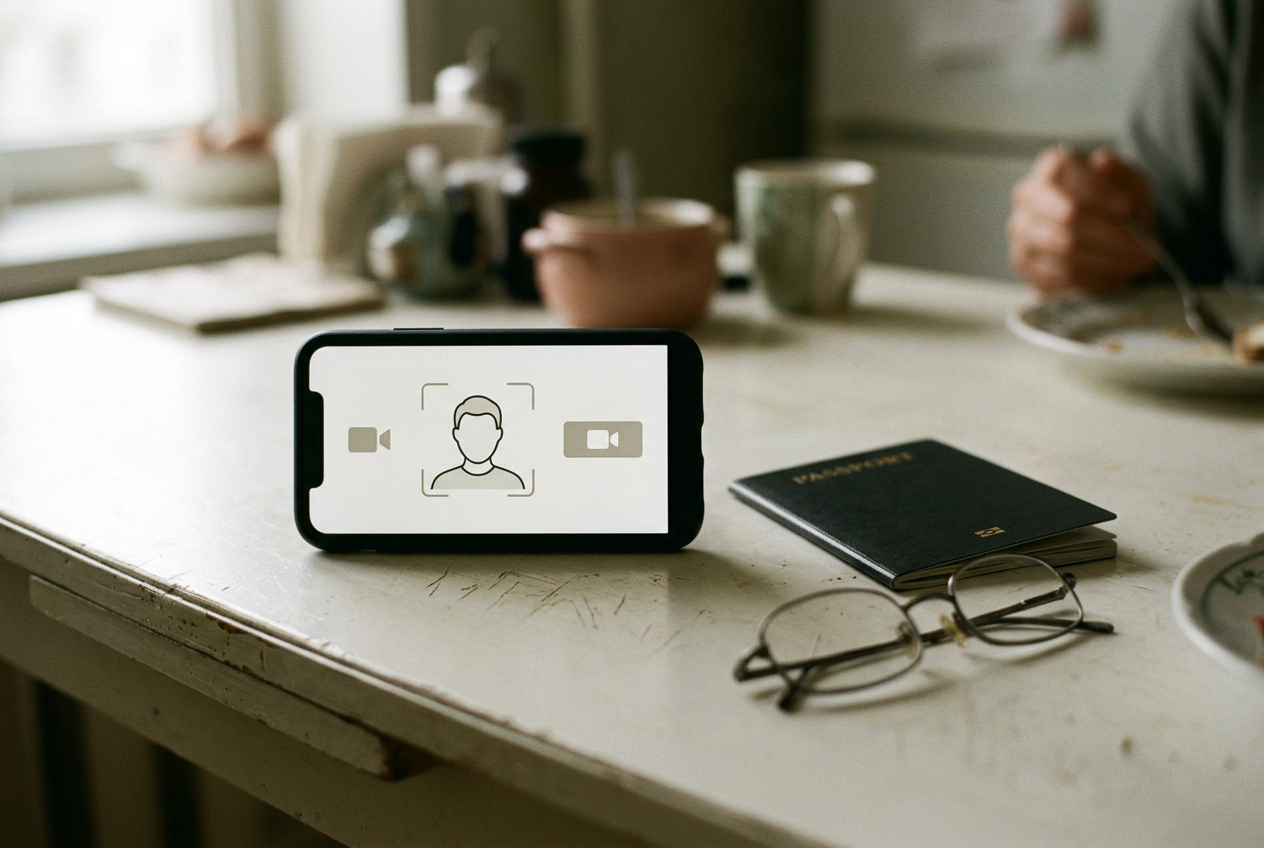
The object at the center of this policy is a phone held at eye level for a short video selfie. No passport beside it. No name entered underneath. The pitch is that a platform can look at your face, estimate whether you clear an age threshold and forget the image.
Meta offered this architecture on Instagram through Yoti, an age-assurance vendor, when some users tried to change a listed birth date from under 18 to over 18. One option was a video selfie. Meta’s public explanation said the video went to Yoti, which estimated age without identifying the person, and that both companies deleted the image after the check.
That flow is a useful anchor because it strips away the comforting confusion between age estimation and identity verification. Yoti does not need to learn your name for the system to govern you. It needs a face, a model and a rule for converting the model’s output into permission.
The rule is where the power sits.
A prediction becomes a verdict
Facial age estimation uses a machine-learning model to infer an age or age range from an image. The model has been trained on faces associated with known ages, then tested against other labeled images to measure how far its estimates drift from the recorded ages.
A platform does not receive biological truth. It receives a prediction, perhaps a single estimated age, perhaps a probability distribution or confidence score. The platform then applies a threshold. If access requires adulthood, an estimate above the configured line passes; an estimate below it fails or triggers another check.
Vendors often report mean absolute error, a measure of the average distance between estimated and recorded age. That number can help compare systems, but it does not tell a user the fact that matters at the gate: how often people near this platform’s threshold will be wrongly refused under these lighting conditions, with this camera, after this particular error buffer has been added.
The buffer matters. A service worried about admitting children may set a challenge age above the legal threshold, meaning someone must look several years older than 18 to pass automatically. This reduces one kind of error by increasing another. More minors may be stopped, while more adults are sent to an identity-document check, a payment-card check or manual review.
The estimate did not make that tradeoff. An institution did.
Public policy documents sometimes treat this buffer as prudent risk management. From the other side of the phone, it means a lawful adult can be denied because a company has decided that false refusals are cheaper than false admissions. The user pays in time, access and additional disclosure. The platform gets a compliance record showing that its gate was conservative.
Return to the video selfie. It looks like the least invasive route because it avoids a passport. If the model places a 19-year-old below the service’s buffered line, however, the supposed privacy option becomes a funnel toward more intrusive proof. The face scan has not replaced identity verification.
It has decided who must undergo it.
Deletion does not erase the processing chain
Vendor documentation emphasizes an important distinction: estimating age does not inherently require recognizing identity. Facial recognition asks whether this face matches a known person or another stored face. Facial age estimation asks what age-related features a model infers from the submitted image.
That difference is real. It is also routinely made to carry more reassurance than it can support.
The image still has to be captured, transmitted or processed on the device, checked for quality, analyzed and linked to a response sent back to the platform. Systems may also use liveness checks, which try to determine whether the input comes from a present person rather than a photograph or replay. Each stage introduces another technical actor, log or failure point, even if the original image is deleted quickly.
Deletion limits retention risk. It does not mean no processing occurred, and it does not make the resulting access decision disappear. A platform may retain the fact that a user passed, failed or completed an age check, because forgetting every result would force another scan at the next restricted page. Public descriptions do not always make the lifespan of that status, or the metadata attached to it, as vivid as the promise to delete the selfie.
The legal word “biometric” also needs care. A face image is personal data in many privacy regimes, but special rules for biometric data can depend on whether technical processing is used to identify someone uniquely. A company can therefore argue, sometimes plausibly, that its age estimate is not facial recognition while still operating a consequential face-analysis system. State laws and national regimes define these categories differently.
The marketing sentence is not the legal test.
That phone at eye level remains a collection point. The user cannot inspect the model, confirm the deletion or see whether the vendor recorded a quality score, estimated age, confidence value and transaction identifier before returning the result. Trust has merely moved from the platform to the platform’s contractor.
The error is shaped before the camera opens
Image quality affects estimation. Lighting, camera angle, resolution, facial obstruction and compression can all change what the model receives. So can the training data: if the examples used to build or evaluate a model do not represent the people facing the gate, average performance can hide uneven errors.
The US National Institute of Standards and Technology evaluates age-estimation algorithms through its Face Analysis Technology Evaluation program. Its work makes the central point difficult to avoid: performance varies among algorithms, across ages and demographic groups, and with image conditions. A broad accuracy claim cannot answer how a particular model treats a particular person near a threshold.
Age itself is unusually awkward ground truth. A birth date is precise in a database, while visible aging is affected by genetics, health, stress, cosmetic choices and the conditions under which an image is captured. The model learns statistical patterns associated with recorded age. Policy then asks it to draw a clean legal boundary across a human face.
Young adults carry much of the error burden because they stand nearest the line. People whose appearance falls outside the model’s strongest training patterns may face repeated capture attempts or escalation. Someone wearing a face covering for health, disability, religion or safety may encounter another layer of friction. A system designed around an unobstructed, well-lit face quietly defines its preferred user before any policy document calls the method inclusive.
Appeals matter here, but vendors do not control the whole remedy. A technically competent estimator can sit inside a hostile product flow with no meaningful explanation, no accessible fallback and no route to challenge a failed result. The platform chooses whether a refusal lasts seconds or days. It chooses whether the alternative is free, whether a human sees the document and whether a person without conventional ID can enter at all.
What the law requires, and what it does not
Age assurance is the umbrella term for methods that determine or estimate whether someone meets an age requirement. Governments are creating a market for it by requiring online services, especially pornography providers and platforms used by children, to apply stronger age checks.
In the United Kingdom, the Online Safety Act is binding law. Ofcom, the regulator, has said facial age estimation can form part of highly effective age assurance when deployed to an appropriate standard. Its guidance and codes explain how Ofcom expects regulated services to meet their duties; they are not a blanket certification of every vendor or configuration.
That distinction gets lost in procurement language. A law may require an effective check without ordering a platform to use a face. A regulator may recognize facial estimation as a possible method without guaranteeing that one model, threshold or fallback complies. In the United States, state age-verification laws differ, litigation has shaped which provisions operate, and a method acceptable under one statute may not satisfy another.
Policy proposals should therefore be read at the decision layer. They need to specify acceptable error near the legal threshold, independent testing, deletion rules, accessible alternatives and a remedy for wrongful denial. Requiring “age assurance” while leaving those choices to vendors does not avoid regulation. It delegates regulation to contracts the public cannot inspect.
The money follows that delegation. Platforms pay specialist vendors for checks, integrations and compliance infrastructure, while regulators create demand by raising the cost of getting age controls wrong. Contract values are rarely visible to the person supplying the face. The person pays differently: another upload, another document, another abandoned page.
Privacy-preserving alternatives exist, though none is free of institutional trust. A trusted party can verify age once and issue a reusable token that reveals only whether the threshold is met. Some checks can run on a device rather than sending the image to a remote server. Services can also limit restricted features instead of demanding proof at the entrance to an entire site.
These choices cost engineering time and can weaken the vendor’s role as a central checkpoint, which helps explain why the easiest compliance flow keeps returning to the camera.
The short video selfie is sold as a narrow transaction. Its real function is broader. It converts uncertainty into an administrative result, then makes the user absorb whatever the institution chose to do with the margin of error.
Questions people ask
Does facial age estimation identify who I am?
It does not need to match your face to a named identity in order to estimate age. The image still undergoes face analysis, and the platform may keep a record that an account or session passed or failed even when the selfie itself is deleted.
Can an adult be blocked by an age-estimation system?
Yes. A model can underestimate age, and platforms may add a buffer above the legal threshold to reduce the chance that minors pass. Adults near that line can be refused or pushed toward a passport, payment card or another form of proof.
Is facial age estimation legally required?
Usually, the binding rule is a duty to use effective age assurance, not an order to use a particular facial-estimation product. Regulators may list it as an acceptable method, but legality depends on the jurisdiction, implementation, error controls and available fallback.
Who gets paid for the check?
The platform or regulated service typically pays an age-assurance vendor for its software and processing. The user usually pays no direct fee, but bears the time, privacy exposure and access cost when the estimate fails or demands more intrusive evidence.
One update a day
Today's story, in your inbox
One story each morning — no hype, no filler, no algorithm deciding for you.