The Council Video Stays. The Livestream Comments Don’t
New Jersey towns archive meeting video while leaving livestream comments inside Facebook, YouTube, or Zoom. The result is a public record with the public edited out.
September 5, 2026 · 8 min read
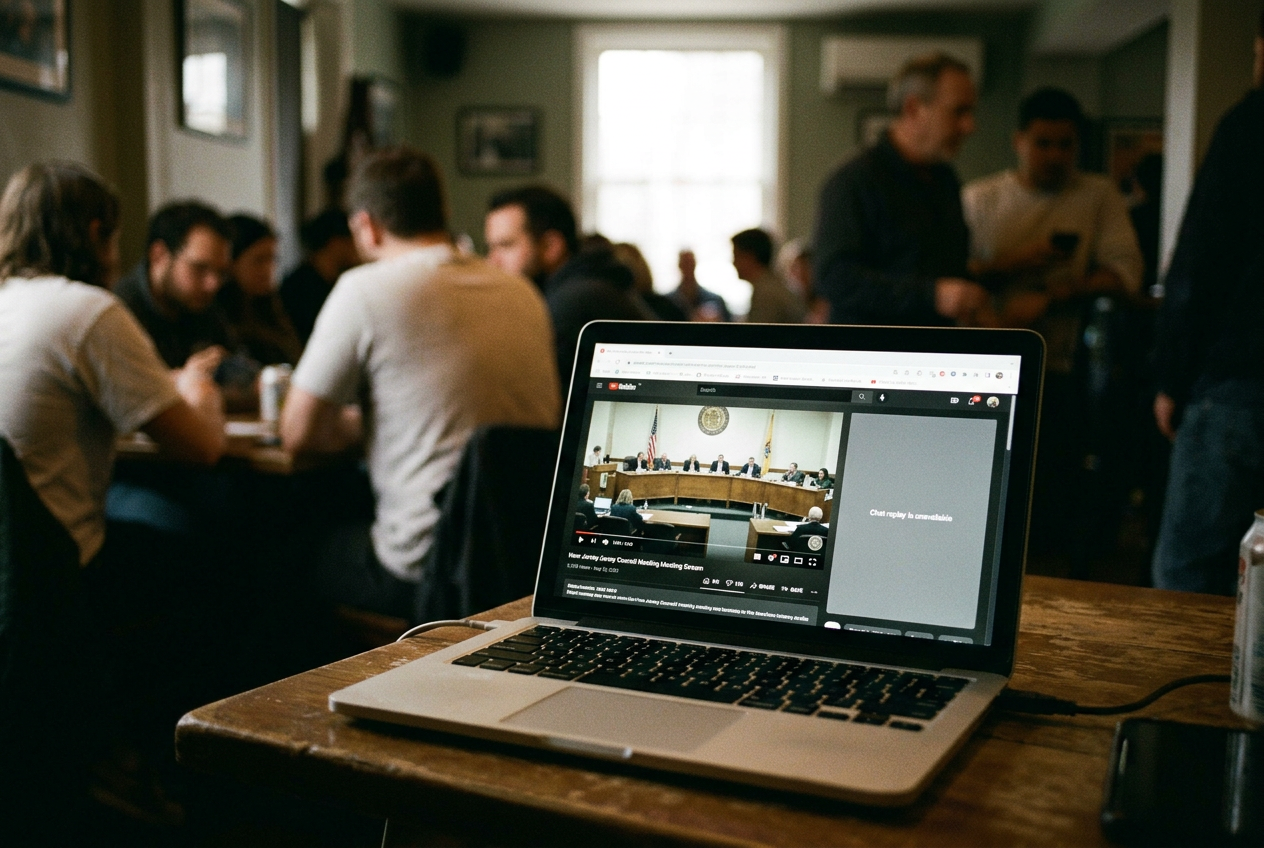
Beside some archived New Jersey council meetings on YouTube sits a small gray notice: “Chat replay is unavailable.” It does not say whether chat was disabled from the start, switched off after adjournment, lost during an upload, or removed under a moderation policy. The meeting survives. The audience around it does not.
That gray panel is the useful object here. New Jersey municipalities increasingly distribute public meetings through several systems at once: an agenda portal, a municipal website, local-access television, Zoom, Facebook Live, YouTube, or a vendor that records and indexes government video. Each system preserves a different slice of the event. Minutes keep decisions.
Video keeps voices and gestures. A platform may keep reactions, chat messages, edits, deleted comments, timestamps, and moderation actions, but only while the municipality or its contractor captures them.
This is why a council meeting can remain online for years while the running public response disappears as soon as the livestream ends. The loss is rarely announced as deletion. It happens through architecture, procurement, and clerical habit. Nobody has to press a large red button marked ERASE THE PUBLIC.
The archive has layers
New Jersey does not give every municipality one standard technical system for broadcasting and archiving meetings. Public-facing practices in places including Newark, Jersey City, Montclair, and Hoboken show the range: municipal channels carry video, clerk or legislative portals hold agendas and minutes, and outside platforms handle live distribution. Smaller municipalities may depend on a single Facebook page, a Zoom recording, or a local-access provider with limited staff.
Those arrangements look interchangeable from a couch. They are not.
A video file contains the camera and audio feed encoded into it. YouTube live chat is a separate data object linked to the broadcast, while ordinary YouTube comments sit below the finished video under another set of controls. Facebook comments remain attached to a post in Facebook’s database. Zoom meeting chat can be saved as a separate text file if the host’s settings permit it and someone retains the export.
When a clerk downloads only the MP4, embeds a player on the municipal site, or sends the recording to an archive vendor, the public’s text may not travel with it.
The municipality has preserved what happened at the microphone. It may have discarded what happened beside it.
New Jersey’s Open Public Meetings Act requires public bodies to keep reasonably comprehensible minutes showing the subjects considered, actions taken, votes, and other information required by the statute. Minutes are an institutional account, not a transcript. They routinely compress public-comment periods into names, topics, or summaries, depending on local practice. A resident’s detailed livestream message may leave no mark there, especially when the town has declared that platform chat does not count as formal public comment.
That distinction protects administrators from having to treat every emoji, duplicate message, or abusive post as testimony. It also lets a government invite engagement on a branded platform without accepting responsibility for preserving the engagement it receives.
The gray “Chat replay is unavailable” panel marks the seam. On one side sits the meeting the municipality recognizes. On the other sits the public activity the platform hosted.
A platform feature can still be a government record
Calling comments “social media” does not settle their status. New Jersey’s Open Public Records Act defines government records broadly enough to include electronically stored information made, maintained, kept on file, or received in the course of official business. Whether a particular livestream comment must be retained or disclosed can depend on how the account is operated, whether officials use the comment in their work, what records schedule applies, and who controls access to the underlying data.
The location alone is not decisive. A message does not become private correspondence merely because Meta stored it, just as an official email does not stop being a record because Microsoft hosts the server. Control matters. Purpose matters.
Retention rules matter.
Municipal social-media policies often emphasize a different concern: moderation. They reserve authority to remove threats, obscenity, spam, commercial promotion, off-topic material, or personal information. Those rules respond to a real operational problem. A government page can attract harassment and coordinated flooding, and staff cannot leave every post untouched merely to demonstrate procedural purity.
Yet moderation and preservation are separate acts. A municipality can hide a comment from public view while retaining a copy and a record of the action. It can also remove an entire chat replay after the meeting, eliminating compliant messages alongside material that violated policy. The second method is administratively clean.
It makes later scrutiny difficult.
Federal courts have spent years examining when officials’ social-media activity counts as state action and when blocking or deleting users raises First Amendment concerns. The Supreme Court’s 2024 decision in Lindke v. Freed focused that analysis on whether an official had authority to speak for the government and purported to exercise it. That doctrine does not automatically turn every municipal Facebook thread into an unrestricted forum.
It does underline the basic problem: government use of a commercial interface does not make government conduct disappear.
A blank replay offers no moderation trail. Residents cannot see whether everyone’s comments vanished, whether certain users were removed during the broadcast, or whether a platform filter held messages back before publication. The final video looks complete because the missing layer has no placeholder beyond that gray notice, if it receives even that.
The cheap recording creates the expensive record
Video storage is no longer the main obstacle. Municipalities can stream hours of proceedings at modest cost using accounts they already maintain, and vendors will package agendas, timestamps, and recordings into a searchable portal. Preserving the surrounding interaction requires more work.
Someone must export the chat in a usable format, record which platform and account produced it, retain timestamps, document deleted or hidden material, apply the correct retention schedule, and review responsive material when a records request arrives. Personal information may require redaction. Platform exports change. Application programming interfaces, the tools that let one system retrieve data from another, can restrict access or omit moderation history.
A contractor’s archive may accept video while offering no field for chat.
The money follows the recognized record. Councils budget for clerk systems, video vendors, local-access equipment, and meeting platforms because agendas, votes, minutes, and broadcasts are established administrative objects. The comment rail is treated as audience engagement, a category associated with communications staff and platform analytics rather than the clerk’s archive.
That division works for vendors. YouTube and Facebook receive attention during the live event without carrying the municipality’s long-term records obligations. Archive providers ingest the stable file they were paid to host. Municipal staff avoid another stream of material requiring retention and review.
Residents absorb the loss.
This does not mean every passing remark deserves permanent display. It means retention should result from a stated records practice, not from the default behavior of software procured for reach. When the software decides, disappearance can look like neutrality.
Participation without a receipt
Municipalities frequently tell residents that livestream chat is not an official channel for public comment. That warning is defensible when speakers must register, identify an agenda item, call into a meeting, appear in person, or submit written remarks through the clerk. The problem starts when the government promotes the livestream as access, staff respond through the same interface, and viewers reasonably understand themselves to be participating in a civic event.
The distinction between access and participation is usually buried in meeting instructions or a social-media policy. Platforms blur it by design. The text box says “Comment,” not “Write something that may be visible tonight but excluded from every municipal account of this meeting.” Reactions rise beside the video.
Officials may refer to the online audience. After adjournment, the municipality keeps the polished evidence of openness and loses the unruly evidence of response.
A better archive does not require publishing every message forever. Municipalities could retain a platform export with the meeting package, preserve moderation logs, state the applicable retention period, and tell viewers in plain language whether chat constitutes public comment. An archive page could identify which layers were captured instead of presenting video as the whole event. Written submissions accepted through an official form could receive a timestamped acknowledgment and enter the same records workflow as correspondence delivered by email.
These choices cost staff time. They also make responsibility visible, which is precisely why the cheaper arrangement persists. Platform ephemera offers government the appearance of participation without the administrative burden of treating participation as evidence.
Return to the gray panel. “Chat replay is unavailable” looks like a minor playback setting. In practice, it can be the only surviving notation that a second public record may once have existed beside the first.
Questions people ask
Are livestream comments part of the official meeting minutes?
Usually not. New Jersey meeting minutes must record the subjects considered, actions, votes, and other required information, but they are not verbatim transcripts. A municipality may also state that Facebook, YouTube, or Zoom chat does not constitute formal public comment, even when those messages relate directly to the meeting.
Can a
New Jersey town delete comments from its page?
Municipalities may moderate material under published rules, including threats, spam, obscenity, or off-topic posts, but constitutional and public-record questions can arise when an official account removes speech. Deleting a comment from public view is also different from retaining a copy and a moderation log for the required period.
Why does the video survive when the chat disappears?
The recording and the chat are usually separate files or platform objects. A clerk or archive vendor may receive only the video feed, while YouTube, Facebook, or Zoom controls the attached messages. If nobody exports and retains that data, the municipal archive keeps the meeting but not its online audience.
What would a complete municipal livestream archive contain?
It would pair the agenda, minutes, video, chat export, and moderation history under a stated retention policy, while protecting information that lawfully requires redaction. It would also tell viewers whether online messages count as public comment, so the text box does not imply a form of participation the municipality refuses to record.
One update a day
Today's story, in your inbox
One story each morning — no hype, no filler, no algorithm deciding for you.