New Jersey Towns Can Delete a Post Without Losing the Record
Municipal posts may vanish from Instagram or Facebook while surviving in a vendor’s private archive. The gap between those two interfaces now shapes what New Jersey residents can inspect.
August 28, 2026 · 8 min read
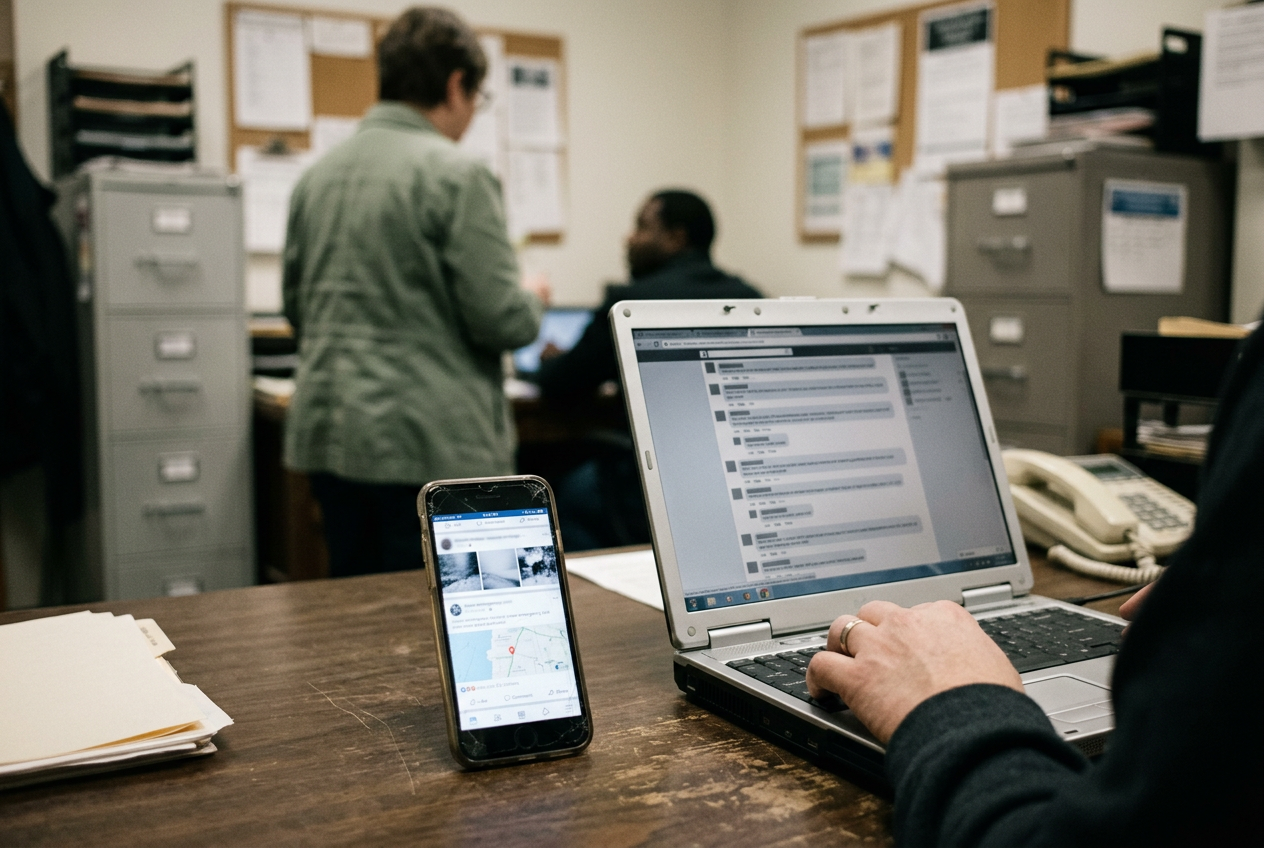
Start with an ordinary object: a municipal Facebook post announcing a snow emergency, followed by a comment thread about which streets were plowed. The town removes several comments. Later, the post itself disappears from the page.
For the resident looking at Facebook, the record is gone. For the municipality, it may still exist inside an archiving service that copied the post, its edits, the comments and enough metadata to show when each action occurred. Or it may not. The answer depends on a chain of policy choices hidden behind the public account: whether anyone classified social content as a government record, whether the town bought archiving software, whether that software could reach the relevant part of the platform and whether staff connected the right account before the deletion happened.
That chain matters because official communication moved into interfaces designed around novelty and disappearance, while New Jersey’s public-record obligations remained attached to the communication itself. A Story can expire. A records schedule does not expire with it.
The public page is not the archive
New Jersey’s Open Public Records Act, usually called OPRA, governs public access to government records. Separate records-management rules determine how long agencies must retain records and how they may dispose of them. Those systems overlap, but they do different work: OPRA concerns access, while retention law concerns custody over time.
The controlling question is generally what the content does, not whether it was printed, emailed or decorated with an Instagram sticker. A mayoral announcement, road closure notice or response issued through an official account can document public business. A resident’s comment may become part of the record received and maintained by the agency. The applicable retention period can vary with the content, which is why treating every social post as disposable publicity is inadequate and treating every reaction GIF as permanent is not a serious records policy either.
Municipal social media policies across New Jersey tend to acknowledge some version of this obligation. They warn that posts and comments may constitute public records, reserve authority to moderate material and tell staff that official accounts remain subject to state law. The language often does more work as a disclaimer than an operating manual. It rarely tells a resident which system captures deleted comments, how often capture occurs, whether Instagram Stories are included or what happens when a platform changes access to its data.
Return to the snow-emergency thread. A moderation policy might permit removal of an address, a threat or spam. That answers whether the comment should stay visible. It does not answer whether the town preserved the original, the deletion time and the rule invoked by the moderator.
Display and retention are different acts. Municipal policy often compresses them into one.
Archiving happens before the deletion
Social media archiving vendors sell a straightforward promise: connect an official account, collect its activity continuously and store a searchable copy outside the platform. ArchiveSocial, owned by CivicPlus, is built specifically around that government and public-sector use. Pagefreezer and Smarsh sell related capture and compliance tools, with broader products that also cover websites or workplace communications.
The software commonly relies on an application programming interface, or API, which is the controlled connection through which a platform lets another system request data. Once authorized, the archive polls or receives account activity, records available metadata and preserves versions when it detects an edit or deletion. Staff can later search the collection and export responsive material for a records request.
This works best when the archive captures the object before anyone removes it. A screenshot made afterward cannot recover a missing comment, and a platform’s account-download tool may omit contextual data or produce a file that is difficult to search. Manual screenshots also cost staff time, separate a post from its metadata and depend on someone remembering to take them during the exact period when a Story remains live.
The vendor therefore becomes a second municipal interface. Residents see the polished account. Records officers see a private dashboard that may contain the discarded versions, hidden replies and deleted snow-emergency comments. The software is useful precisely because the public platform is unstable, but that usefulness creates another dependency: a town’s ability to answer a records request can rest on a contractor’s capture methods, export formats and continued access to platform systems.
Vendors get paid by the agency, sometimes directly and sometimes through a larger communications or records-management contract. The platform that created the retention problem does not pay. Residents fund a second layer of infrastructure so that official speech made on privately governed networks can still meet public obligations.
The holes sit between policy and product
No archiving contract makes capture automatic in the ordinary sense of the word. Someone must identify every official account, authorize access and keep credentials working. Departments may create side accounts for police units, recreation programs or elected officials. A newly opened profile can sit outside the archive until staff add it.
Personal accounts used for public business create a harder problem because their status depends on how officials use them, not on the biography line alone.
Platform design adds further gaps. APIs expose only what the company chooses to expose, under permissions it can revise. Stories, direct messages, edited captions and nested comment threads may require different access or may not be available in the same form. If Facebook or Instagram changes an endpoint, the point of access used by software, a vendor must adapt; during that interval, a municipality may continue posting without knowing that part of the record is no longer arriving intact.
Procurement documents do not always settle the question. A town may publish a social media policy without naming its archive vendor, while a payment record may name a software company without identifying which accounts or content types the subscription covers. Residents trying to understand the system must piece together policy manuals, contracts and OPRA responses. The archive preserves transparency material, then becomes difficult to inspect as infrastructure.
This is where the snow-emergency post stops being a minor communications artifact. If criticism disappeared from the public page but survives in an export, a requester can reconstruct what happened. If the archive missed the account, the agency may report that it holds no responsive record. OPRA can compel production of records an agency maintains; it cannot restore data that nobody captured.
Questions about improper destruction remain, but the missing comment does not reappear because a request was correctly phrased.
Moderation leaves a second paper trail
Deleting a comment raises a speech issue as well as a retention issue. Government-run comment spaces can trigger First Amendment constraints, although the legal analysis depends on how the account operates, who controls it and what moderation rules the government established. The US Supreme Court’s 2024 social media decisions emphasized that an official’s title alone does not resolve whether account activity counts as state action.
An archive cannot make selective moderation lawful. It can show the sequence.
That distinction is important. A town may have a legitimate reason to remove personal information or material that violates a viewpoint-neutral rule. It should still preserve the comment and, where its systems allow, the administrative event around removal. Otherwise the public sees only the cleaned thread, while the government retains no reliable account of who cleaned it or under which policy.
The better model is mundane. Municipalities should publish which official accounts they archive, identify the categories of content captured and state how residents can request deleted material. Contracts should require usable exports, coverage reports and a way to retrieve records when the subscription ends. Staff should audit account lists and sample captures, especially after a platform changes its API.
None of this makes social media a good place to keep the civic record. It recognizes that municipalities already use it that way.
A Story announcing a hearing may vanish after 24 hours, exactly as the platform intended. The government’s copy should remain for the period required by the record’s function, and a resident should not need to know the name of a compliance vendor to ask for it.
Questions people ask
Are deleted municipal social media posts public records?
They can be. Record status generally turns on the post’s connection to official business and the applicable New Jersey retention rule, not whether the platform still displays it. A removed announcement, reply or comment may remain accessible through OPRA if the municipality preserved it and no exemption applies.
Do
New Jersey towns have to save every comment forever?
No. Retention periods depend on the kind and purpose of the record, and access can be limited by lawful exemptions. The practical obligation is to classify social content under an approved schedule and preserve it for that period, rather than letting Facebook or Instagram’s interface decide when the government’s copy disappears.
Can a vendor recover a Story after it vanishes?
Only if the system captured the Story while it was available through the account and platform access provided to the vendor. Archiving products can retain an expired Story, but they cannot promise recovery of content that was never connected, never exposed through the platform’s tools or missed during an access failure.
How can residents find out what their town archives?
Check the municipality’s social media policy, records-retention materials and contracts or payment records for archiving software. An OPRA request can seek archived posts, deleted comments, account inventories and vendor agreements, although the response will only be as complete as the records the town maintained.
One update a day
Today's story, in your inbox
One story each morning — no hype, no filler, no algorithm deciding for you.