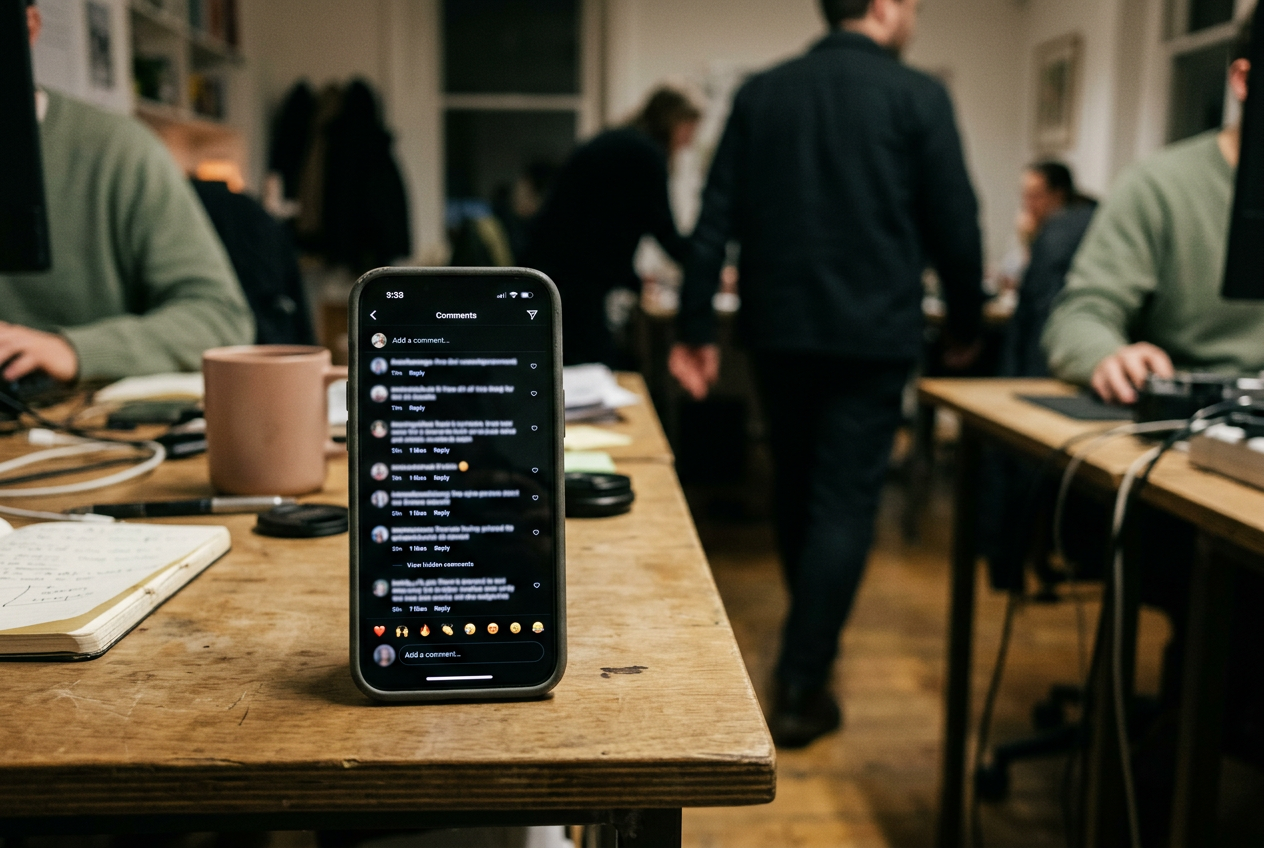
Keyword Filters Can Make Criticism Look Public When It Isn't
Creator filters do more than remove abuse. They can quietly hold criticism while leaving the person who wrote it staring at a normal-looking comment.
August 27, 2026 · 8 min read

Use one comment as the test object: Your captions make disability access harder. It is specific, civil and critical. It also contains a word, captions, that a creator can add to a custom filter without blocking comments generally or making any public moderation decision.
That sentence exposes the real function of creator-side filtering. Instagram, TikTok, YouTube and Facebook give account owners tools that can intercept comments containing chosen words, while X offers a looser mixture of personal mutes and manually hidden replies. The interfaces describe these controls as protection from unwanted language. In practice, the same machinery can remove recurring criticism from public view.
The removal may be invisible to the person being moderated. Their account can keep showing the comment as if it landed normally, even while another account sees nothing. No deletion banner. No rejection notice.
No useful clue that captions has become forbidden speech in one tiny private jurisdiction.
This is shadow moderation at the account level: a restriction that limits distribution without clearly informing the affected user. It works because platforms treat the author’s view of a comment and everyone else’s view as separate products. The screen showing you your own words is not proof of publication. It is only proof that the interface accepted them.
The three-account check
A reliable evaluation needs three controlled accounts. Account A owns the post and turns on the filter. Account B submits the comment. Account C acts as an ordinary observer with no connection to either account.
A logged-out browser helps, but it cannot replace C because some platforms restrict comments differently by age, location, login status or relationship to the poster.
Post the same neutral piece of content from A, such as a short gray-screen video with captions enabled. From B, submit Your captions make disability access harder. Then submit a control comment that avoids the filtered word while keeping the criticism intact: Your text makes disability access harder. Account C checks the post, B reloads it, and A inspects both the public thread and any review queue.
That wording matters. If the first comment disappears and the control remains, the filter caused the difference. If both vanish, another moderation layer may be involved. Platforms also run automated classifiers, systems that estimate whether text is spam, abuse or otherwise risky, and those systems can hold a comment before the creator’s own keyword rule gets a chance to act.
Notifications require their own pass. A comment can enter a creator’s review area without generating a push alert, while the commenter receives no warning that publication failed. Record what each account sees rather than trusting the comment count, which may update slowly or include replies unavailable to the account looking at it.
The useful unit is not posted versus deleted. It is the visibility relationship among A, B and C.
Instagram hides the conflict, then files it away
Instagram’s Hidden Words controls let an account owner supply custom terms alongside Meta’s automated filtering. A matching comment can be removed from the ordinary thread and placed in a hidden area that the creator may inspect later. The commenter is not given a clear notice that the filter caught it, and their own account may continue to display a normal-looking copy.
For Your captions make disability access harder, that creates two incompatible records. The writer sees participation. The audience sees no criticism. The creator sees the comment only if they enter the hidden-comments interface, which means a filter sold as housekeeping can become an inbox nobody opens.
Instagram also allows manual hiding after publication. That has a different social perimeter: Meta says a hidden comment can remain visible to the person who wrote it and, in some contexts, their friends. The distinction matters because hidden does not always mean invisible to every member of the public. It means the platform has narrowed the audience without offering the author a dependable account of who remains inside it.
The design favors calm surfaces. A creator avoids a visible argument, Instagram avoids telling a user that moderation occurred, and the commenter has little reason to appeal because there is no decision to point at. Everyone keeps scrolling. The thread looks healthier because the symptom has been moved offstage.
TikTok turns criticism into pending inventory
TikTok’s creator controls include keyword filtering and settings that route comments into review. A matching comment can wait for approval rather than appearing to ordinary viewers. The posting account may still retain a normal-looking version, while the creator sees the text in a filtered-comments queue instead of the live discussion.
Captions is an especially useful example because it is neither an insult nor an obvious spam term. A creator facing repeated accessibility complaints could filter the noun and make each new complaint look successfully posted to the person raising it. People who independently identify the same problem then appear isolated from one another.
That isolation changes more than tone. Public criticism accumulates evidence. Ten visible comments about missing captions show that a complaint is shared; ten comments distributed across ten private author views look like ten people speaking alone. TikTok does not need to determine whether the criticism is fair.
The creator supplies the word, and the platform supplies asymmetric visibility.
TikTok’s review queue gives the owner a route to approve mistakes, but a queue is not notice. Unless the creator checks it, the comment sits in administrative limbo. The author has no meaningful status indicator explaining that another person must approve the sentence before anyone else can read it.
YouTube holds the sentence without holding the upload
YouTube lets channel owners add blocked words, which can send matching comments to the held-for-review area. The video remains public, monetizable and open for more engagement. Only the troublesome line gets detained.
A commenter may see their submission under the video while another account cannot. The channel owner can approve, remove or ignore it from YouTube Studio, but YouTube does not frame the event to the commenter as a failed publication. The visible copy under their own login can therefore mislead them in the same way as the TikTok and Instagram versions.
YouTube’s machinery has extra layers. Its automated systems may hold comments considered potentially inappropriate, and channel owners can hide an entire user rather than filtering one word. A hidden user is not reliably notified, while their future comments can disappear from the channel’s public conversations. That makes diagnosis difficult: Your captions make disability access harder might have triggered captions, a machine judgment or an account-wide restriction.
The clean check is the control sentence. If Your text makes disability access harder appears from Account C while the captions version does not, the keyword rule is the likely cause. If neither appears, test from a fresh account and inspect the channel’s held-comments area before drawing a conclusion.
Facebook leaves a small audience attached
On Facebook Pages, hidden comments have a peculiar afterlife. A hidden comment can remain visible to its author and that person’s friends while disappearing for other viewers. Page managers can still see and manage it.
That is not the same arrangement as a private review queue. The comment has an audience, but the platform chooses that audience in a way likely to reassure the author. People closest to them may still see Your captions make disability access harder, making the thread look public enough during a casual check, while the Page’s broader audience gets a cleaner version.
For criticism, this is useful to the Page because social confirmation becomes containment. Friends may like or reply to the hidden comment without restoring it to general view. The discussion continues inside a reduced pocket, and the institution being criticized avoids the visible pile-on that would make the complaint legible as a pattern.
X does something different
X’s muted-word settings do not give a poster the same automatic power over public replies. Muting captions can reduce where matching posts appear for the person who set the mute, including notifications or timeline surfaces, but it does not by itself erase another user’s reply from everyone else’s view.
A post author can manually hide a reply. Hidden replies remain reachable through a separate control rather than vanishing into a private creator queue, so Account C may still find the criticism after an extra tap. The friction matters, particularly when most people never open collapsed material, but the mechanism is closer to demotion than secret nonpublication.
This distinction prevents a common testing error. A reply absent from the poster’s notifications is not necessarily absent from the thread. On X, search from Account C and open the hidden-replies area before concluding that a keyword mute censored it.
The filter is doing reputation management
Keyword tools have legitimate uses. A person targeted with slurs should not have to read each one before removing it, and creators dealing with repetitive spam need controls that do not demand a full-time moderator. None of that requires deceiving the person whose comment was limited.
The deception is a product choice. Platforms could label a filtered comment as pending review, limited by the account owner or visible only to its author. They mostly avoid that clarity because silent filtering reduces confrontation and support work. A user who knows their criticism was blocked may repost it, appeal or contact the creator elsewhere.
A user shown a convincing private copy may leave.
Creators receive a cleaner comment section. Platforms retain the comment action as engagement and avoid adjudicating the underlying dispute. Critics pay in wasted attention, repeating themselves inside a conversation that has already excluded them.
Return to captions. The filter does not rebut the accessibility complaint, classify it as false or tell the writer that the creator refuses to discuss it. It changes who can witness the complaint while preserving the appearance that speech occurred. That is why the third account matters more than the comment box.
Questions people ask
Can someone tell if their comment was filtered?
Usually not from their own account. Instagram, TikTok and YouTube may continue showing an author-facing copy while withholding the comment from ordinary viewers or placing it in a creator review queue. Check from an unrelated account, preferably on another device, and do not treat the visible comment count as proof.
Does hiding a comment delete it?
Not necessarily. A filtered comment may remain available to the creator for review, while a Facebook hidden comment can still be visible to its author and some friends. X hidden replies remain accessible behind an extra control. Hidden describes reduced distribution, not one consistent deletion state.
Do creators get notified when a keyword catches a comment?
The comment may appear in a moderation or review area, but creators should not assume every match produces a direct alert. The practical burden stays with the account owner, who must inspect the queue. The commenter generally receives even less information and may see no indication that approval is pending.
How can
I test whether a specific word caused the filter?
Post two civil comments that make the same point, changing only the suspected keyword, then inspect both from an unrelated account. If Your captions make disability access harder disappears while Your text makes disability access harder remains, the custom word is the likely trigger, though automated moderation can still complicate the result.
One update a day
Today's story, in your inbox
One story each morning — no hype, no filler, no algorithm deciding for you.