Your App Store Country Can Make News Apps Disappear
Apple does not need to erase a news app everywhere. It can remove the listing for one national storefront, turning government pressure into an account setting that travels with you.
August 29, 2026 · 8 min read
In October 2019, the Quartz news app disappeared from Apple’s App Store in mainland China while the publication was covering protests in Hong Kong. Quartz reported that Apple acted after a complaint from the Chinese government, which considered material in the app illegal.
The app itself had not vanished. Its code did not become unlawful worldwide, and readers attached to other national versions of the App Store could still reach its listing. Apple had changed one distribution record: Quartz was no longer available in the China storefront, the national catalog assigned to an Apple Account.
That missing listing is the concrete object to keep in view. It shows how a state can narrow access to journalism without blocking every server or taking possession of anyone’s phone. The government pressures the company controlling distribution. The company edits the catalog.
The user searches and finds no download button.
This is censorship as inventory management.
The border is inside the account
Apple lets developers choose where their apps are offered through App Store Connect, the dashboard used to submit software and manage its distribution. A publisher can release an app worldwide, restrict it to selected territories or withdraw it from one market. Apple can also delist an app, meaning it removes the listing from a territory while potentially leaving it available elsewhere.
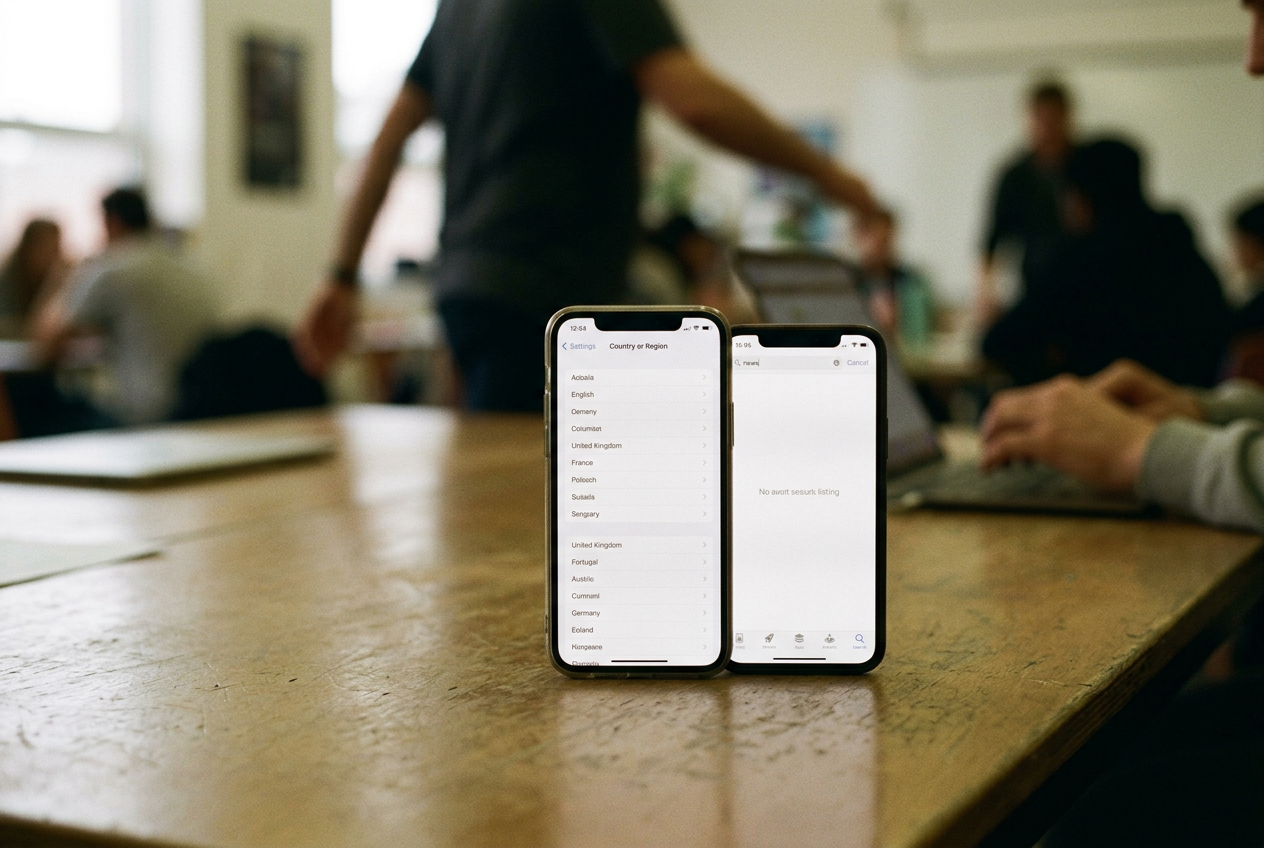
For users, the decisive field is generally the country or region attached to the Apple Account used for Media Services. That setting determines which App Store catalog appears, which payment methods Apple accepts and which media can be purchased. It is not the same as the phone’s language, its hardware model or the country where the device was manufactured.
It may not match the user’s immediate location either. Someone who created an account in mainland China and later travels abroad can remain attached to the Chinese storefront. Someone moving in the other direction may retain another storefront, although apps themselves can impose separate location checks and Apple can require regional eligibility for particular services.
Changing the account region is possible, but Apple’s own support instructions make clear that it is not a casual privacy switch. A user may need to spend any store balance, wait for pending purchases, leave a Family Sharing group and cancel subscriptions that prevent the move. Apple can require a payment method and billing address valid in the new region. Some previously obtained media or apps may not be offered there.
The cost is friction, not necessarily dollars. It is accumulated subscriptions, purchase history and the risk that software already woven into daily life will not cross the border cleanly. The Quartz listing was absent by policy; escaping that policy could mean reorganizing the account around which the phone had been built.
A government request is not the same as a court order
Apple describes regional removals in the language of legal compliance. That phrase can conceal several different instruments: legislation, an administrative demand from a regulator or a binding judicial order. They do not carry identical legal weight.
In the Quartz case, public reporting identified a Chinese government complaint and Apple’s conclusion that the app contained material considered illegal in China. The public explanation did not provide a court judgment testing that conclusion. A regulator’s demand may still create serious legal or commercial exposure for Apple, particularly where the company needs licenses, suppliers and continued market access, but readers should not mistake corporate compliance for an independent ruling that the journalism was unlawful.
Apple made a similar storefront decision involving The New York Times at the end of 2016. The company removed the newspaper’s English-language and Chinese-language apps from the mainland China store after authorities informed it that the apps violated local regulations. Apple did not publicly identify a detailed judicial finding. The apps remained available in other storefronts.
That distinction matters. Chinese law and official directives act on Apple’s operations in China. Apple’s catalog decision then governs users through its private distribution system. The absence of Quartz or The New York Times from a storefront is binding inside the App Store because Apple controls the store, not because the underlying reporting has been adjudicated illegal everywhere.
The government gets a practical result without writing software for every phone. Apple preserves access to a valuable market. The user receives the finished decision as an empty search result, stripped of the pressure, correspondence and risk calculations that produced it.
Russia used the same pressure point
The mechanism is not particular to China. Public reporting from Radio Free Europe/Radio Liberty documented Apple removing its news apps from the Russian App Store following demands from Roskomnadzor, Russia’s communications regulator. Current Time, an RFE/RL-operated network, also reported an Apple removal notice tied to the regulator.
Russia’s legal campaign against RFE/RL included blocking its websites and designating the organization “undesirable,” a status that carries legal consequences inside Russia. The App Store removal added another layer. A blocked website might still be reached through circumvention tools; an absent app cannot be newly installed through Apple’s ordinary channel, and a user who loses access after deleting or replacing a device may have no supported route back.
An installed copy can sometimes continue working after delisting, depending on whether its servers remain reachable and whether the operating system still supports it. That is temporary shelter. Without store access, updates may stop, security fixes may not arrive, and restoring the app can become impossible. A government does not need to seize the existing copy if normal device turnover will eventually clear it away.
Quartz in China and RFE/RL in Russia were different publications facing different legal systems. The repeated move was the same. Officials addressed the intermediary that controlled the default installation channel, then Apple translated national pressure into territory-level availability.
The private phone is the delivery mechanism
Apple markets the iPhone as a personal device protected by strong boundaries. The App Store operates differently. It is a centrally managed commercial service whose rules arrive through the account every time a user searches, downloads or requests an update.
That structure offers real security benefits. Central review can remove malware, revoke compromised software and distribute updates at scale. It also gives Apple unusually clean control over lawful speech distribution, because the same machinery that rejects a fraudulent banking app can quietly make a newspaper unavailable to accounts assigned to one country.
The company does not need to inspect a user’s reading history to enforce the restriction. Storefront eligibility does the sorting in advance. A Chinese account receives the catalog without Quartz. A Russian account receives the catalog without the removed RFE/RL apps.
The decision reaches millions of private devices as a property of the store, while looking on each device like a mundane issue of availability.
This works for governments because Apple has concentrated distribution. On a less controlled system, a publisher can offer an installation file directly, though regulators may still block sites or punish users. Apple historically made the App Store the standard route for consumer app installation, with limited regional alternatives introduced under specific regulatory regimes. The state therefore has one company to pressure rather than every reader to identify.
Apple also has something to lose. Removing an app may provoke criticism, but refusing a government demand can threaten local operations and revenue extending far beyond that publisher. The news organization pays through lost reach. Readers pay with time, account disruption and reduced access.
Apple retains the storefront.
Transparency stops before the individual search result
Apple publishes transparency reports that include government requests to remove apps. The reports can identify requesting countries, broad legal grounds and whether Apple complied, which is more disclosure than silence. Aggregated tables still leave a large gap between a national request and the title a user cannot find.
Independent projects have tried to map that gap. GreatFire’s AppleCensorship project compares app availability across storefronts and has documented large differences involving news, privacy and communication tools. Its work is useful because Apple’s public catalog can be tested from the outside. An unavailable app, however, does not by itself prove government intervention.
Developers also limit territories for licensing, staffing, sanctions exposure or commercial reasons.
The strongest cases combine observed unavailability with reporting from the publisher, an Apple notice or a documented regulator demand. Quartz supplied that chain in 2019: active news app, Chinese government complaint, regional removal. The New York Times and RFE/RL provide comparable examples, while Apple’s support documents explain why the resulting border attaches to the account.
Apple could disclose every government-directed removal by app name, storefront, requesting authority and legal instrument, with a note stating whether it received an order, an informal demand or a warning about possible liability. That would not end censorship. It would stop the company from presenting a political choice as if a product happened to be out of stock.
Questions people ask
Can changing my
App Store country restore a removed news app?
It can make a regionally available app visible, but Apple may require you to clear store credit, cancel incompatible subscriptions, leave Family Sharing and provide a valid payment method for the new country. The app may also block access by location or remain unreachable because its servers are filtered.
Does an
App Store removal delete an app already on my phone?
Usually, delisting affects discovery and future downloads rather than remotely erasing every installed copy. The app can still fail if its service is blocked, and losing updates matters over time. Deleting it, replacing the phone or restoring the device may leave no ordinary way to install it again.
Who decides which country’s App Store I see?
Apple uses the country or region attached to your Apple Account for Media Services, subject to its account and payment rules. Developers select their distribution territories, while Apple can remove a listing after legal demands or its own review. Your current physical location is not always the decisive field.
Is every missing news app evidence of government censorship?
No. A publisher may skip a territory for licensing, sanctions, language support or commercial reasons. A censorship claim is strongest when the missing listing is paired with an Apple notice, a regulator’s demand or reporting from the affected publisher, as happened with Quartz’s removal from the mainland China storefront.
One update a day
Today's story, in your inbox
One story each morning — no hype, no filler, no algorithm deciding for you.