
A Day’s Background Pay Can Now Include a Body Scan
A digital scan can become a reusable production asset while the performer receives only one day’s pay. The decisive terms are buried in what the consent form allows after wrap.
August 17, 2026 · 8 min read
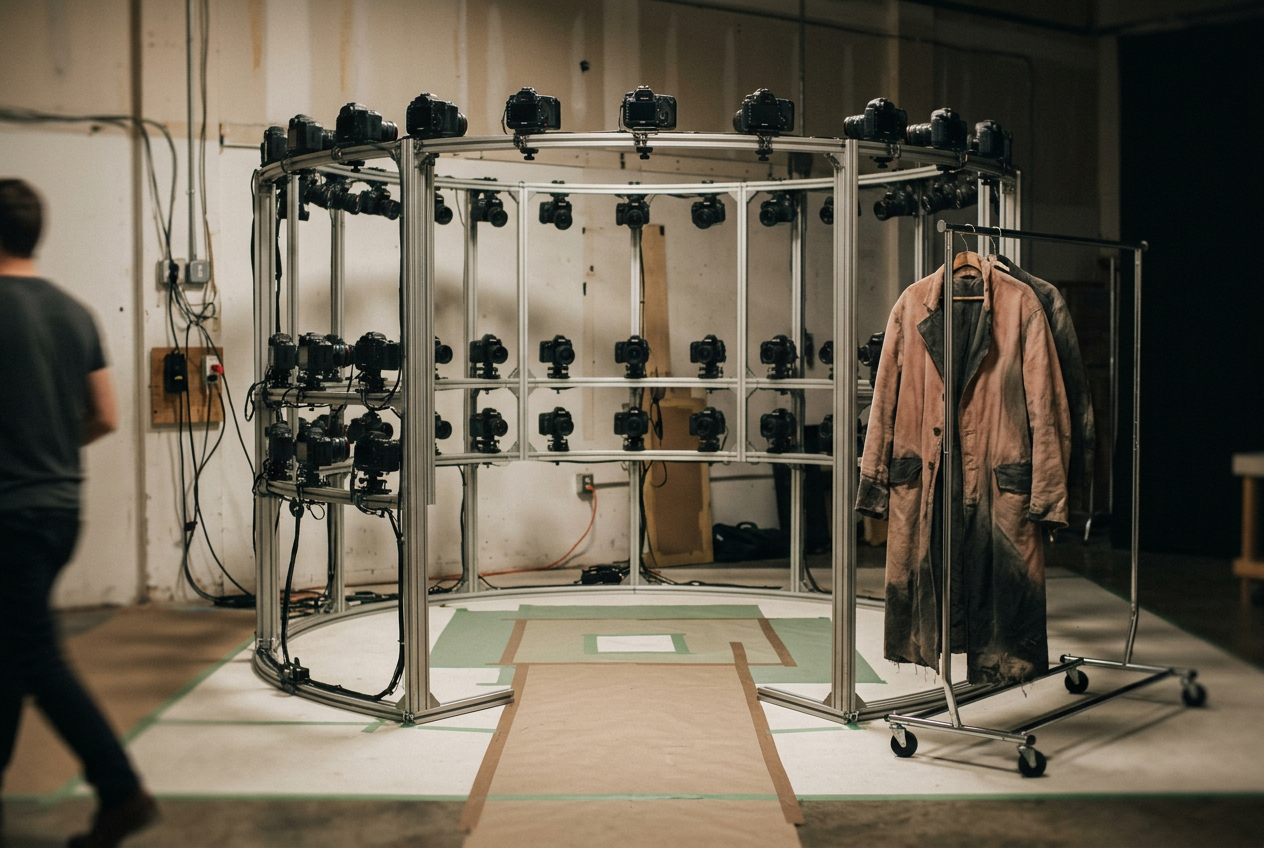
In public reporting during the 2023 Hollywood strikes, background actor Alexandria Rubalcaba described being directed from the set of Marvel’s WandaVision into a scanning trailer. A camera array captured her face and body while she wore the hair, makeup, and costume prepared for that day’s work. She was paid for the day. She said the future purpose of the scan was not explained.
Keep the costume in view. It had been fitted for one production, during one period of employment, but the scan could preserve the entire assembled person as production data: body shape, face, styling, and the wardrobe silhouette that placed her inside the fictional world. Once those elements enter a reusable file, the labor question changes. The performer has finished the shift.
The asset has not.
That distinction became one of the clearest fights of the SAG-AFTRA strike. Public discussion often reduced it to whether studios should be allowed to scan actors. Scanning already existed, and performers sometimes have good reasons to approve it. A replica can handle dangerous shots, crowd expansion, continuity problems, or work that would otherwise require repeated physical capture.
The dispute lives one layer lower, where production accounting prefers it: who may use the file, for what, for how long, and whether each later use triggers consent or money.
Four events disguised as one task
A digital replica is a computer-generated version of an identifiable performer’s face, body, or voice. Creating one can look like another stop in the workday. Report to the trailer. Stand on the floor mark.
Hold several expressions. Turn around. Go back to holding.
Legally and economically, however, at least four things may be happening inside that appointment. The production captures biometric and visual data. It stores the resulting files. It receives permission to use some version of the performer.
It may also claim permission to alter, transfer, or reuse that version later.
Those permissions do not naturally arrive together. A person can agree to be photographed without agreeing that the photographs may train a model. A performer can approve a replica for one episode without approving it for another season, an advertisement, or an unrelated title. Payment for standing in the scanner covers the performer’s time unless a contract says it buys something broader.
Production paperwork benefits from collapsing these events. A consent clause placed inside a start form can make a durable grant of rights feel like payroll administration, particularly for background actors who are hired by the day, processed in groups, and expected to keep the set moving. The scanner takes minutes. Reading, questioning, and negotiating a dense likeness release can cost the worker the job before lunch.
That is the first mechanism. Consent may be formally present while bargaining power is functionally absent.
The useful words are after the verb
A release saying the producer may “use” a scan tells the performer very little. The operative language comes afterward. Use where. Use for how long.
Use in which production. Use through which technologies. Use with alterations. Use by the original producer or by its affiliates, licensees, successors, distributors, advertisers, and future owners.
A narrow agreement could authorize a replica only for crowd scenes in the project being filmed. A broader one could permit use across promotional material or later installments. Language covering technologies now known or later developed tries to keep the permission alive even when production methods change. Perpetual and irrevocable terms remove the practical moment when the worker can reconsider.
The distinction between a scan file and its rendered output matters too. A studio may retain raw capture data without placing a visible replica in the final cut. Years later, another vendor could process that file with better software, producing an output that was technically impossible during the original shoot. If the agreement governs only a particular finished image, the new use may fall outside it.
If it grants broad rights in the underlying data, the production has bought optionality at background-actor prices.
Rubalcaba’s WandaVision costume makes the issue concrete. The costume was part of paid work performed on a specific set, yet its captured shape could help turn her scan into a ready-made person from that world. The useful asset is not a neutral body measurement. It is a worker already styled, positioned, and cleared through a production pipeline.
One body, several payment clocks
Compensation can split just as sharply as consent. The actor may receive a day rate for appearing on set, with no separately identified scan fee. Another agreement might pay for capture but not later use. A stronger contract can require additional compensation when the replica performs work that the actor otherwise would have been hired to do.
Residuals, payments triggered by certain later exhibitions or reuse under a union agreement, do not automatically solve this. Whether they apply depends on how the replica is classified, what production uses it, and what the governing contract says. A scan sitting on a server earns nothing by merely existing, although its availability may still reduce future bargaining power because production knows it can attempt a synthetic solution before calling the performer.
This is why a promise to pay “if used” needs a definition of use. A distant crowd figure may appear for seconds. A body may be composited beneath another face. Parts of several scans may be combined.
Software may change clothing, movement, age, or apparent identity. Without an auditable connection between the retained file and the finished shot, the performer may have no practical way to know that payment became due.
The production has the files, vendor records, edit history, and distribution reports. The background actor has a pay stub and a memory of standing in the camera rig.
The union contract moved the paperwork
The SAG-AFTRA television and theatrical agreement reached in 2023 added detailed rules for digital replicas, including clearer consent requirements and descriptions of intended use. It also established compensation protections for covered uses, with specific provisions affecting background actors. The point was not to ban visual effects. It was to stop a general employment form from functioning as a quiet purchase of unlimited synthetic labor.
Collective bargaining changes the timing of consent. Instead of leaving each day player to negotiate with a production company while already dressed for set, the union sets minimum conditions before the worker enters the trailer. That does not erase disputes over whether a new use fits the original description, and it does not cover every nonunion production, but it makes the grant easier to identify and challenge.
California has also tightened the rules around certain digital-replica clauses. Legislation signed in 2024 limits enforcement of provisions that allow a replica to replace work a performer would otherwise do when the contract lacks a reasonably specific description and the performer lacked qualifying professional representation. The statute targets contracts designed to secure broad permission without meaningful negotiation.
These protections still depend on classification. A production may argue that a replica merely expanded a crowd rather than replaced a person, or that promotional use was already contemplated by the original project language. Technology does not settle that argument. Definitions do.
The asset survives the production company
Media ownership adds another complication. Film and television rights move among corporate parents, distributors, financiers, libraries, and buyers. A likeness license that extends to successors and assigns can travel with the project, even though the performer consented while dealing with a different production entity under different expectations.
Storage creates its own chain. The studio may commission the scan, while a visual-effects vendor captures it and another company hosts the files. A contract should distinguish permission to store data from permission to exploit a replica, but broad releases can blur that boundary, leaving the actor dependent on internal controls they cannot inspect.
Security matters because a high-resolution body and face scan cannot be replaced like a password. Yet privacy protection and labor compensation answer different problems. A production can secure the file perfectly and still reuse it unfairly. It can also pay for an authorized use while retaining the data badly.
Compliance in one column does not clear the others.
The practical alternative is not complicated, though studios may find it administratively impolite. State the project and scene category. Identify permitted alterations. Set a retention period.
Require fresh consent for materially different uses. Attach payment to each defined reuse and give the performer or union enough records to verify it.
Return once more to the WandaVision costume. Its fabric and fit were not documented in the reporting, which is precisely why they should not be embellished now. What matters is verifiable: Rubalcaba entered the scanning rig prepared as a particular background character, then left without a clear account of what that captured character could do after her paid day ended.
Questions people ask
Can a production scan a background actor without paying extra?
Payment depends on the governing union agreement, individual contract, and jurisdiction. A day rate may cover the time spent being scanned without buying unrestricted future use. Under covered SAG-AFTRA work, digital-replica provisions can require specific consent and compensation when the replica is used in defined ways.
Does agreeing to a scan mean agreeing to every future use?
No universal rule makes capture consent identical to unlimited reuse consent. The answer turns on the release language and applicable law. Project-specific permission is narrower than a clause covering perpetual use, affiliates, advertising, later productions, or technologies developed after the original job.
How would a background actor know that a replica was reused?
Often, the actor cannot tell from watching the finished work, especially if the replica appears deep in a crowd or has been altered. Meaningful compensation therefore needs reporting and audit mechanisms that connect production records to the retained scan, rather than placing the entire detection burden on the performer.
Are digital scans always bad for performers?
No. A defined scan can support safe stunt work, crowd effects, continuity, or a specific visual-effects shot. The danger begins when one paid capture becomes an open-ended labor substitute, stored beyond the job and reusable without fresh consent, traceable records, or another payment.
One update a day
Today's story, in your inbox
One story each morning — no hype, no filler, no algorithm deciding for you.