A Negative Fentanyl Test Strip Does Not Mean the Bag Is Safe
Fentanyl and xylazine strips can look interchangeable. Their thresholds, blind spots and instructions are not, and one negative line answers far less than the packaging suggests.
August 11, 2026 · 8 min read
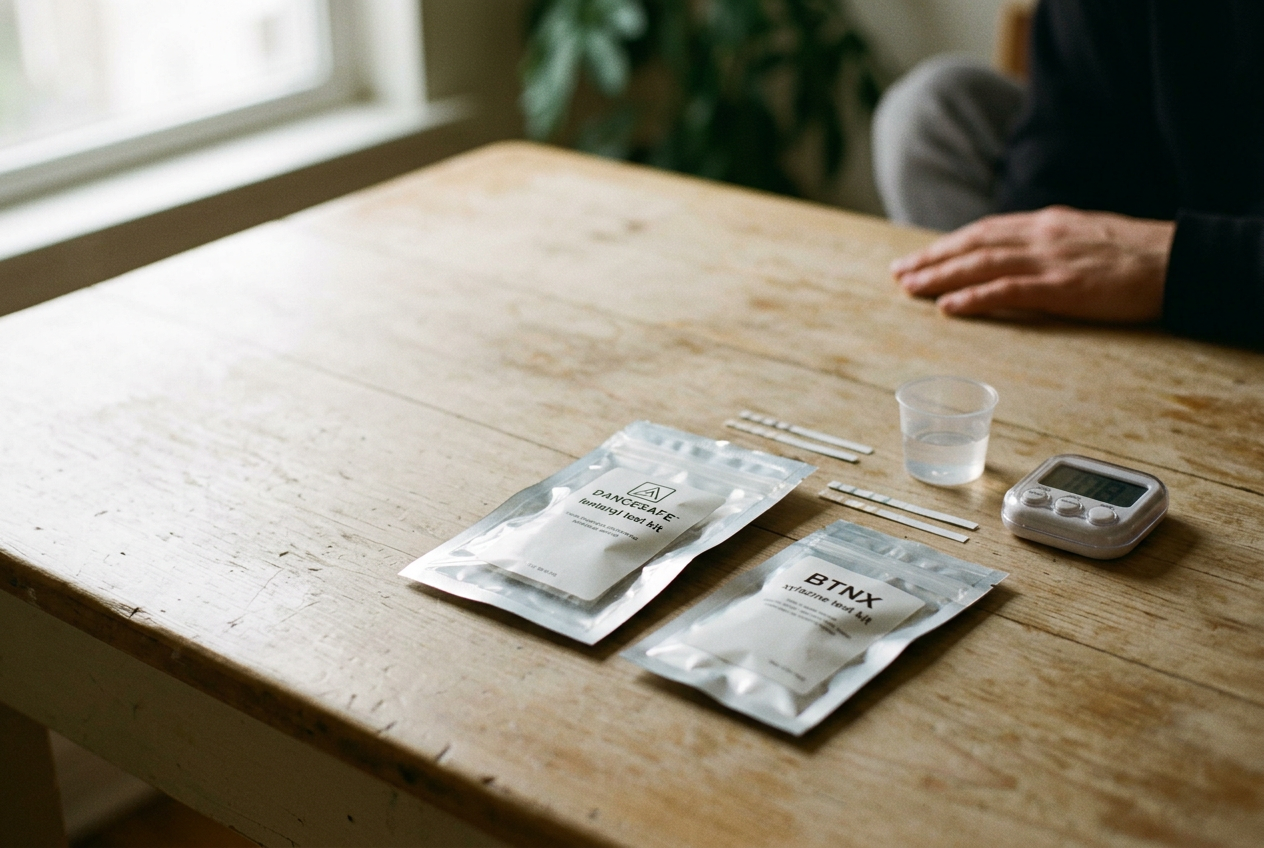
Put two individually sealed test-strip pouches beside each other: a DanceSafe Fentanyl Test Strip V2 and a BTNX Rapid Response Xylazine Test Strip. Both contain a narrow strip meant to be dipped into a liquid sample. Both produce lines. Both arrive through the visual language of certainty, the same basic grammar that pregnancy tests trained everyone to read.
They do not answer the same question.
The fentanyl strip looks for fentanyl and some closely related compounds. The xylazine strip looks for xylazine, a veterinary sedative that may appear alongside opioids but is not itself an opioid. A negative result on one says nothing about the target of the other, and neither strip screens broadly for whatever else might be present. The resemblance between the pouches is a manufacturing convenience.
Treating it as scientific equivalence is where the trouble starts.
This is harm-reduction information, not medical advice. The useful discipline here is modesty: know what the strip can say, then refuse to make it say more.
The line is the end of a chain
Most drug-checking strips sold for fentanyl or xylazine use a lateral-flow immunoassay, a paper-based test in which antibodies react with a target compound as liquid moves along the strip. The result is qualitative. It reports detected or not detected under the test’s stated conditions; it does not tell you how much drug is present, how evenly it is distributed or what taking the sample will do to a particular body.
The control line has a narrow job. It indicates that liquid migrated through the strip and that the test ran well enough to interpret. It does not certify that the sample was mixed properly. It has no opinion about contaminants outside the assay’s target.
Fentanyl strips also use a competitive format, which makes the display feel backward: on commonly sold strips, one visible control line can mean the target was detected, while two lines can mean it was not detected. A faint test line generally still counts as a line under brand instructions, provided it appears within the specified reading window. Results read too early or long after that window can mislead.
That is why the leaflet matters more than familiarity. The DanceSafe pouch and the BTNX pouch may fit in the same pocket, but their dip times, sample preparation rules and reading windows come from separate validation work. An instruction remembered from a different strip is not a universal method.
Detection limits are not safety limits
DanceSafe documents a fentanyl detection threshold in the low nanograms per milliliter for its V2 strip. BTNX documents its fentanyl and xylazine products with their own cutoffs, including a much higher numerical cutoff for the xylazine assay. A detection limit is the lowest concentration at which a manufacturer says its test can reliably register the target under stated conditions.
Those numbers cannot be ranked as if they were phone cameras. Ten nanograms per milliliter for one chemical and a larger number for another do not establish that the first product is broadly better, because antibody behavior, expected concentrations and validation conditions differ by target. The unit describes the prepared liquid in the cup. It does not directly describe the concentration throughout the original powder, pill or residue.
Dilution changes the answer. Too little water can leave interfering compounds concentrated enough to distort a test. Too much can push the target below the strip’s cutoff, even when it was present before dilution. DanceSafe’s current fentanyl guidance gives a defined sample-to-water ratio and a timed dip, while BTNX inserts specify procedures for their own products.
The figures printed for one brand should not be carried over to another because the strip looks familiar.
This is the first return to those two pouches on the table. The product name tells you the target. The insert tells you the conditions under which the result has meaning. Lose either one and the line becomes theater.
The bag is not a uniform object
A strip tests the material that reached the water. That sounds obvious until the sample comes from a pressed pill or a bag where the target is unevenly distributed. A tiny scraping can miss a concentrated pocket. Harm-reduction groups sometimes call this the chocolate-chip problem: sampling one part of a mixture cannot prove what is happening everywhere else.
Testing a larger, well-mixed portion can make the sample more representative, but it still does not turn a targeted strip into a full laboratory analysis. Testing residue from an empty bag is more limited again. It may provide information about that residue, not every portion that previously occupied the bag.
A careful walkthrough begins before dipping anything. Confirm the target and brand, then read the supplied directions rather than a screenshot saved months ago. Prepare the sample with the ratio specified for that exact strip. Use the indicated end, keep the strip submerged only to the marked line, time the dip and read the result during the manufacturer’s window.
If the control line does not appear, the test is invalid, not negative.
The cost is not only the strip. It is the few minutes required to read fine print, measure water and resist improvising from memory. That friction is annoying by design standards and necessary by chemistry standards. Packaging tends to foreground the target name and bury the conditions, although the conditions determine what the answer can support.
Cross-reactivity cuts in both directions
Cross-reactivity means the test’s antibodies respond to a compound other than the intended target. It can produce an apparent positive without the named target, while incomplete recognition of related compounds can produce the opposite problem.
Brand documentation matters here. DanceSafe describes its V2 fentanyl strip as designed to reduce interference associated with concentrated samples of substances such as methamphetamine and MDMA. BTNX package inserts publish tables of compounds tested at specified concentrations, including fentanyl-related substances that may trigger a response at different levels. A strip detecting fentanyl does not therefore detect every fentanyl analog equally, and it does not detect nitazenes merely because they can also be potent synthetic opioids.
The xylazine pouch carries its own cross-reactivity profile. A fentanyl strip cannot stand in for it. A xylazine strip cannot reveal fentanyl, and neither can identify the broad contents of an unknown sample. Even a documented non-reactive compound was tested under particular laboratory conditions; street samples can contain mixtures, dyes or concentrations outside that tidy frame.
Cross-reactivity is often treated as a footnote because it complicates the clean retail promise. The complication is the product. A positive strip is a presumptive result, meaning an initial indication that may require laboratory confirmation to identify the substance. A negative strip is narrower still: the target was not detected above the assay’s threshold in the liquid that touched this strip, during this test.
Negative is a result, not permission
A negative fentanyl result does not rule out xylazine, nitazenes or other hazards the strip was never designed to see. It cannot measure potency. It cannot establish that a pill contains the dose printed on it, and it cannot predict interactions with other substances or an individual’s tolerance.
The practical response is layered rather than triumphant. Use more than one relevant checking method where available, follow local drug-checking guidance and seek laboratory or spectrometry-based services when a fuller identification matters. Keep naloxone available when opioids may be involved, avoid using alone and make a plan for contacting emergency services. Naloxone addresses opioid overdose; it does not reverse xylazine itself, though fentanyl and xylazine can appear together.
A positive result deserves caution even when cross-reactivity is possible. The strip cannot settle the identity dispute, so confirmation requires a more specific method. A negative deserves caution for a different reason: it has already reached the edge of its jurisdiction.
Back at the table, the DanceSafe fentanyl pouch and BTNX xylazine pouch remain nearly identical objects with incompatible assignments. Read the target. Read the threshold. Follow the insert.
Then stop where the evidence stops.
Questions people ask
Does a faint second line mean the fentanyl test is negative?
On commonly sold competitive fentanyl strips, manufacturer instructions generally treat any visible test line within the reading window as a negative result, even if faint. Check the insert for the exact product. A negative still means only that fentanyl was not detected above that strip’s threshold in the prepared sample.
Can one strip test for fentanyl and xylazine together?
A standard fentanyl strip and a standard xylazine strip use different antibodies and answer separate questions. Testing for both usually requires separate products and each product’s own preparation instructions. Neither result identifies all ingredients, and a negative pair cannot rule out other synthetic opioids, unexpected drugs or non-drug contaminants.
Why can too much water cause a false negative?
The strip reads concentration in the liquid, not the total amount that entered the cup. Excess water can dilute the target below the assay’s detection limit, while too little water can concentrate other compounds enough to interfere. Use the sample-to-water ratio printed for the exact brand and product rather than a remembered generic recipe.
What should I do with a positive result?
Treat it as a presumptive warning, not a measurement of dose or a complete identification. A laboratory or local drug-checking service may provide more specific analysis. If opioids may be involved, keep naloxone accessible, avoid using alone and have an emergency plan; this article does not replace medical guidance.
One update a day
Today's story, in your inbox
One story each morning — no hype, no filler, no algorithm deciding for you.