A Negative Xylazine Test Strip Does Not Make a Bag Safe
Xylazine strips are becoming easier to find in New Jersey. Their result can change how someone approaches a sample, but it cannot certify the supply or measure the risk.
August 11, 2026 · 8 min read
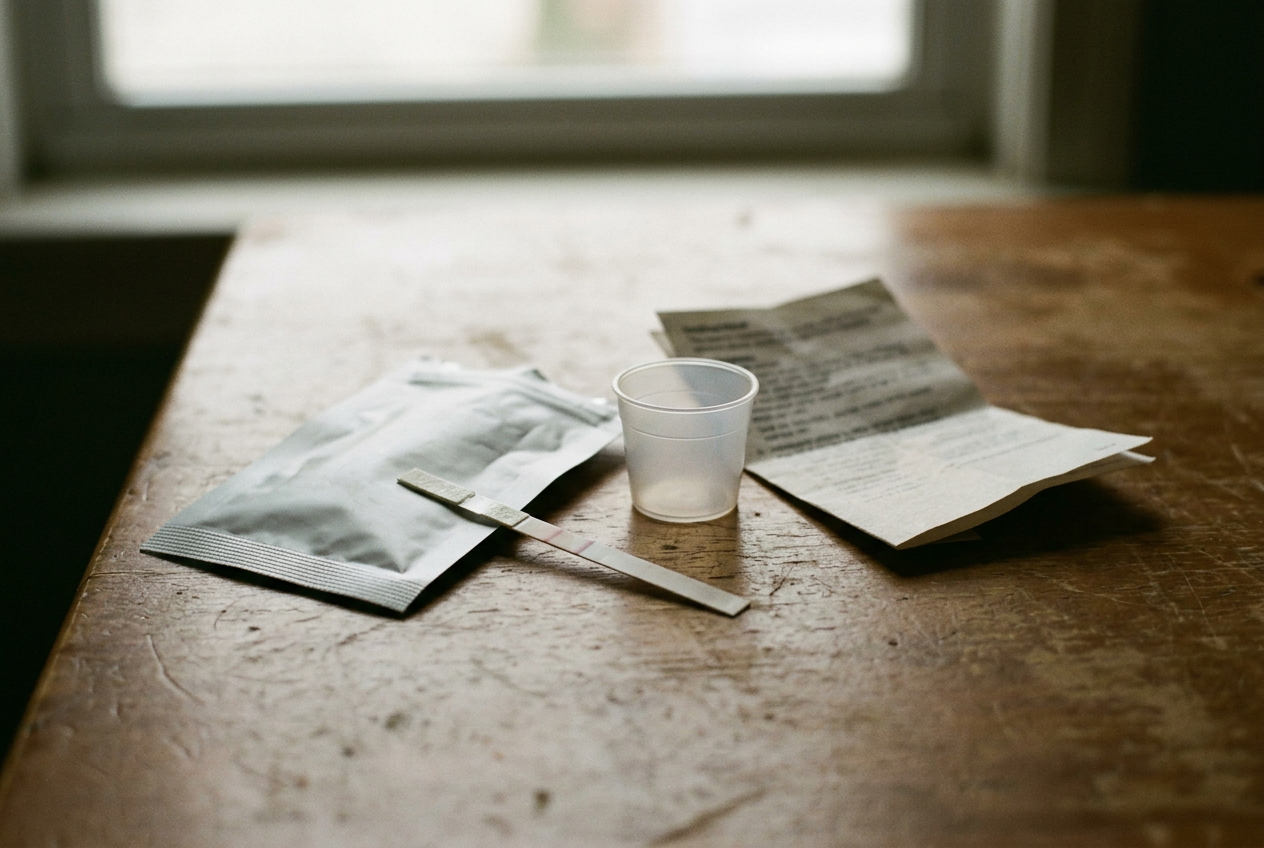
The object at the center of this is unimpressive: a narrow BTNX Rapid Response xylazine test strip, pulled from a foil pouch and dipped into diluted drug residue. After several minutes, one or two pink lines appear. The visual grammar is familiar from pregnancy tests and COVID tests. It invites a clean verdict.
That is more certainty than the strip can provide.
A xylazine strip answers a tightly framed analytical question: did this small portion of prepared liquid contain enough xylazine, or a substance that interferes with the test in a similar way, to cross the strip’s detection threshold? It does not establish how much xylazine is in the original material. It does not reveal fentanyl, medetomidine or another unexpected compound. It cannot tell whether a different pinch from the same bag would produce the same result.
The strip can still be useful. Harm reduction often works with partial information because the alternative is no information at all. The problem begins when a product designed for screening inherits the authority of a safety certificate, especially after it enters a market where packaging, distributor instructions and social-media explainers do not always describe the same preparation method.
The result starts with the dilution
BTNX’s strip is a competitive immunoassay, a test in which xylazine in the sample prevents a colored test line from forming. A control line shows that the liquid moved through the strip correctly. Two lines generally mean the result is negative; one control line generally means presumptive positive. No control line means the test failed.
That backward-looking result is easy to misread. A faint test line still counts as a line under standard lateral-flow interpretation, provided it appears within the stated reading window. Reading much later can introduce drying artifacts. The foil pouch is not the place for improvisation.
Preparation matters even more. Instructions circulated by manufacturers, public-health departments and harm-reduction groups have not always used identical ratios or sampling approaches. Some describe testing a measured amount of powder dissolved in water. Others adapt the strip for residue left in a cooker or bag, an approach that preserves the drug but gives the tester less control over concentration.
Guidance may also recommend retesting after further dilution when common adulterants could interfere.
These are not cosmetic differences. If the mixture is too concentrated, lidocaine and some other substances reported in illicit drug samples can produce a presumptive positive even when xylazine is absent. Peer-reviewed evaluations of commercial xylazine strips have identified concentration-dependent interference involving compounds including lidocaine, diphenhydramine and levamisole. Further dilution may clear some false positives, though it also changes the analytical conditions and should follow validated guidance rather than guesswork.
If the mixture is too dilute, xylazine may fall below the cutoff, meaning the minimum concentration that reliably triggers the test. The strip then shows two pink lines. The chemistry has answered its narrow question correctly while the person holding it may hear something broader: no xylazine here.
That leap is the central hazard.
A bag is not a laboratory sample
Street drugs are not necessarily mixed evenly. Powder can separate during transport, settle according to particle size or collect in pockets inside a bag. A few grains from one corner may not represent the material beside them, much less another bag sold under the same stamp or name.
Laboratories address this through sampling protocols, calibrated instruments and confirmatory analysis. A person using a test strip at home has a cup, some water and whatever residue they can spare. The strip deserves respect for what it can do under those conditions, but no reverence.
A positive result is presumptive because immunoassays recognize molecular features rather than producing a complete chemical inventory. Confirmatory methods such as mass spectrometry, which identifies compounds by measuring molecular mass and fragmentation, can separate xylazine from interfering substances and estimate concentration. That equipment belongs to drug-checking programs and laboratories, not a foil pouch.
A negative result has a different limitation. It says the tested liquid did not contain enough detectable xylazine to trigger that strip. It cannot rule out uneven distribution, preparation error, degradation, an expired strip or a concentration below the cutoff. It also says nothing about the potency of fentanyl or the presence of other sedatives.
The emergence of medetomidine makes that last point harder to ignore. Public-health alerts in parts of the United States have described medetomidine, a veterinary sedative related to xylazine, in the unregulated opioid supply. A strip built to detect xylazine should not be treated as a class-wide sedative test. Two pink lines can coexist with a sample carrying risks the strip was never built to see.
This is why guidance from organizations including the Center for Forensic Science Research and Education, DanceSafe and public-health drug-checking programs frames strips as one layer of information. The result may support a decision to use less, avoid using alone, carry naloxone or seek more complete checking. Those precautions are not rendered unnecessary by a negative.
Naloxone reverses opioid effects, not xylazine itself, but public-health agencies still recommend giving it during a suspected overdose because xylazine is commonly found with fentanyl. Rescue breathing and emergency assistance remain important when a person is not breathing normally. That is general harm-reduction information, not individualized medical advice.
The package sells an event, not a map
The test-strip format compresses a complicated supply into an event: dip, wait, read. That simplicity works for distributors because the strips are cheap, portable and usable without a laboratory. It works for public agencies because giving out strips is faster than building comprehensive drug-checking infrastructure.
It works less well when availability is presented as surveillance.
A state can distribute thousands of strips and still know little about concentration, geographic variation or which sedatives are replacing one another. Individual strip results are often never reported to a central system. When they are reported, inconsistent sampling and dilution can make comparison difficult. Distribution expands personal access to a clue; it does not automatically create reliable market intelligence.
The distinction matters in New Jersey, where xylazine has appeared in the illicit opioid supply and state agencies direct residents toward authorized harm-reduction centers. These programs can distribute drug-checking supplies, explain current instructions and connect people with wound care, naloxone and other services. Availability is local, though. Not every site carries every product at all times, and hours or eligibility practices can change.
The New Jersey Department of Health maintains a directory of authorized harm-reduction centers. The New Jersey Harm Reduction Coalition also publishes service information and supply resources. Calling or messaging before traveling is less elegant than clicking an order button, but it establishes whether xylazine strips are currently stocked and which instructions the program uses.
That human explanation has value. A loose strip without the correct dilution guidance is not the same intervention as a strip handed over by someone who can explain why two lines mean negative, when to dilute and retest, and why neither result closes the case.
Mail-based harm-reduction programs may also serve New Jersey residents, although their available supplies and coverage change. The useful question is not whether xylazine strips exist somewhere in the state. It is whether a person can obtain an unexpired strip, the matching instructions and enough context to interpret the result before the information is needed.
What should change after the lines appear
Harm-reduction guidance does not demand that everyone make the same decision. It tries to prevent the strip from making the decision for them.
A presumptive positive gives a person reason to treat the sample as containing xylazine, while remembering that the strip cannot estimate dose and may have encountered interference. Some programs advise a second test at a different validated dilution. Where spectrometry-based drug checking is available, that can offer a more specific answer.
A negative should produce less confidence than the packaging aesthetic encourages. It may reduce uncertainty about the tested solution, but it does not erase the baseline risks of an unregulated supply. Using a small test amount cannot guarantee safety either, although it may reveal unexpected potency before more is taken. Avoiding solitary use, having naloxone nearby and making sure someone can respond remain relevant regardless of the second pink line.
Xylazine also complicates overdose response and longer-term health. It can deepen sedation and is associated with severe wounds, including wounds that may appear away from an injection site. People should not be treated as disposable because the supply harmed them. Public-health guidance recommends low-barrier medical care for wounds rather than waiting for them to become emergencies.
The foil pouch promises no such system. It contains a strip.
That strip is worth distributing, particularly when the choice is between incomplete evidence and total blindness. Yet the more institutions rely on it, the more plainly they should state what remains unfunded: broad confirmatory drug checking, rapid public alerts grounded in laboratory evidence, wound care people can enter without punishment and a supply that is not governed by secrecy.
Two pink lines are data. They are not permission.
Questions people ask
Does a negative xylazine test mean the drugs are safe?
No. It means the tested liquid did not trigger that strip under those preparation conditions. Xylazine could be unevenly distributed or below the detection cutoff, and the sample could still contain fentanyl, medetomidine or other substances the strip does not detect.
Can xylazine test strips give false positives?
Yes. Published evaluations have found that concentrated samples containing substances such as lidocaine, diphenhydramine or levamisole can interfere with some commercial strips. Programs may recommend retesting at a validated dilution, but confirmatory laboratory checking gives a more specific answer.
Where can
I get xylazine test strips in New Jersey?
Start with the New Jersey Department of Health directory of authorized harm-reduction centers or the New Jersey Harm Reduction Coalition’s public resources. Stock varies, so contact a program before traveling and ask whether the strip comes with current preparation and interpretation instructions.
Should naloxone be used if xylazine is suspected?
Yes, according to CDC and other public-health guidance, because xylazine is often mixed with opioids such as fentanyl. Naloxone does not reverse xylazine, but it can reverse the opioid component; call emergency services and support breathing when someone is unresponsive or not breathing normally.
One update a day
Today's story, in your inbox
One story each morning — no hype, no filler, no algorithm deciding for you.