A Negative Xylazine Test Strip Does Not Mean the Supply Is Safe
A strip can flag xylazine in one prepared sample. Dilution, uneven mixtures, detection limits and everything the strip cannot see make a negative result much narrower than reassurance.
August 11, 2026 · 8 min read
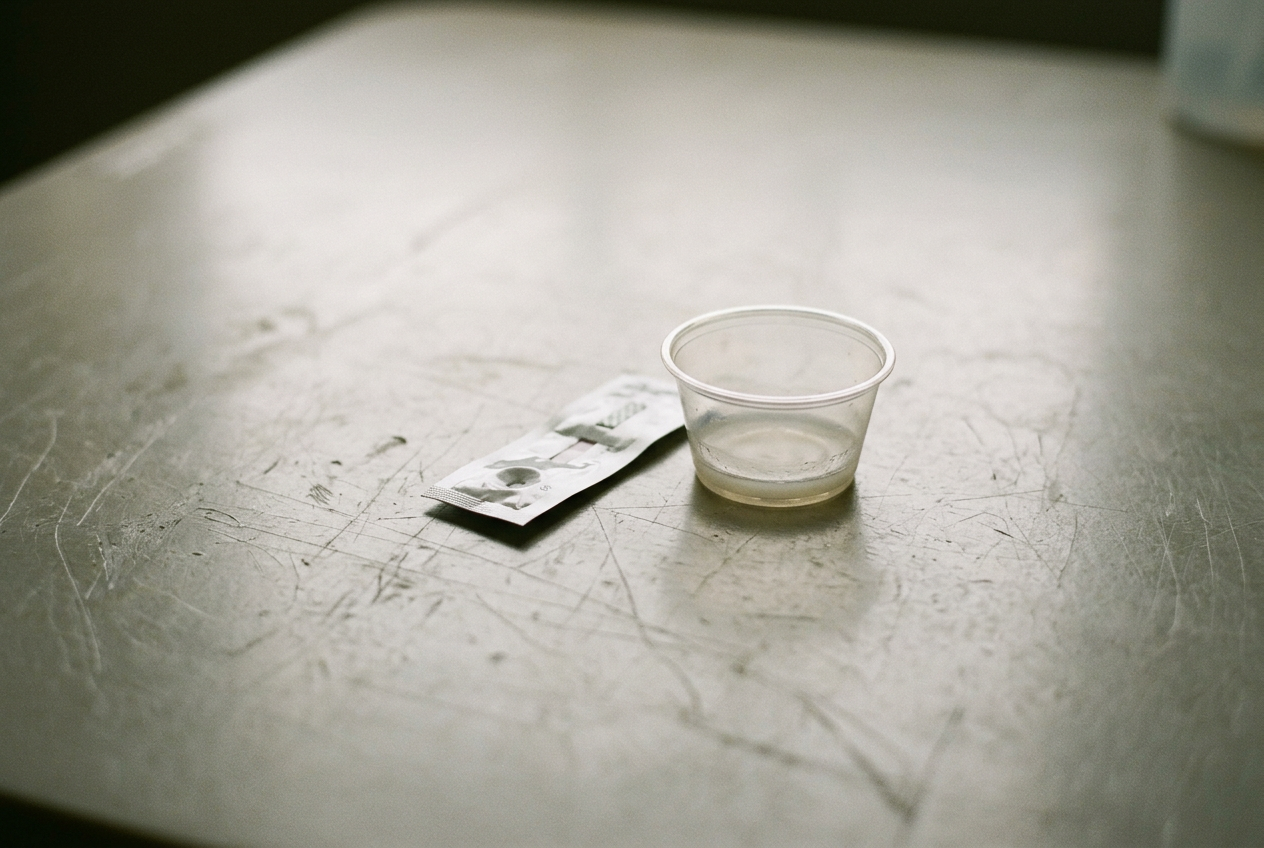
The object is unimpressive: a slim paper strip beside a small cup of diluted drug residue. After the strip sits in the liquid, colored lines appear in its result window. One arrangement suggests xylazine was detected. Another says it was not detected.
No arrangement means safe.
That distinction has become harder to hold onto as xylazine test strips move through harm-reduction programs and informal supply networks. The strips offer useful information at a moment when xylazine, a veterinary sedative, is appearing in parts of the illicit opioid supply and complicating overdoses, withdrawal and wound care. They are cheap compared with laboratory testing, portable and fast. Those are real advantages.
They also invite a familiar institutional shortcut. Put a consumer test in somebody's hand, then let the person carrying the risk absorb every uncertainty around sampling, technique and interpretation. The strip becomes a tiny compliance ritual for surviving a market that regulators have largely surrendered to whoever mixed the bag.
What the lines measure
Most xylazine strips used for drug checking are lateral-flow immunoassays, meaning liquid travels along a membrane where antibodies react with a target compound. Their layout is commonly competitive: when xylazine is present above the strip's detection threshold, it prevents the test line from forming. That makes the visual logic feel backward. A control line without a test line usually indicates a presumptive positive, while two lines, including a faint test line, usually indicate a negative.
Usually matters. Instructions vary by manufacturer, and the result must be read within the specified time window. A missing control line makes the test invalid, regardless of what appears elsewhere. Strips can also differ in cutoff, cross-reactivity and intended sample type.
Some products originated as tests for biological samples rather than street-drug residue, while independent researchers and harm-reduction organizations have evaluated particular strips under drug-checking conditions.
The strip beside the cup therefore answers a tightly framed question: did this specific device react to enough xylazine, or a compound it cross-reacts with, in this prepared portion at the time it was read? It does not identify every ingredient. It does not measure dose. It does not reveal how much xylazine is present, and the darkness of a line should not be treated as a concentration gauge unless a product has been validated for that use.
A positive result is presumptive, not a full chemical profile. A negative result is even easier to overread because the word sounds final while the measurement is conditional.
Dilution can push the result in either direction
Drug checking with a strip requires a liquid sample, so the material must be diluted according to the manufacturer's instructions or guidance from a credible local drug-checking program. This is where a low-cost tool acquires a technique problem.
If the mixture is too concentrated, unrelated compounds or the sample's chemistry may interfere with the assay and produce a misleading result. Public-health guidance and validation studies have identified product-specific cross-reactivity with some common cutting agents and medications at high concentrations. Further dilution can sometimes resolve that interference, but there is no universal correction that works across every strip and every drug mixture.
Over-dilution creates the opposite problem. Xylazine may be present yet fall below the strip's detection threshold, producing a negative result. A person can follow an improvised online ratio with total confidence and still ask the device a question it is no longer sensitive enough to answer.
Water volume, immersion depth, timing, storage conditions and whether the strip has expired can all affect the test. This is not an argument for home chemistry bravado. It is an argument for using the exact instructions supplied with that product, checking that the control line appears and taking uncertain results to a harm-reduction service when confirmatory drug checking is available.
The physical costs are modest but not zero. You need the strip, a clean container, water, enough light to read a faint line and enough uninterrupted time to avoid guessing. In a shelter bathroom, a parked car or the edge of a crowded room, the controlled conditions implied by the packaging may be fiction. A test can be easy to distribute without being equally easy for everyone to perform.
The cup may not represent the bag
Even flawless technique cannot fix a sample that does not represent the supply. Illicit powders are not guaranteed to be evenly mixed, and tablets made outside regulated manufacturing can vary within a batch. A speck taken from one corner of a bag may contain no detectable xylazine while another portion does. Residue collected from the whole container can improve the sample, but it cannot turn an unregulated mixture into a uniform pharmaceutical product.
This is the second narrowness of the strip. The first comes from what its chemistry detects. The second comes from what reaches the cup.
Testing one bag also says little about the next bag, even when both arrived in similar packaging from the same seller. Supply chains change upstream, powders are repackaged and familiar branding on illicit pills is decoration rather than quality control. A negative result has no warranty period.
The strip beside the cup cannot see fentanyl unless it is a separate combined product designed and validated to do so. It cannot identify benzodiazepines, medetomidine or the broader set of compounds that may alter sedation and overdose risk. It does not measure opioid potency. A sample without detectable xylazine can still stop breathing.
That is why the language around results matters. “Xylazine not detected in this sample” is accurate. “Xylazine-free” outruns the evidence. “Safe” abandons it.
Useful information is still useful
Rejecting false certainty does not require dismissing the strip. A presumptive positive can change a person's plan. They may choose not to use that supply, use less, avoid using alone or make sure naloxone and another person are present. Those choices do not erase risk, but harm reduction has never required purity of outcome.
It works with the options people have.
Xylazine is not an opioid, so naloxone does not reverse its sedative effects. Naloxone should still be given during a suspected overdose because xylazine is often found with fentanyl or other opioids, and reversing the opioid component can restore breathing. Rescue breathing and emergency medical help remain critical when someone is unresponsive or breathing poorly.
Xylazine-associated wounds also deserve prompt, low-barrier care. They can become severe and are not evidence of personal failure, nor should wound treatment be made conditional on abstinence. A strip may explain part of an exposure, but it cannot assess tissue damage, infection or the urgency of care.
A negative result should leave those precautions intact. Carry naloxone. Avoid using alone when possible, or use an overdose-prevention line where available. Start with less after any change in supply and avoid mixing sedating substances.
The point is not to turn every person who uses drugs into an unpaid laboratory technician. It is to keep one result from canceling everything else known about an unpredictable market.
The strip cannot carry the whole policy
Test strips flourish partly because they fit the budgets and politics available to harm reduction. They are inexpensive, discreet and easy to count in a grant report. Laboratory drug checking, supervised consumption services, stable housing, accessible wound care and a regulated supply demand more money and more political nerve.
The strip can then become proof that an institution has responded while the conditions producing the danger remain untouched. The user gets a paper sensor. The market stays opaque. The emergency department may still punish disclosure, and the wound clinic may still be difficult to reach.
That does not make distribution cynical by definition. Programs that pair strips with clear instructions, confirmatory testing, naloxone and nonjudgmental care give people more than a prop. The failure begins when a narrow screening tool is marketed as an answer to supply safety, or when authorities treat individual testing as a substitute for surveillance that can identify changing adulterants across a city.
Keep returning to the cup. The strip is valuable because it can reveal one hidden fact before exposure. It becomes dangerous only when its clean little lines are asked to stand in for everything they cannot know.
Questions people ask
What does a negative xylazine test strip mean?
It means the strip did not detect xylazine above its cutoff in the prepared portion tested, assuming the control line appeared and the instructions were followed. It does not prove the entire bag is xylazine-free, measure other substances or establish that the supply is safe to use.
Can dilution cause the wrong result?
Yes. A sample that is too concentrated may create interference or cross-reactivity, while too much dilution may lower xylazine beneath the detection threshold. Follow the instructions for the specific strip rather than a universal online ratio, and seek confirmatory drug checking when a result is unclear or consequential.
Should naloxone be used if xylazine is suspected?
Yes. Naloxone will not reverse xylazine itself, but illicit xylazine is often present with opioids such as fentanyl. Give naloxone during a suspected overdose, support breathing if trained, seek emergency help and do not assume continued sedation means the naloxone failed to address the opioid component.
Why can one part of a bag test negative while another does not?
Unregulated powders and pressed pills may not be mixed evenly, so the portion placed in the cup may not represent the rest. Sampling residue from the whole container may improve representation, but no paper strip can certify uniformity; every new supply brings the same control line back into view.
One update a day
Today's story, in your inbox
One story each morning — no hype, no filler, no algorithm deciding for you.