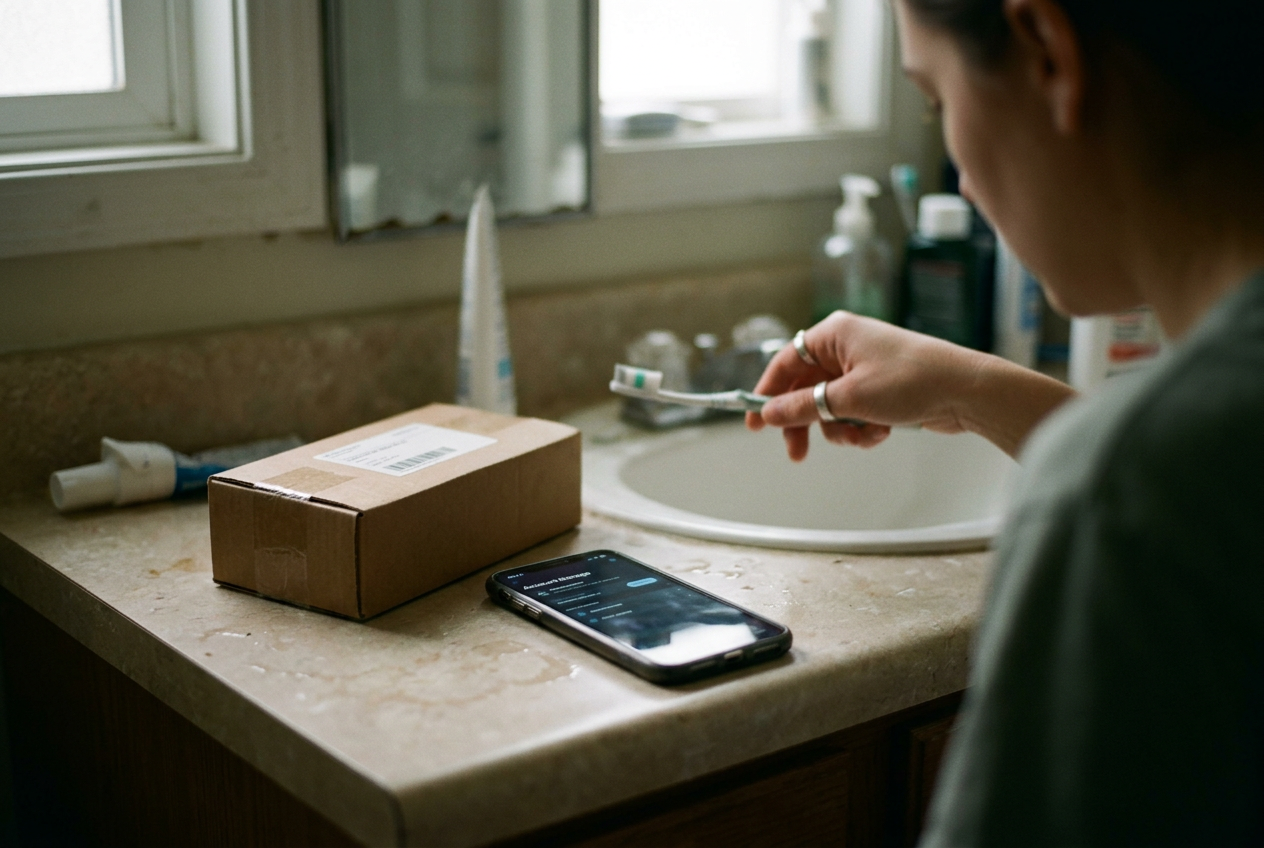
Fentanyl Test-Strip Instructions Don’t Agree on the Sample
The strip looks definitive. The preparation is not. Guidance diverges before the test touches water, leaving users to resolve sampling and dilution under pressure.
August 11, 2026 · 8 min read
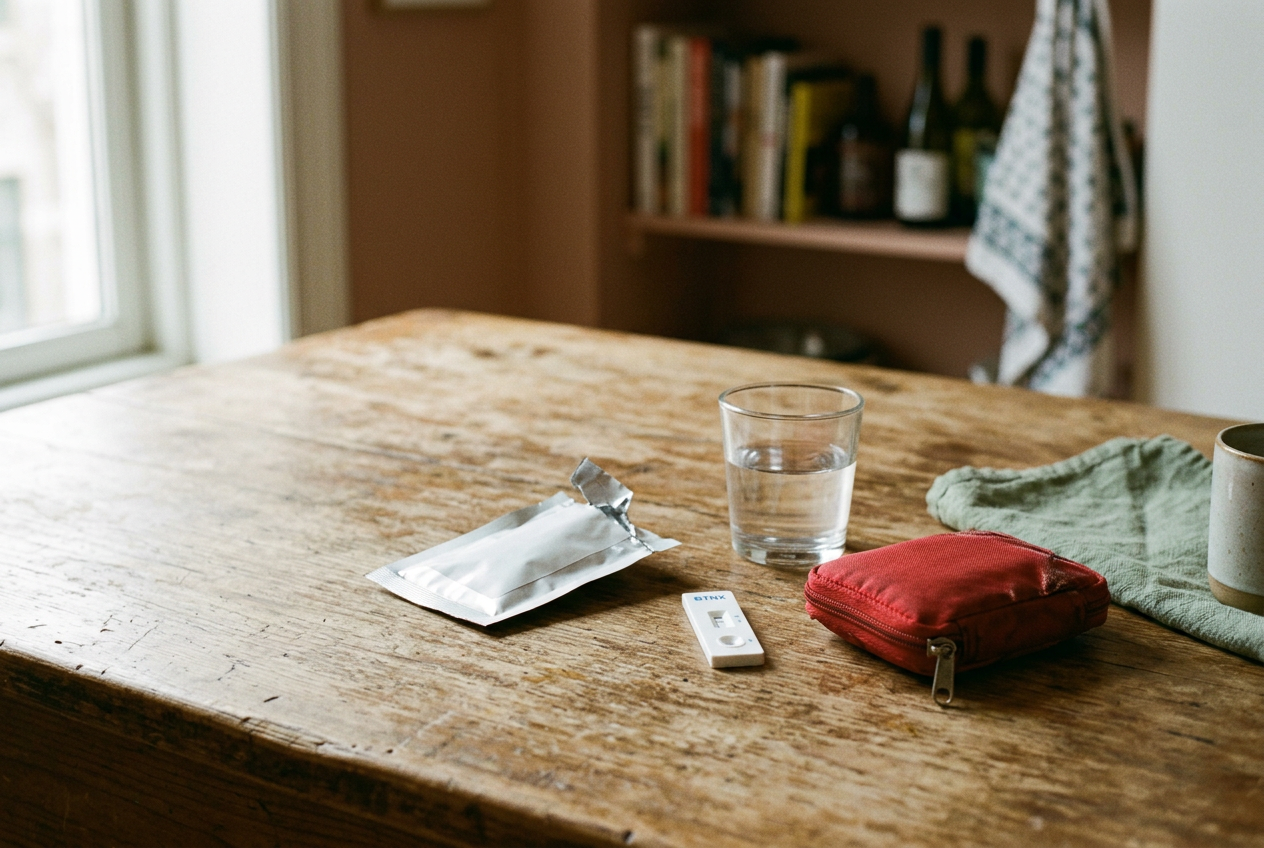
Take one widely distributed BTNX Rapid Response fentanyl test strip: white membrane, red handle, lines marked control and test. The object is almost aggressively uncomplicated. Dip it into a prepared liquid, wait for the specified reading window, inspect the lines. Public-health agencies present that sequence as an accessible intervention, which it is.
The trouble arrives before the strip gets wet.
The manufacturer’s original instructions and many public-health protocols are solving different problems. One describes a standardized urine specimen. The other asks a person to turn powder, a counterfeit pill, residue from a bag or an uneven chunk of material into a liquid sample that the same strip can read. That translation is where certainty drains out.
The result may look binary. The decisions producing it are not.
A urine test became a drug-checking tool
The commonly distributed strip is a lateral-flow immunoassay, a paper test that uses antibodies to react to a target compound as liquid moves across the membrane. BTNX’s urine-test instructions assume the sample already exists as a fairly uniform liquid. They can specify dipping depth, timing and a reading window without explaining how to make the specimen representative.
Direct drug checking is an adapted use. CDC, SAMHSA, state health departments and harm-reduction groups have published instructions for dissolving drugs or residue in water, then dipping a strip into that solution. These guides often share the basic reading method, yet differ over how much material to sample, how much water to add and whether certain drugs need further dilution.
That disagreement does not mean the strips are useless. It means the institutional language around them compresses a messy chemical and practical problem into a diagram that fits on a card. Manufacturers validate products under defined conditions. Public-health programs need instructions that people can carry out in bathrooms, bedrooms, cars and service sites.
Street drugs decline to respect either setting.
The white BTNX strip sits at the end of this chain, not the beginning. By the time it produces a line, the user has already made the consequential choices.
Sampling is the first unresolved decision
Fentanyl may not be distributed evenly through a powder or pressed pill. Harm-reduction educators often describe this as the chocolate-chip effect: testing one part of a mixture cannot establish what is present elsewhere. A scraping from a pill’s surface may miss material concentrated inside it. Residue from one corner of a bag may not represent another corner.
Some guidance therefore favors dissolving the entire amount intended for use, because testing the whole supply reduces the sampling problem. That can be practical for drugs already prepared in water. It is harder when someone does not want to dissolve everything, needs to preserve the material or lacks a clean container and a way to retain the solution. Public-health language may call whole-sample testing preferable without resolving those costs.
Other instructions describe taking a small amount from the supply. This preserves most of it, but puts the burden back on the person sampling. They must decide where to scrape, whether to combine material from several points and whether the powder has been mixed enough for the portion to mean anything. There is no line on the BTNX strip that reports sampling quality.
A negative result therefore means fentanyl was not detected above the strip’s threshold in the liquid that reached the membrane. It does not mean the bag, pill or batch is fentanyl-free. That distinction is routinely printed under the larger promise of rapid detection, where it has to compete with a result window designed to look final.
Dilution can push the result in either direction
Once a sample reaches water, guidance splits again. Public-health protocols generally provide a drug-to-water ratio, but the recommended amount can vary by agency, strip and expected substance. Several guides call for greater dilution when testing methamphetamine or MDMA because concentrated samples can interfere with some strips and produce a misleading positive result.
More water can reduce that interference. Too much water can also dilute fentanyl below the assay’s detection threshold, producing a negative result even though fentanyl was present in the original material. Too little water may create its own problems. The user is balancing two possible errors with no measuring equipment beyond whatever the program supplied or whatever happens to be nearby.
The manufacturer can define a cutoff for a controlled liquid. It cannot convert an unknown street sample into that liquid on the user’s behalf. Public-health instructions attempt the conversion with teaspoons, bottle caps, supplied tubes or visual estimates, each of which trades laboratory precision for access. That trade is defensible.
Pretending it has disappeared is not.
The same red-handled strip can return different results after the same material is prepared at different concentrations. Some guidance recommends retesting a diluted version after an unexpected positive from a concentrated stimulant sample. That is a useful troubleshooting step, but it also exposes what the first test never disclosed: the answer depends partly on how the question was prepared.
The faint line problem is less mysterious than it looks
On commonly distributed competitive fentanyl strips, one control line with no test line indicates a presumptive positive. Two lines indicate a negative result, even when the test line is faint. No control line means the test is invalid. Users still need to follow the markings and current instructions for their specific product, because layouts and reading windows can differ.
The faint line causes understandable hesitation. In a competitive assay, more target compound suppresses the test line rather than making it darker, so the visual logic runs opposite to a pregnancy test. A faint test line is generally read as negative under the product instructions; it is not a measure of a small or safe quantity of fentanyl.
Reading too early or well after the specified window can also mislead. Lines may develop as the membrane runs or change after the valid period. Yet timing guidance varies across materials, and people often receive loose strips separated from the full manufacturer sheet. The tool may be free.
The context arrives in fragments.
What the strip cannot settle
A fentanyl strip does not measure dose, potency or overdose risk. It cannot show whether fentanyl is concentrated in one part of a pill. It does not provide a general safety screen for the drug supply, and a fentanyl strip will not identify unrelated compounds such as xylazine or nitazenes. Detection of fentanyl analogs can vary by strip and compound.
False positives and false negatives remain possible. Cross-reactivity, which occurs when the test responds to a compound other than its intended target, can affect interpretation in some concentrated samples. Low fentanyl concentration, uneven sampling, degradation or preparation errors can move a contaminated sample toward a negative result.
A positive result has limits too. It confirms neither the amount present nor what the rest of the mixture contains. The strip gives one narrow piece of information, often valuable information, from a supply capable of presenting several risks at once.
Instructions offload the hardest work
The unresolved judgment calls are not design glitches that one better infographic will erase. They follow from putting a standardized assay into an unstandardized market. Prohibition leaves composition uncertain, packaging unaccountable and buyers without enforceable ingredient labels. Harm-reduction programs then inherit the job of making that uncertainty survivable, often with inexpensive tools and short encounters.
The polished instruction card can obscure this transfer of responsibility. The agency chooses a dilution rule. The service provider explains the faint line. The person holding the drug decides whether their sample was representative, whether an unexpected positive reflects fentanyl or interference, and what a negative result is worth.
Institutions describe the strip as empowering because the alternative is often no information. Empowerment is doing flattering work there.
The safer reading is modest. Follow the current instructions supplied for that exact strip and ask the distributing program about drug-specific dilution. Treat a negative result as limited to the prepared sample. Where available, community drug-checking services may combine strips with technologies that offer broader identification, though no method can guarantee safety.
Test results should sit alongside other overdose precautions, not replace them. Keeping naloxone nearby, avoiding use alone where possible and using an overdose-prevention hotline or supervised consumption service where legally available can reduce risk. Mixing opioids with other depressants can increase danger. A test dose can still contain a lethal amount, particularly when the supply is uneven.
Return to the white BTNX strip. It can answer whether its antibodies reacted under the conditions placed before it. Sampling decided what entered the cup. Dilution decided the concentration.
The person holding the strip is left to decide what that narrow answer permits.
Questions people ask
Does a negative fentanyl test strip mean the drug is safe?
No. It means the tested solution did not produce a positive result under that strip’s conditions. Fentanyl may be elsewhere in an uneven supply or below the detection threshold, and the strip does not screen for every dangerous compound. A negative result should not replace naloxone or other overdose precautions.
Should the entire supply be dissolved before testing?
Testing a fully dissolved supply can reduce the risk that a small sample misses an unevenly distributed contaminant. It may be impractical, and preparation still matters. Follow current product-specific or local harm-reduction guidance, especially for storing or using a solution afterward; this explainer is not medical advice.
Why can adding more water change the result?
Concentrated samples can interfere with some strips, particularly when certain stimulants are present, while excessive dilution can push fentanyl below the test’s detection threshold. That is why public-health guides sometimes recommend different ratios or a second, more diluted test rather than one universal cup of water.
Does a faint second line mean a small amount of fentanyl?
No. On commonly distributed competitive strips, any visible test line within the valid reading window is generally interpreted as negative, even if faint. Line darkness does not measure fentanyl quantity. Check the instructions for the exact product, and treat a missing control line as an invalid test.
One update a day
Today's story, in your inbox
One story each morning — no hype, no filler, no algorithm deciding for you.