A Warehouse Party Has a Bathroom Problem Before a Police Problem
Temporary venues live or die by the infrastructure nobody posts: working toilets, free water, breathable air and exits that remain usable when the room fills.
August 11, 2026 · 8 min read
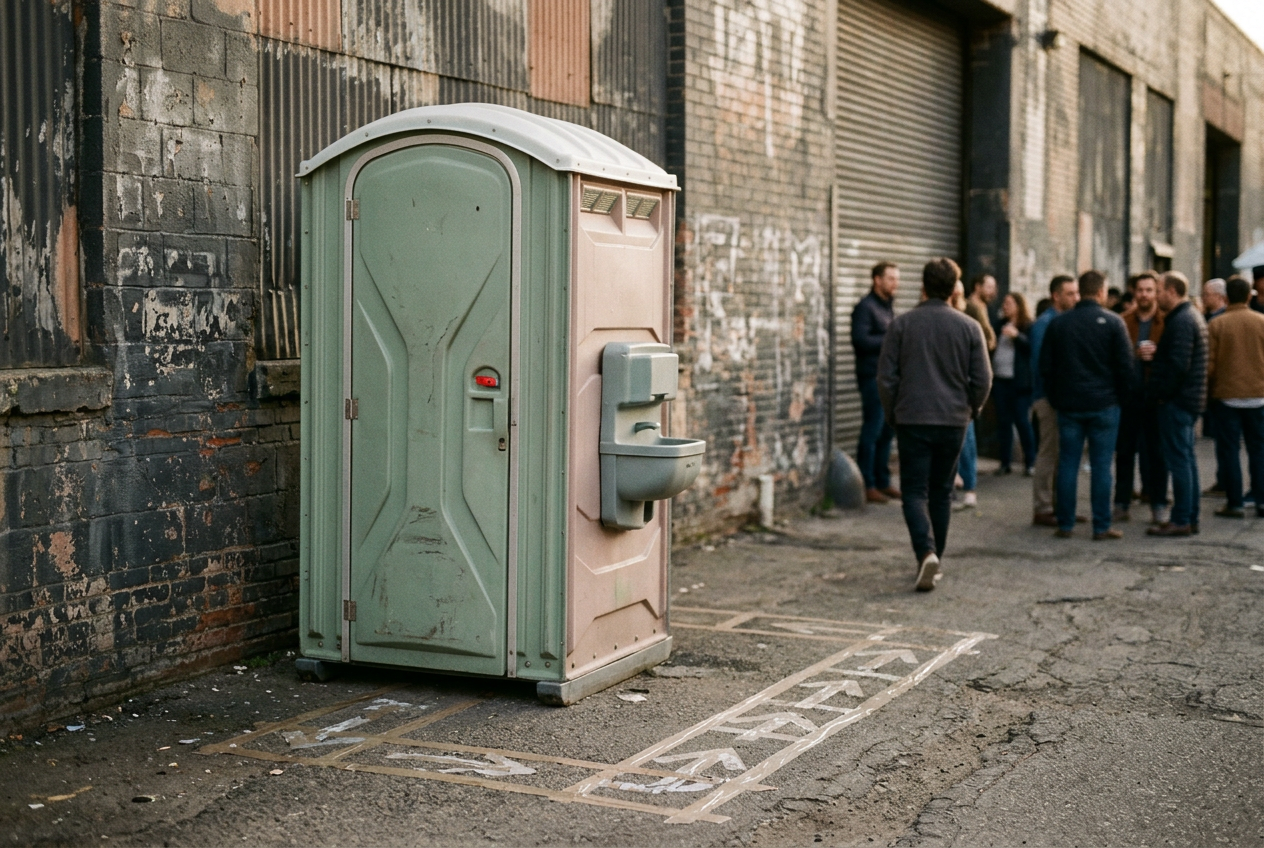
The most consequential object at a warehouse party may be a molded-plastic portable toilet with a chemical holding tank and a small red occupancy latch. It is rarely in the flyer. It will not improve the sound system. By midnight, though, that latch has become a live indicator of whether the organizer understood the room.
One toilet placed against a wall looks like infrastructure. A line folding across a loading bay proves otherwise.
The queue blocks circulation, people start searching for alternatives, the handwashing station runs dry, and a problem that began as an attempt to save rental money spreads into the rest of the event. Guests leave and do not return. Neighbors find people outside. Security gets pulled away from doors.
Someone who needs privacy, medication or an accessible unit waits behind fifty other bodies. The party has acquired a sanitation problem, a crowd problem and a street problem through one red latch.
This is how underground events often fail. The dramatic story arrives later, attached to a raid, a shutdown or a landlord changing the locks. The operational failure starts earlier, in the difference between renting an empty building and running a place where hundreds of people can safely remain for hours.
The room has changed jobs
A warehouse is designed around storage, fabrication or freight. A party turns it into an assembly space, meaning a room where a crowd gathers for a shared activity, and that change makes demands the building may never have been designed to meet.
The concrete floor and high ceiling sell the fantasy of raw capacity. They do not supply toilets, potable water, fresh air, emergency lighting or enough safe paths to the street. A loading door big enough for a truck can still become useless when it is chained, covered by drape, surrounded by speaker cabinets or assigned to staff who treat every departure as an attempt to sneak someone inside.
Licensed venues spread infrastructure costs across years of shows. Their bathrooms, exit signs, plumbing and mechanical ventilation remain in place after the crowd leaves. A temporary organizer buys much of the same capacity for one night, often through rentals, extra labor and equipment that produces no headline value. The expense arrives before the first ticket is scanned.
That difference shapes the underground. Talent can help sell tickets. A larger lighting package can appear in promotional clips. Nobody buys admission because the organizer ordered another accessible toilet or paid for the holding tanks to be serviced, although everyone notices when they did not.
The incentive is ugly and predictable: spend on what the audience can see, then hope the invisible systems survive.
The toilet is a throughput calculation
A portable toilet is not merely present or absent. It has a rate at which people can use it, a finite tank, a location and a service plan. The relevant calculation includes attendance, event length, alcohol sales, the expected arrival pattern and whether guests can use fixed plumbing inside the building. Codes and public-health requirements vary by jurisdiction, so a unit count copied from another party is not a plan.
Placement matters as much as quantity. Toilets need enough light to be found and used, but putting them directly beside the dance floor creates another set of problems. They need a route for delivery and collection. Accessible units need an accessible path, not a symbolic patch of level ground after a gravel lot, a curb and a cable ramp.
Handwashing or sanitizer must remain stocked after the first rush.
The red latch returns here. If every indicator stays occupied, the organizer has created a queueing system without admitting it. A competent setup gives that line somewhere to exist without swallowing an exit route, the bar or the only corridor between rooms. Staff monitor supplies and conditions because a toilet can be technically available while becoming unusable in practice.
Bathrooms also carry more than waste. They provide privacy for menstrual care, medication and decompression. They are places where friends notice that someone is overheating or too intoxicated to stand. Harm reduction becomes harder when the room’s only private spaces are filthy, unlit boxes at the edge of a parking lot.
A shortage pushes the event beyond its walls. Public urination and clusters of waiting guests are visible to neighbors in a way that a bass line behind concrete may not be. Complaints bring landlords, health departments, fire officials or police into a situation the promoter hoped to keep informal. The bathroom problem becomes an enforcement problem by producing evidence outside.
Water and air are part of crowd control
Free drinking water is often treated as a courtesy until heat, alcohol, stimulant use and sustained dancing turn access into a harm-reduction measure. Bottles for sale at the bar do not do the same job if the line is long, the price is punitive or payment systems fail. A utility sink is not automatically a public drinking source, either. Organizers need to know whether water is potable, how guests will reach it and who will refill containers or stations.
The room’s temperature can be deceptive at load-in. An empty warehouse feels cool because concrete and air have had hours without bodies, amplifiers and lighting equipment heating them. Once the party fills, the same shell stores warmth, while a high ceiling gives hot air somewhere to collect without guaranteeing that fresh air enters where people are breathing.
Ventilation means replacing indoor air with outdoor air, rather than pointing a fan across the dance floor. Fans can improve circulation and perceived comfort, but they may only move hot, stale air around a sealed building. Carbon-dioxide monitors can help indicate whether exhaled air is accumulating, although they are a proxy for ventilation rather than a complete reading of every indoor hazard.
Temporary airflow has tradeoffs. Opening a loading door can release sound toward homes, undermine access control and place a major opening behind a dense crowd. Portable cooling and exhaust equipment require power, ducting and safe placement. Any organizer who waits until the room is hot has fewer choices, because opening doors or stopping the music may then be the only interventions left.
Water and air determine how long people can remain inside without distress. They also affect medical workload. A welfare team can provide rest, observation and basic support, but it cannot compensate for a room that keeps producing overheated guests. Harm reduction fails when it is asked to operate downstream from bad building management.
An exit is a route, not a rectangle
The most sobering object in American warehouse nightlife remains the improvised stairway at Oakland’s Ghost Ship warehouse, portions of which were built from wooden pallets. In December 2016, a fire during a music event killed 36 people. Public investigations documented a building used for purposes its conditions could not safely support, with the party taking place upstairs and escape routes that became difficult to navigate.
Ghost Ship should not be used as a lurid shorthand for every unlicensed show. It should end the idea that an exit plan consists of pointing at a door before doors open.
Egress is the continuous route from an occupied space to safety outside. Every part matters: the way off the dance floor, the corridor, the stairs, the door hardware and the exterior landing. A visible door can fail as an exit when it is locked, blocked, disguised by darkness or reachable only through a bottleneck. An exterior gate can undo an otherwise clear route.
Occupancy load, the maximum crowd permitted for a space based on its use and layout, is not interchangeable with the number of bodies that physically fit. Sound equipment, temporary walls, bars and coat piles change usable space. So does the crowd itself. People do not distribute evenly when the headliner starts; they compress toward one room, which can leave an exit elsewhere technically clear and functionally remote.
Exit management costs money because it reduces sellable capacity and consumes labor. Organizers must keep routes open, maintain emergency lighting, prevent equipment from migrating into corridors and give staff authority to interrupt the event. A security worker focused on stopping reentry may become an obstacle if nobody has made clear that, during an emergency, the door’s job changes.
The pallet stairway matters because it exposes the central mistake. Infrastructure is often evaluated while the room is empty, under ordinary conditions, by people who already know the layout. An exit has to work in smoke, noise, darkness and crowd pressure for a guest who arrived two hours earlier and never saw the front door without a line around it.
The infrastructure is the business model
Independent organizers operate inside a structural disadvantage. The cheapest rooms are cheap partly because they lack the systems that make public assembly expensive. Bringing those systems in temporarily raises the break-even point, while lowering attendance to a defensible capacity limits ticket revenue. The promoter absorbs that gap unless a landlord, sponsor or public arts fund shares it.
Skipping infrastructure can make a night look viable on paper. It transfers cost to guests, workers and neighbors, then converts the consequences into reputational damage. A performer may tolerate a weak green room. People remember the party where they could not get water, where the toilet line trapped them against a wall or where staff could not identify another way out.
Survival therefore depends on repetition rather than secrecy alone. Organizers need vendors willing to return, landlords who do not discover ruined plumbing, neighbors who are not greeted by a sidewalk bathroom, and attendees who trust that the next event will be managed at least as well as the last one. Basic infrastructure produces that trust without announcing itself.
The portable toilet’s red latch is still a useful test. When the organizer sees it as an expense to hide, the event is borrowing against everyone in the room. When it is treated as one moving part in a system of queues, water, staffing and clear passage, the warehouse begins to function as a venue rather than a rented shell with speakers.
Questions people ask
How many toilets does a warehouse party need?
There is no universal number. Local rules, crowd size, event duration, alcohol service, fixed plumbing and servicing arrangements all affect the requirement. The practical test goes beyond unit count: toilets must remain stocked, reachable and usable without their queues blocking circulation or exits.
Why is free water a harm-reduction issue?
Dancing, heat, alcohol and some drug use can increase dehydration or overheating risk. Water that requires a long bar line or an expensive purchase is not reliably accessible, particularly when someone is already distressed. Free water works best alongside ventilation, rest space and staff who can recognize when a guest needs more help.
Can fans ventilate a temporary venue?
Fans move air but may not replace it. A sealed warehouse can feel breezy while exhaled air and heat continue to accumulate. Effective ventilation brings outdoor air inside or exhausts indoor air safely, which may require openings, ducting, powered equipment and a plan for the sound and security problems those openings create.
Why do exits matter before an event reaches capacity?
Equipment and temporary partitions can compromise a route long before the room looks crowded. Staff should be able to identify continuous paths from each occupied area to the outside, while guests need visible, unlocked routes that do not depend on local knowledge. A pallet stairway does not become safer because the ticket count stayed modest.
One update a day
Today's story, in your inbox
One story each morning — no hype, no filler, no algorithm deciding for you.