The Afterparty Address Is Now a Payment Trap
Copied flyers and lookalike promoter accounts turn the post-club scramble into a cash grab. The defense is tracing the address, not demanding that underground parties behave like corporations.
September 7, 2026 · 8 min read
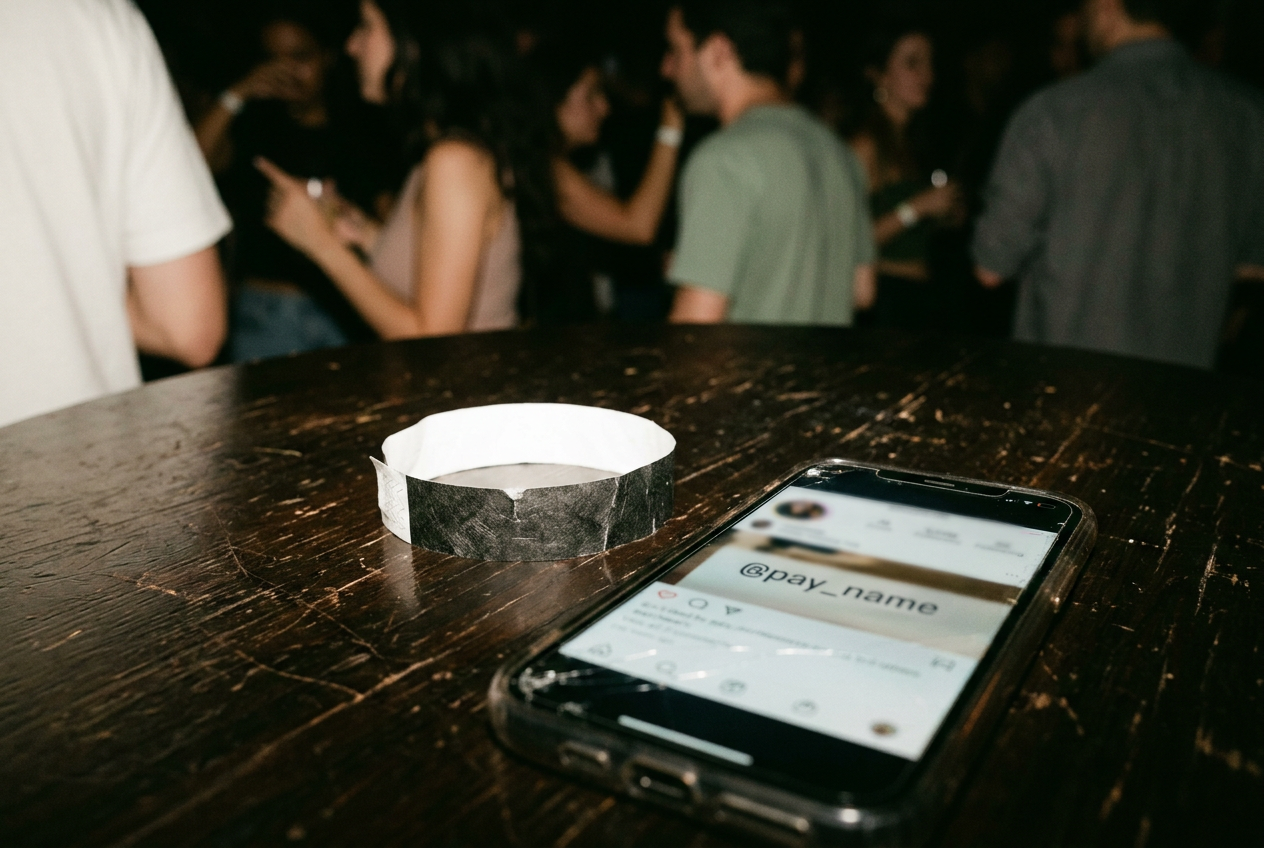
Start with the black Tyvek wristband around your left wrist. Tyvek is a tear-resistant synthetic material that looks like paper, and this strip has spent several hours absorbing sweat while its adhesive tab tightens every time your hand swells. It came from the official event. By closing time, its silver print has rubbed dull at the edges.
The wristband proves where you have been. It does not prove where you are going.
Outside, the official room is emptying into rideshares and arguments about batteries. An afterparty flyer appears in a reposted Instagram Story or a group chat. The typography matches the earlier event. The logo is right.
There is an address, a payment handle and a warning that capacity is nearly gone. All the familiar parts are present, which is precisely why the fraud works.
Afterparty scams do not need to invent a scene. They borrow one at the moment its normal trust system is weakest: late, dispersed, moving between platforms and unwilling to publish every detail in advance. The scammer sells borrowed proximity. The buyer supplies the urgency.
The gap after the official event
Legitimate underground organizers often release locations late. They may need to protect a small venue, avoid landlord trouble, prevent an unwanted crowd or reduce attention from police and licensing authorities. Tickets can move through informal channels because a conventional platform is expensive, restrictive or liable to remove the listing. Cash at the door is not evidence of fraud.
Neither is a private address.
These customs create a narrow information gap between the known event and the next room. A real promoter might fill that gap through a mailing list, a private account or a message sent to ticket holders. A scammer can fill it with a screenshot.
Social platforms make the substitution easy because a repost preserves the visual asset while losing its provenance, meaning the record of where the information came from. A flyer detached from the original account becomes a portable claim. Each repost adds social proof but no verification. By the time it reaches somebody standing under a streetlight with 12 percent battery, it appears endorsed by several friends who merely passed it along.
The black wristband encourages the mistake. It marks you as part of the night, and the fake listing offers a plausible continuation of it. Admission has already happened once. The second payment feels less like a new transaction than an extension of the first.
The fake-listing patterns
The copied flyer is the cheapest version. Somebody takes artwork from a real promoter, lineup announcement or previous party, then replaces the address, ticket link or payment handle. A static image gives the viewer little to inspect. Logos survive copying better than context does, and visual polish is not reassuring when the polished thing can be saved in a second.
Promoter impersonation adds a social layer. The account may use a near-identical username, the same profile image and posts copied from the real organizer. A small spelling change can disappear on a phone screen. Some impostors follow people engaging with the official event, then send direct messages offering afterparty access.
Others appear in replies beneath the genuine post, where proximity to the organizer looks like affiliation.
A compromised account is harder to spot because the username and post history may be authentic. A sudden change in payment instructions, tone or address-release method matters more than the account’s age. Verification cannot stop at seeing the correct avatar.
The payment request usually narrows the buyer’s options. A direct transfer through Zelle, Venmo, Cash App or another payment service is framed as a reservation rather than a ticket. The amount may be low enough to discourage scrutiny and high enough to reward repetition. Federal Trade Commission guidance and payment services’ own scam warnings stress that peer-to-peer transfers can behave like cash: once sent, recovery may be difficult, particularly when the user authorized the payment.
Then comes the location switch. The first address may be vague, copied from another event or replaced after payment with a claim that the venue moved. Late location changes happen in real nightlife. Fraud turns that familiar inconvenience into an endless deferral, with each new message asking for another deposit, transportation cost or stretch of patience.
The scammer gets the transfer. The social platform keeps the messages and reposts moving, while the payment app handles a transaction detached from any clear promise of admission. No single company has to recognize the whole event as a sale. The victim is left proving that a party which was meant to remain discreet was also meant to exist.
Trace the information, not the aesthetic
Begin at the official event rather than the afterparty flyer. Open the promoter or venue account you used before the night started, preferably through your own saved history, ticket confirmation or earlier messages. Do not rely on a tag inside the suspicious post. Look for an afterparty announcement, a stated release method or a warning about impersonators.
Next, compare continuity. A real follow-on event should connect to something already established: the same announcement channel, a promoter with relevant history, a link from an official page or instructions given inside the venue. None of these alone guarantees legitimacy. Together, they create a source chain that a copied image lacks.
The black Tyvek wristband can become useful here. Check whether the official organizer has said that the wristband grants entry, a discount or no benefit at all. An imposter may claim that every attendee gets automatic access because the claim sounds inclusive and cannot be checked at the door until the buyer has traveled. The wristband is evidence only when the organizer defines what it means.
Treat payment details as details, not decoration. Compare the handle character by character with any one previously published through a verified channel. Recipient names displayed by an app can help catch an obvious mismatch, but display names can be incomplete or imitated. A screenshot showing that somebody else paid proves only that somebody produced a screenshot.
A formal ticket link is stronger when it is reachable from the organizer’s established page and states the event, refund terms and admission conditions. It is weaker when it arrives only through an unsolicited direct message. Pressure to use a payment method without purchase protection shifts nearly all risk onto the attendee. Scarcity language does the emotional work: send now, inspect later.
Check the address without demanding that organizers publish sensitive details to everybody. Search the location alongside the promoter and event name. Compare the building type with what was promised. A residence is not automatically fake, and a warehouse pin is not automatically real.
A mismatch is a reason to pause and contact the known organizer through a separate channel.
Finally, plan for the address to fail. Keep enough phone charge and transportation money to leave. Share the location with somebody you trust, particularly if the destination changed after the official event. If the entrance, crowd or building does not match the listing, do not let the transfer already made become a reason to stay.
Money spent is not a safety credential.
Underground does not mean unaccountable
The lazy response is to treat every informal party as suspect and send people toward branded venues, large ticketing companies and permanent locations. That misunderstands why underground events use partial privacy, and it conveniently turns fraud into another sales pitch for platformization.
Legitimate organizers can reduce the opening without publishing the room. They can state in advance which account will release the address, pin warnings about lookalike profiles, keep payment handles consistent and tell guests whether an official wristband has any afterparty value. Watermarks may slow crude copying, although they do not establish provenance once the image starts traveling.
The better distinction is continuity versus extraction. Underground organizing relies on relationships that persist before and after one payment. Fake listings compress the relationship into a deadline, a transfer and a disappearing account. They mimic secrecy while removing accountability.
Verification has a cost. It takes time while friends are leaving, batteries are dying and the next room may fill. Promoters also absorb the labor of correcting fake posts and answering messages that platforms helped create. That is the fraud tax: scammers take the money, while attendees and organizers perform the unpaid authentication.
If the payment has gone through
Stop sending more money, even if the account says another transfer will release the address or refund the first one. Save the flyer, profile URL, username, payment record and messages before anything disappears. Report the account and transaction through the relevant services, and contact the bank or card provider linked to the payment. Recovery depends on timing, payment method and the provider’s rules; reporting is not a guarantee.
Do not travel to a suspicious address to confront whoever may be there. The location could belong to an uninvolved resident, another venue or nobody connected to the payment. Remove the black wristband when you get home. Cut it rather than wrenching the adhesive over your hand.
It did its job at the event that issued it. It was never a passport to the next room.
Questions people ask
How can
I tell whether an afterparty flyer is fake?
Trace it to the organizer’s established account, ticket email or previously announced channel. Check whether the payment handle, address-release method and wristband policy match earlier information. A polished flyer, repost from a friend or familiar logo can all be copied, so appearance alone proves very little.
Is a last-minute address automatically a scam?
No. Underground events often hold locations until late to protect venues, neighbors and attendees. The useful test is continuity: the address should arrive through the method announced by a known organizer, without a surprise payment account or unexplained demand for repeated deposits.
Can
I get back money sent through a payment app?
Possibly, but peer-to-peer transfers can be difficult to reverse when the sender authorized them. Save the transaction and messages, report the recipient inside the app, and contact the linked bank or card provider promptly. The outcome depends on the service’s rules and how the transfer was funded.
What should organizers do about impersonated accounts?
Announce one address-release channel before the event, keep payment details stable and pin a warning that identifies common lookalike accounts. Organizers do not need to make a private party public, but attendees should know where authentic instructions will appear and whether the official-event wristband has any meaning afterward.
One update a day
Today's story, in your inbox
One story each morning — no hype, no filler, no algorithm deciding for you.