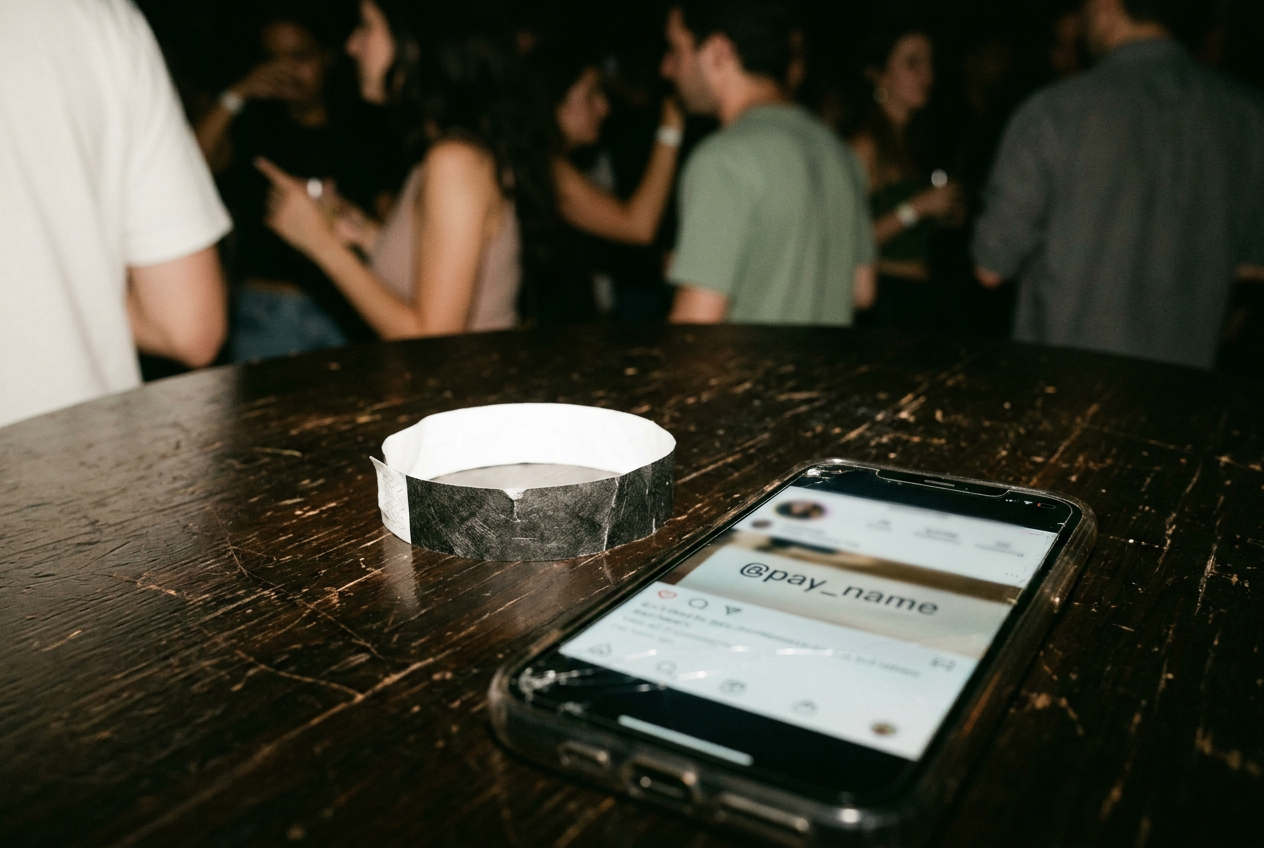
Underground Flyers Hide the Address. The Invite Chain Takes Over.
Image-only details and private location drops can keep a party away from search engines and unwanted attention. They also turn access into a favor controlled by a few phones.
September 5, 2026 · 8 min read
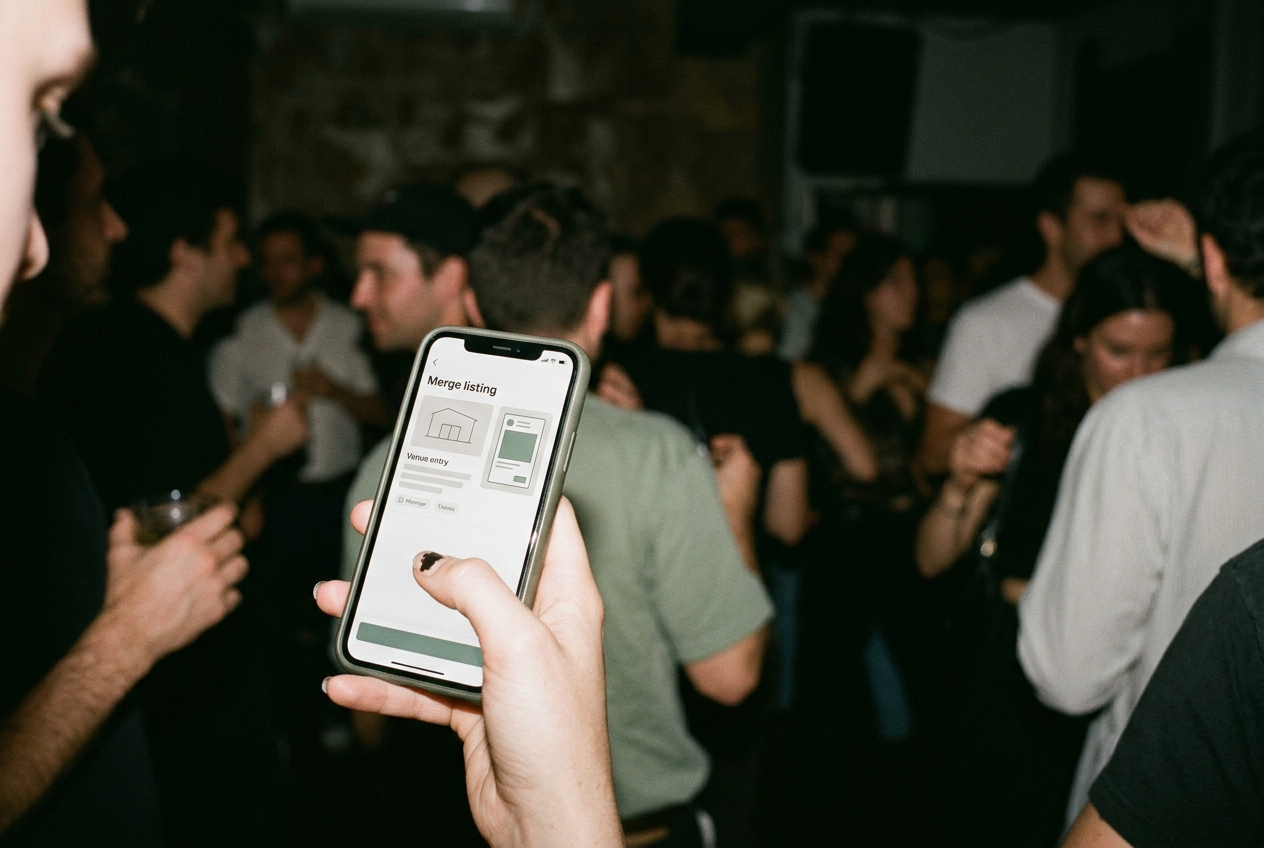
Consider the Resident Advisor page for a Merge party in New York. The lineup is public. The date is public. The venue field has often been some variation of TBA in Brooklyn, with the useful information held until closer to the event.
Techno is the standard label, though that broad market category tells you less than the distribution method does.
That empty venue field is the piece to watch. It changes the event from something you can locate into something you must be told. Search can deliver the page, but not the room.
Merge is not alone, and venue secrecy is older than any ticketing platform. Rave organizers used phone lines, map points and hand-to-hand flyers long before Instagram began flattening local nightlife into a stream of recommended rectangles. What has changed is the environment around the secret. Promoters now work inside systems built to copy, rank and retain information, while landlords, police, licensing authorities, hostile spectators and content aggregators can use the same search box as a dancer.
The contemporary underground flyer often responds by becoming less machine-readable and less complete. An address appears inside an image rather than the caption. A venue name becomes initials. A neighborhood replaces a street.
The final pin moves through Signal, Telegram, WhatsApp or an Instagram close-friends list after a ticket purchase or a social check. Sometimes the public post disappears after circulation has begun.
This is usually described as mystery. It is better understood as access control.
The flyer has stopped being a document
A conventional event page is a small database. Artist, venue, date and ticket link sit in separate fields, which means a search engine can index them and another site can copy them. Structured data, information marked so machines can identify fields such as time and location, makes that transfer easier. The promoter gains discovery.
Everyone else gains a clean record.
An image-only flyer disrupts that record. A person may read the address in two seconds, while ordinary text search fails to retrieve it because the letters are pixels rather than caption text. Optical character recognition, software that extracts writing from images, can still recover the words, and major platforms already analyze images for moderation and accessibility. The address is not invisible.
It is merely inconvenient to find, copy and connect.
That inconvenience matters. Most exposure does not come from a determined investigator. It comes from low-effort circulation: a search result, a repost account, a scraper filling an events calendar, or a recommendation system showing the post to people who resemble previous viewers. Removing searchable text raises the cost of each step.
A coded location drop raises it again because the recipient must understand that a certain phrase, account or pin refers to the party.
Return to the TBA field on the Merge listing. It does not conceal that an event exists. It separates promotion from coordinates. The lineup can travel widely enough to sell tickets, while the address moves through a narrower channel with a delayed clock.
That split is the mechanism underneath the look. The warped lettering and grainy export may signal underground taste, but the operational feature is compartmentalization: different people receive different pieces of information at different times.
Friction is doing the moderation
Platforms promise promoters reach, then make reach hard to control. A public post can leave its intended neighborhood within minutes, stripped of context and delivered to people who have no relationship to the room. More attention may sell tickets. It can also produce noise complaints, hostile comments, overcrowding or official scrutiny, especially when a venue occupies a warehouse, temporary lease or other space whose nightlife use is contested.
Public reporting on underground parties has repeatedly shown how organizers balance visibility against exposure. Reporting from Resident Advisor and Vice has documented scenes that rely on late venue disclosures, mailing lists and trust networks, while the Brennan Center for Justice has cataloged how US law enforcement monitors public social media. A promoter does not need to believe every post is watched to understand the basic asymmetry. Once an address is searchable, the organizer cannot choose the searcher.
Closed-message distribution tries to restore that choice. Signal uses end-to-end encryption, which means message content is readable only on the devices participating in the conversation. WhatsApp offers the same protection for message content, while Telegram’s ordinary group chats do not provide that form of encryption. None prevents a recipient from taking a screenshot, forwarding a pin or handing over a phone.
Secrecy here is probabilistic. It reduces casual discovery. It does not defeat a motivated observer.
The image-only address works for the same reason. It adds labor. Someone must receive the image, read it and decide to pass it on. That sounds slight, but nightlife is full of marginal decisions made while commuting, working or watching six chats at once.
Every extra action removes some people from the audience. Promoters call the survivors community. Sometimes they are. Sometimes they are merely the people closest to the administrator.
The invite chain becomes the institution
Once the flyer stops carrying complete public information, whoever controls the complete version acquires power. The administrator of a group chat can add a friend and ignore a stranger. A promoter can recognize a familiar Instagram profile while missing someone who does not post. A regular can forward the address to one person and tell another that the party is full.
No written exclusion policy is required. The chain produces its own sorting system through familiarity, response time and social proof. Those with established ties experience the friction as atmosphere. Newcomers experience it as paperwork without instructions.
This distinction matters in scenes that describe themselves as safer alternatives to commercial clubs. A private address can protect queer or racialized attendees from gawkers and targeted harassment. It can also reproduce the same exclusions under softer language, particularly when admission depends on being vouched for by people who already resemble one another. The door has moved into the phone, where its decisions are harder to see and nearly impossible to appeal.
The TBA field on the Merge page therefore carries two promises. The first is practical: the location will not be exposed before it needs to be. The second is social: somebody downstream will decide that you need it. Those promises are not identical.
Secrecy does not remove the platform
There is another catch. Hiding the venue often increases dependence on the ticketing and messaging services positioned between promoter and attendee. Resident Advisor, DICE, Shotgun and other ticket platforms can process payment, maintain purchaser accounts and deliver event updates even when the public never sees an address. Their data practices differ, but the underlying exchange remains: the room becomes less visible while the customer relationship becomes more legible to an intermediary.
Promoters accept that bargain because ticketing infrastructure solves real problems. It moves money before doors open, limits capacity and provides a channel for schedule changes. Attendees pay through service fees, account creation and attention. Organizers pay in fees as well, and in dependence on tools whose moderation or account decisions they do not control.
Closed distribution also creates unpaid labor. Someone answers direct messages, checks mutual contacts, updates lists and sends the final pin. Larger commercial clubs buy customer-management software and security staff. A temporary party often pushes the same work onto organizers and trusted regulars, where personal judgment stands in for policy.
Hard-to-search flyers are therefore not an exit from platform nightlife. They are a hybrid arrangement. Public platforms advertise the names. Payment platforms identify the buyers.
Private channels disclose the room. The organizer tries to gain the reach of a public event without accepting full public exposure, while each layer collects its own toll in money, data or social obligation.
Protection needs more than opacity
Location secrecy can be justified. Publishing the address of a vulnerable gathering days in advance may offer little public benefit and plenty of risk. Yet opacity carries costs that do not fall evenly.
A disabled attendee may need early information about stairs, bathrooms and the distance from transit. Someone traveling alone may want to plan a safe route rather than receive a pin near midnight. Workers with rigid schedules cannot hover over a chat waiting for confirmation. If the only trusted route runs through personal introductions, people without scene status pay with time and uncertainty.
Organizers can separate sensitive coordinates from basic conditions. A public access note does not need to name the warehouse. A staged disclosure system can release the location to ticket holders at a stated time rather than according to personal closeness. Codes of conduct and harm-reduction information can remain searchable even when the door cannot.
Those choices cost labor, which is precisely why many events stop at TBA and call the job finished.
The hard-to-search flyer works. That is why it has returned. It lowers ambient exposure and interrupts the effortless copying on which platform discovery depends. Its politics are decided afterward, in the gap between the public lineup and the private address, where a person with the complete flyer chooses which phone receives it next.
Questions people ask
Why do underground parties hide their addresses?
Promoters may want to reduce casual attention from hostile spectators, authorities, landlords or crowds with no connection to the event. Delaying the address also gives organizers more control over capacity. It does not make a party undiscoverable; it raises the effort required to connect its promotion to a physical room.
Can search engines read text inside a flyer image?
Often, yes. Optical character recognition can extract words from images, and platforms analyze visual content for several purposes. Image-only details remain useful because they are less consistently indexed, copied and retrieved than text placed in a caption or structured venue field, not because pixels provide reliable secrecy.
Who gains power from closed-message distribution?
Promoters, chat administrators and established regulars gain control over when information moves and who receives it. That can protect a vulnerable gathering, but it can also turn familiarity into an unwritten admission rule. People outside the existing network bear the cost through delayed answers, uncertain travel and dependence on personal approval.
Does a secret location keep attendee data private?
Not by itself. A venue can remain hidden from public search while a ticketing platform records payment and account information, and recipients can still forward private messages or screenshots. Location secrecy limits one form of exposure. Data minimization depends on the services chosen and the information organizers require.
One update a day
Today's story, in your inbox
One story each morning — no hype, no filler, no algorithm deciding for you.