The DIY Venue Address Is Now a Moderation Queue
Promoters hide addresses to protect underground rooms from harassment and police attention. The same system quietly gives a few accounts control over who gets through the door.
August 28, 2026 · 8 min read
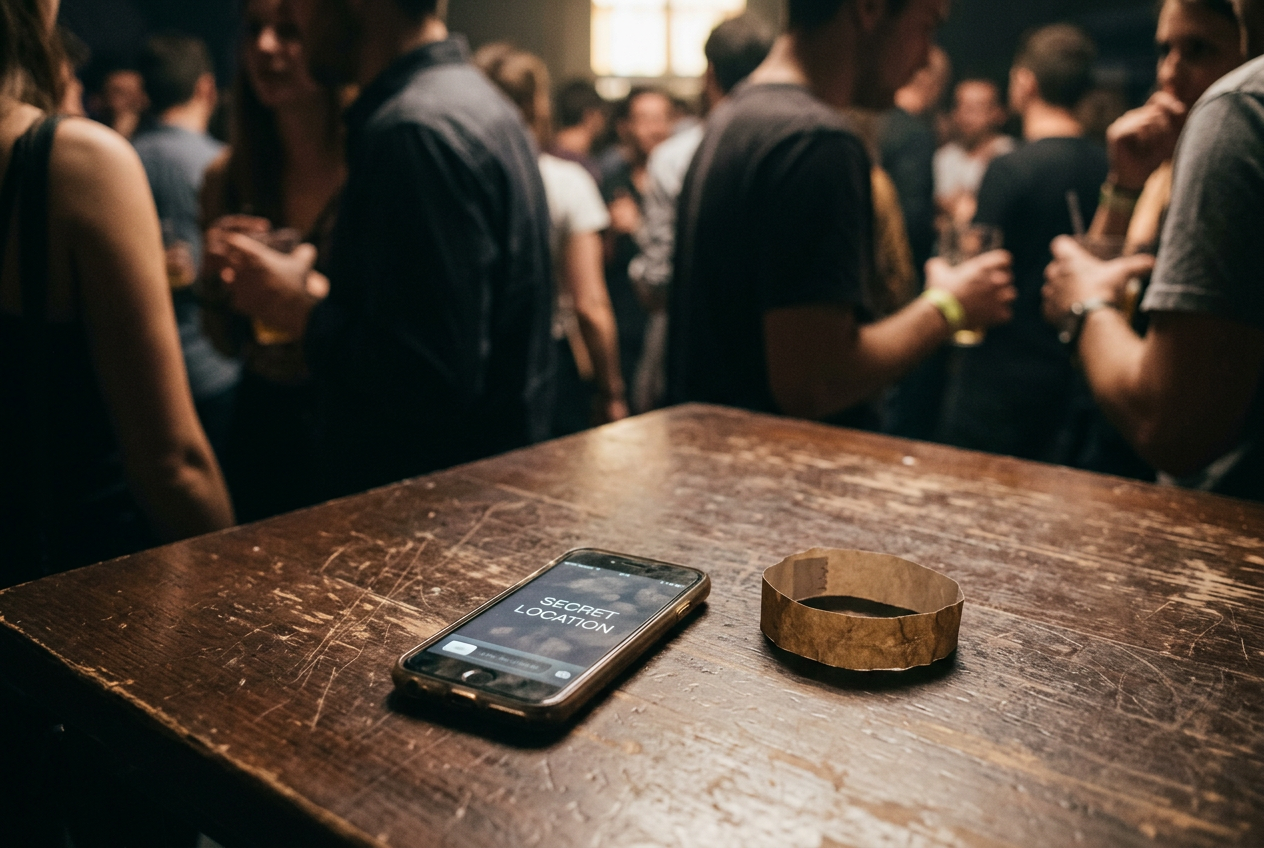
On archived Resident Advisor listings for Unter, the long-running queer techno party in New York, the venue field often did its job by declining to name a venue. It said “Secret Location.”
That gray line is the object to keep looking at. A ticket could establish that a party existed and that money had changed hands, while the useful piece of information remained elsewhere, waiting in an email or another controlled channel closer to opening. The missing address was not a marketing flourish. It was a filter.
Underground parties have always withheld locations. Phone trees, flyers with partial directions and instructions delivered at a meeting point all predate Instagram. What changed is that the address now passes through commercial platforms that make secrecy easy to administer at larger scale, while leaving the promoter to decide who counts as safe. The address has become moderated content.
A public event page can advertise a lineup and sell tickets without revealing the room. Instagram carries the visual pitch. Resident Advisor, DICE or another ticketing service handles payment. A confirmation email delivers instructions.
Closed chats absorb regulars, while direct messages catch everyone who missed the approved route. Each layer has a different audience and leaves a different record.
The result looks informal from the dance floor. Behind the screen, it resembles a small trust-and-safety department run by people who also need to book a sound system and find someone willing to clean the bathroom.
The address became a permission
An ordinary venue publishes an address because being found is part of the business. A DIY room may need the opposite arrangement. Its lease may not permit events. Its neighbors may complain.
Local licensing rules can turn a missing permit or an overcrowding allegation into closure. Queer, trans and racially marginalized parties also face harassment that has nothing to do with paperwork, including targeted reporting campaigns and people entering mainly to film or provoke attendees.
Withholding the location reduces casual discovery. It does not make the event invisible, and promoters know that. A flyer can travel far beyond its intended audience within minutes. An address has different consequences: once copied into a public post, it can bring hostile visitors, police scrutiny or a landlord who has just discovered what happens after midnight.
Promoters therefore separate discoverability from arrival. The public receives enough information to desire the party. Ticket holders receive enough to plan a night. The exact address goes to a narrower group, sometimes shortly before doors, when there is less time for it to spread.
That timing has a cost. Attendees cannot assess the route properly, particularly if they use public transit, need step-free access, work late or are deciding whether a ride home will consume the rest of their budget. Accessibility information often gets trapped behind the same curtain as the street number. The person who most needs advance detail is asked to demonstrate trust before the room has returned it.
The gray “Secret Location” line solves the promoter’s exposure problem by transferring uncertainty to the attendee.
The human filter behind the ticket link
Buying a ticket is the simplest filter, but it is weak. Hostile people have credit cards. So promoters add social judgment.
A request may arrive through an Instagram account. Someone checks whether the profile looks established, whether mutual followers belong to the scene and whether previous posts suggest harassment or unwanted filming. A regular might vouch for a newcomer. Closed groups allow invitations to circulate among people who have already passed through some version of this review.
At the door, staff perform the final check against names, behavior and whatever warnings have moved through the promoter network.
None of this requires a written blacklist to become moderation. Content moderation is the practice of deciding what people or material a platform will admit, restrict or remove; here, the thing being moderated is access to physical space. The account holder receives reports, interprets screenshots, compares partial stories and makes a decision that may have no appeal beyond another DM.
This labor is necessary more often than nightlife mythology admits. A room cannot call itself safer while treating harassment reports as interpersonal clutter. Promoters may need to exclude someone quickly, before a formal process could establish a complete record, because the downside of waiting lands on the person who was already targeted.
Still, the system tends to confuse legibility with safety. An attendee with mutuals and a tidy profile appears knowable. Someone using a new account, a pseudonym or no social media at all can look suspicious, although avoiding a searchable identity may be its own safety practice. Tourists, recent arrivals and people outside the dominant friendship network have less social proof to offer.
The filter rewards those who already resemble the room.
It also rewards fluency. You need to know which account to follow, when to check Stories, how to phrase a request without sounding like a cop and which friend can move the message out of the requests folder. This knowledge is rarely written down because writing it down would weaken the filter. Insider status becomes the ability to navigate undocumented interface behavior.
Safety turns into taste
Every scene excludes. The honest question is whether exclusion follows a stated purpose or the preferences of whoever holds the password.
The same account that screens credible harassment reports can quietly screen for coolness, appearance, follower quality or personal loyalty. A promoter may believe they are protecting the room while reproducing a social hierarchy that favors attractive regulars and people close to the organizers. Since the address arrives privately, rejection can remain private too. There is no visible queue of people who paid, waited and never received enough information to attend.
Door policies at established clubs at least occur in a recognizable location, where exclusion can be witnessed and challenged. The distributed DIY version happens across inboxes. One person never sees the message. Another is told that details will come later.
A third receives them because a mutual follower intervenes. Each outcome looks incidental, which is useful to organizers who do not want to describe the rule they applied.
Secrecy concentrates authority because the address is indivisible. Either someone has it or they do not. Promoters can publish community standards, explain refund practices and divide moderation among several trusted people, but many parties still rely on a founder’s account as ticket desk, complaints department and informal court. Burnout follows.
So does favoritism, even without malicious intent.
The scene then mistakes centralized access for intimacy. A party feels close-knit because one small group approves nearly everyone in the room, while people outside that group experience a locked feed and a ticket page that never becomes directions. The atmosphere may be excellent. The governance is still a group chat with a sound system.
Platforms keep the receipts
Private distribution is not the same as private communication. Instagram direct messages sit inside Meta’s infrastructure. Ticketing companies collect transaction and account data under their own policies. Email can be forwarded, searched and retained.
Closed groups limit who can see a post, but the platform still operates the group and may respond to valid legal demands.
Signal offers end-to-end encryption, meaning message contents can be read only by the sender and intended recipient, but it does not solve the social problem of deciding who belongs in the chat. Nor does moving everyone to a more private app erase screenshots, compromised accounts or the ordinary member who forwards an address without understanding why it was withheld.
Police attention also changes platform incentives unevenly. The promoter carries the legal and physical risk of an exposed room, while the platforms earn ticket fees, advertising money or engagement from the event’s circulation. They provide useful distribution tools without taking responsibility for whether those tools expose a vulnerable venue. If an account is suspended, the promoter may lose years of contacts and safety history at once.
This is the hidden economy of the blank venue field. Promoters perform unpaid identity review on commercial infrastructure, attendees exchange personal data for uncertain access, and the platform remains a neutral-looking intermediary even though its account systems now help determine who can participate in a local culture.
A safer room needs boring rules
The alternative is not publishing every warehouse address at noon. Some rooms need secrecy. Pretending otherwise treats police attention and organized harassment as abstract concerns rather than recurring features of underground nightlife.
The useful reform is narrower: separate safety decisions from social taste, and make the hidden system less arbitrary. An event can state what conduct leads to exclusion without explaining how to evade its filter. It can offer refunds when location details are withheld, give accessibility information before purchase and provide a route for someone without an established social profile. Several moderators can review difficult cases, particularly when friendship with an organizer affects the decision.
Promoters can also collect less. A government ID or a sweep through years of personal posts may create more risk than it removes. The relevant question is whether someone can follow the room’s conduct rules, not whether they can present a marketable online self. Limited records of serious incidents may protect attendees; indefinite gossip archives create another unaccountable database.
These practices take time and money. Additional door staff cost money. Reviewing reports takes hours. Refunds hurt a party operating on thin margins.
Yet the cost already exists. Scenes currently charge it to the harassed person who stays home, the newcomer who cannot decode the invitation ritual and the exhausted promoter making consequential decisions between sound check and doors.
The “Secret Location” field should remain available where a room needs it. It should stop functioning as an alibi. Once an address becomes permission, whoever sends it is governing the scene, whether or not they enjoy the title.
Questions people ask
Why do DIY venues hide their addresses?
Promoters may withhold an address to reduce harassment, police attention, neighbor complaints or problems with landlords and licensing. The location usually travels later through ticket emails, direct messages or closed groups, which limits casual discovery without making the event fully private.
How do promoters decide who receives the location?
Some rely on ticket purchase alone. Others check social profiles, mutual contacts, prior attendance or recommendations from regulars, then use door staff as a final screen. These checks can identify known harassment risks, but they also favor people who already have visible ties to the scene.
Are private messages safe from police or platform surveillance?
A private message limits the immediate audience, but it may still be stored by the platform, forwarded by a recipient or disclosed under legal process. Encrypted services reduce access to message contents, though they cannot prevent screenshots, account compromise or an approved member sharing the address.
Can secret-location parties avoid arbitrary gatekeeping?
They cannot remove judgment, but they can constrain it with published conduct rules, shared moderation, clear refund policies and access routes for people without scene connections. Keeping accessibility details available before purchase also prevents secrecy from placing the heaviest burden on attendees who need planning time.
One update a day
Today's story, in your inbox
One story each morning — no hype, no filler, no algorithm deciding for you.