If the Venue Access Note Hides the Stairs, Don’t Buy Yet
Small venues often publish access copy that sounds reassuring and answers almost nothing. Here is how to check the entrance, seat, bathroom, sensory warnings, and human response before checkout.
August 25, 2026 · 8 min read
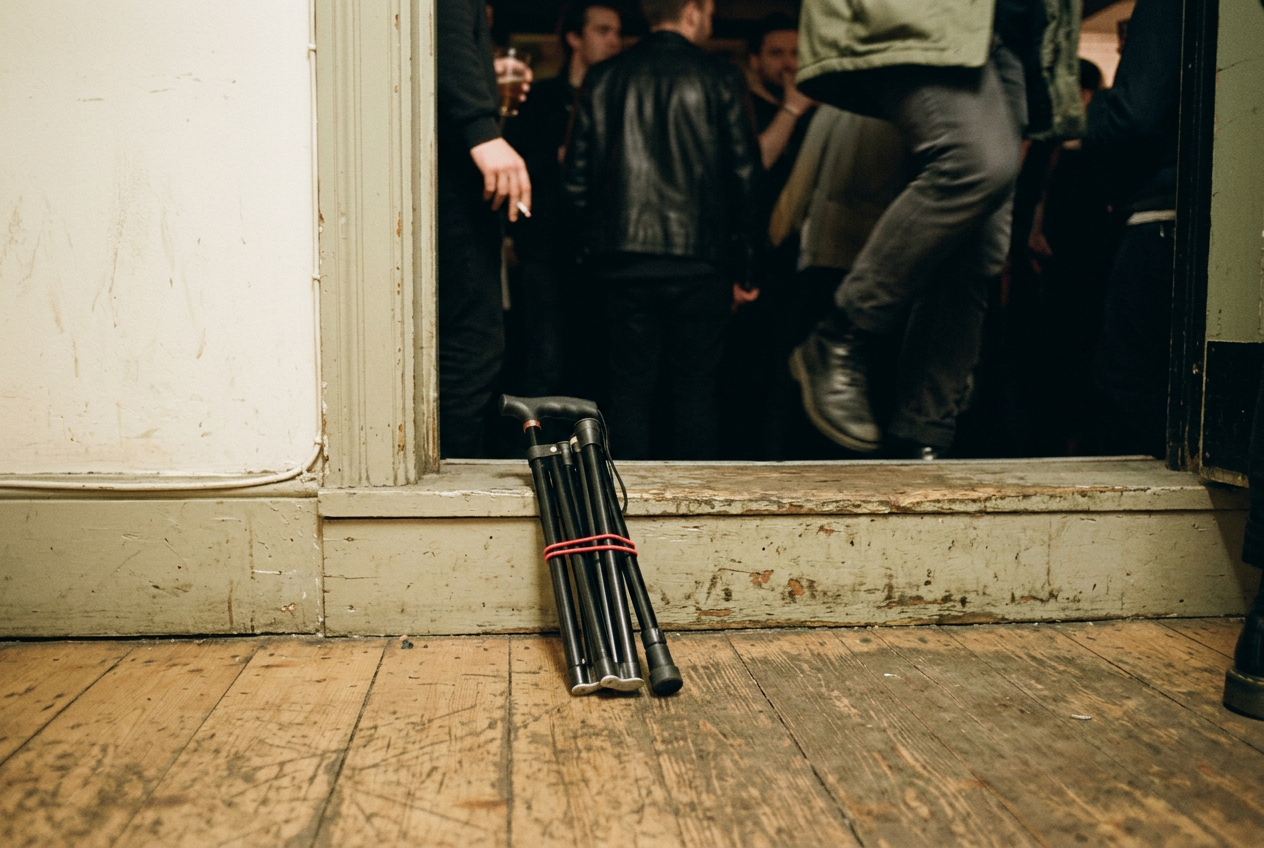
The object I kept beside the laptop was a black folding aluminum cane, collapsed into four sections and held shut with a red elastic loop. It became the test for every accessibility note in a manual review of small-venue event pages: where does this cane unfold, which door does its user take, where can they sit, and what happens after the headliner finishes?
Most notes could not carry the cane from the sidewalk to the stage.
They carried it somewhere near the concept of welcome. The venue was “committed to accessibility.” Staff were “happy to assist.” A building might be described as accessible without saying whether that meant a level entrance, a portable ramp, a side door behind the dumpsters, or one heroic employee expected to improvise architecture between soundcheck and doors.
The wording matters because a ticket is usually sold before the venue has answered the practical questions. Once payment clears, the burden changes shape. The customer has spent money, the promoter has recorded a sale, and discovering an unusable bathroom now looks like an individual complication rather than missing product information.
Start at the sidewalk
Ignore the mood of the note. Trace the route.
A useful entrance description starts outside the building. It names the door, identifies steps and thresholds, and explains whether the route is available whenever the venue is open. “Step-free,” meaning a route without stairs or abrupt level changes, is better than “wheelchair friendly,” but it still needs supporting detail. A steep portable ramp may technically avoid a step while remaining difficult or unsafe to use independently.
Look for whether the accessible entrance is the main entrance. If it is elsewhere, the note should explain how to find and open it, whether staff must unlock it, and how a customer signals their arrival. An instruction to “ask at the box office” fails if reaching the box office already requires climbing stairs. This appears more often than it should.
The staircase has apparently been promoted to customer service.
The folding cane exposes another gap. A person may arrive using it, then need to leave briefly for air, medication, transportation, or a quieter space. A note that describes entry but says nothing about reentry has only mapped half the evening, especially where ticket terms prohibit leaving once scanned.
Check the event page against the venue’s general information. Promoters routinely sell tickets through pages assembled from reusable templates, while the building’s access note lives several clicks away and may describe a different room. Small venues often contain multiple spaces reached by different stairs, corridors, or elevators. “The venue is accessible” means little if tonight’s show is upstairs.
A seat is a policy, not a chair
Standing-room venues often treat seating as an exception to request rather than part of the ticket. That can work, but only when the note explains how the exception operates.
“Limited seating available” is evasive because it leaves every consequential term unstated. Is the seat reservable before payment? Is it placed with a sightline to the stage? Can a companion stay nearby?
Must the customer arrive before a cutoff? Will staff protect the space once the room fills? A barstool retrieved after someone asks for help is seating in the same sense that a coat rack is storage: materially true, operationally unserious.
The strongest notes explain whether customers should buy a standard ticket and request accommodation afterward, or contact the venue before purchase so staff can confirm a workable place. They also separate seated access from wheelchair space. Those are not interchangeable. Someone using the black cane may need a conventional chair because standing causes pain or fatigue, while a wheelchair user needs clear floor space and room to maneuver without being parked in a fire route or behind the sound booth.
This is where ticket economics intrude. A venue wants to sell as much of the room as possible, and holding flexible space can feel inefficient before staff know who needs it. The result is often a request system that asks disabled customers to pay first and negotiate later, protecting the sale while leaving the accommodation uncertain. A better system confirms the arrangement before the ticket becomes nonrefundable.
Follow the route to the bathroom
An accessible entrance does not make an accessible night.
Bathroom information should identify the floor, route, door arrangement, and whether the room is available to patrons throughout the event. The phrase “accessible restroom” is useful only when attached to a location. If the performance space is step-free but the bathroom is down a flight of stairs, the note should say so plainly before checkout.
Look for evidence that the writer has followed the route rather than copied a facility label. A bathroom may have grab bars and still be reached through a narrow corridor blocked by stacked chairs. A designated room may become equipment storage on show nights. Public copy cannot guarantee that staff will keep every path clear, but specificity reveals whether anyone has considered the path as part of the event.
The cane comes apart here. Collapsed beneath a chair, it occupies little room; unfolded on a crowded bathroom route, it needs clear floor and turning space. The relevant question is not whether the building owns accessible fixtures. It is whether a person can reach and use them while the venue is operating at show-night density.
Do the same with the exit. Notes love arrival because arrival is adjacent to purchase. Closing time is less photogenic. Check whether an elevator, side entrance, or staffed route remains available through the end of the event, including after coat check and last call begin pushing everyone toward the same door.
Sensory warnings need an event owner
A general warning that performances “may include flashing lights” protects the venue from surprise better than it protects the audience. It describes nearly every club and confirms almost nothing.
Useful sensory information distinguishes the building’s normal conditions from production choices controlled by the artist or promoter. It should address strobes, sustained flashing, haze, unusually loud effects, and whether patrons can leave and return. A strobe warning matters most when it reaches the ticket holder before payment, not when it appears on a sheet of paper taped beside the door.
Small venues face a real information problem here. Lighting plans may change during setup, touring productions bring their own equipment, and the ticket seller may not control either. That fragmentation explains uncertainty; it does not excuse silence. The venue can assign responsibility, state when details will be confirmed, and provide a contact that knows the difference between a rotating light and a strobe.
Avoid treating earplugs as a complete answer to sensory access. They can reduce sound exposure, but they do not resolve flashing, crowd compression, inaccessible quiet areas, or a policy that forbids reentry. If the note mentions a quieter space, it should locate it and explain whether sound still carries there. “Ask staff” is not a location.
Test the contact before paying
The contact line is part of the accessibility information, not a decorative escape hatch beneath it.
Send one concise message containing the detail the page failed to supply. Ask about the route to the specific room, the method for reserving a seat, or whether the bathroom remains step-free from the performance area. Do not send a biography to earn an answer. The venue needs functional requirements, not proof that the customer deserves accommodation.
Then assess the response as information. A useful reply addresses the named event and gives enough detail to make a purchasing decision. A fast answer that repeats “we are accessible” has failed. So has a friendly promise that staff will work something out on arrival, particularly when the ticket terms make refunds difficult.
Silence also tells you how the system works. Many small venues split responsibility among building management, outside promoters, ticketing services, security contractors, and bar staff, which means the person monitoring social media may have no authority over the room. The customer experiences one venue; behind the page sits a chain of parties, each able to direct the question elsewhere while the ticket clock keeps moving.
That delay has a cost. It can mean missing a lower-priced ticket tier, coordinating transportation twice, or buying entry that cannot be used. The boilerplate works for the seller because it keeps checkout moving without requiring anyone to maintain event-level access data. Disabled customers pay in attention before they pay in dollars.
Read omissions as operating information
No access note can anticipate every body or every production. It can show whether the venue understands its own building.
Specific measurements can help, although they are not the only mark of competence. Plain descriptions often do more: one step at the main door, level entry through a named side door, seating available by advance request, bathroom on the same floor, strobe status pending confirmation from the promoter. That copy admits constraints without turning them into a scavenger hunt.
Evasive boilerplate usually has the opposite shape. It announces values, cites “ADA compliance,” meaning claimed alignment with requirements under the Americans with Disabilities Act, and sends all further questions to a generic inbox. Compliance language is not a route description. It also cannot tell you whether tonight’s staff know where the ramp is.
Before the payment screen, return to the folded cane and run the whole night once more. Sidewalk. Door. Ticket scan.
Room. Seat. Bathroom. Exit.
If the note loses the person carrying it at any point, pause the purchase and ask for that missing link. The venue may have a good answer. Its website has not earned your money yet.
Questions people ask
What makes a venue accessibility note useful?
It should describe the route through the specific room hosting the event, including entrances, level changes, seating arrangements, bathroom access, sensory conditions, and exit. Useful notes state who must be contacted, what needs advance notice, and whether an accommodation can be confirmed before a nonrefundable ticket is purchased.
Is “ADA compliant” enough information?
No. The phrase states a broad compliance claim but does not explain which entrance to use, whether the performance room is reached without stairs, or where the bathroom is. Treat it as a prompt to find operational detail, not as proof that the event will work for your access needs.
Should
I buy the ticket before requesting a seat?
Only if the published policy explains that process and makes clear how the seat will be confirmed. Where the page says seating is limited or available on request, contact the venue first; otherwise the sale becomes certain while the accommodation remains a conversation someone intends to have later.
What should I ask a small venue before payment?
Ask one event-specific question tied to the missing link in your route, such as how to reach the room without stairs or reserve a chair with companion space. A concrete answer is more useful than general reassurance. Save the reply with the ticket confirmation, then bring the black cane through the door the message identified.
One update a day
Today's story, in your inbox
One story each morning — no hype, no filler, no algorithm deciding for you.