
An EXIT Sign Means Nothing If the Door Cannot Open
Before the first band starts, trace the route out. Capacity paperwork matters, but the real test is whether doors, aisles and people will still move when the room fills.
August 20, 2026 · 8 min read
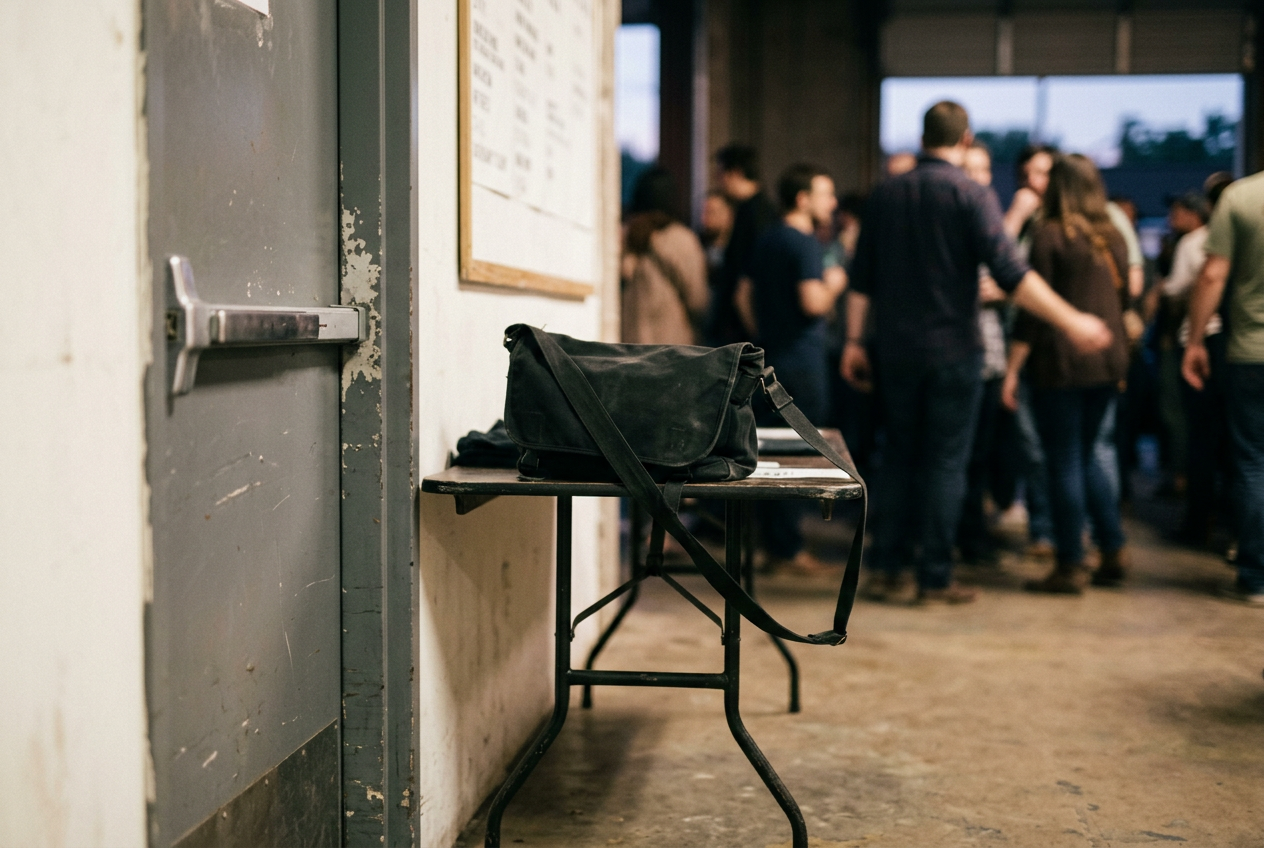
The red EXIT sign is glowing above a gray steel door. Good. A folding merch table sits beside it, close enough that a black canvas messenger bag worn crossbody catches the table’s corner as you pass. Less good.
The room is still mostly empty, which is exactly when this check matters: before bodies turn a narrow route into a negotiation.
This is not a professional inspection, code determination or substitute for emergency planning. Local requirements vary by building, use and jurisdiction. You are not there to certify the venue, confront a promoter or build a case file while conditions deteriorate. You are deciding whether to stay.
A real exit plan is more than signage. It is a route that remains recognizable, unlocked and physically passable after the opener starts, when the merch area expands, the bar line curls toward the stage and every person instinctively moves toward the door they used to enter. DIY rooms often run on borrowed space and thin margins, so every square foot is asked to earn twice: dance floor becomes queue, hallway becomes storage, exit edge becomes retail frontage. The danger arrives through those ordinary compromises.
Start with the number on the wall
Look for the posted occupant load, the maximum number of people approved or calculated for that use of the space. It may appear near the main entrance, behind the bar or with other permits. Read what it describes. A number for a restaurant dining room does not automatically explain a standing show spread across a basement and side room.
Do not reverse-engineer a safe capacity from floor area or assume the promoter’s ticket count settles it. Occupant load calculations can depend on how the room is used, its layout and available exits, while the people inside may include staff, performers, volunteers and guests who never bought a ticket. A copied sign, an old posting or a confident hand gesture cannot tell you whether the current setup was reviewed.
The useful comparison is cruder. Does the posting appear to belong to this room and this use? Does the crowd already look close to the number before the first band? Can you see staff tracking entries, or is the door operation based on wristbands moving in one direction while friends and performers cycle through another?
A missing or confusing capacity sign does not let a visitor diagnose a code violation; some locations post information differently, and enforcement rules vary. It does remove one layer of reassurance. When nobody can explain which number governs the event, the burden shifts onto the physical room, and the room rarely improves as more people arrive.
Walk the whole route, not the glowing sign
Trace your way from where you expect to stand to the outside. Exit access means the part of an escape route that leads from the occupied room toward an exit. It includes the unglamorous space between the stage edge and the door: aisles, corridors, stairs, landings and whatever somebody has decided to park there.
The gray steel door is only the endpoint. Begin at the crowd position. A route that looks open from the back wall may disappear beside the stage once a guitar case lands there, while a basement stair can be technically visible but functionally useless when people queue on its landing. Follow the path with your body rather than your eyes.
The messenger bag catching the merch table is minor during soundcheck; under pressure, the same projection catches coats, shoulders and people trying to turn around.
Look low as well as forward. Loose cables, folded chairs, beverage crates and uneven changes in floor level matter because a crowd does not preserve the empty room’s neat walking line. Avoid moving equipment yourself. If clearing a route requires unplugging production gear, climbing over stock or getting permission from the person selling shirts, treat that dependency as part of the plan.
Check where the route ends. Outside should mean away from the immediate doorway, not a fenced smoking pen packed with patrons or a narrow passage that deposits everyone against traffic. Two doors opening into the same obstructed enclosure do not give you much resilience, because one problem can compromise both.
Then choose where you will stand. The closest place to the stage may leave you dependent on a single aisle, and the deepest corner is not improved by knowing that an exit exists somewhere behind the speaker stack. Keep a route in memory that does not require crossing the densest part of the room. Tell the person you came with where you would meet outside.
Phones lose signal, batteries die and group chats are poor crowd-control systems.
Read the door as hardware
A sign identifies a direction. Hardware determines whether the direction works.
Panic hardware is a horizontal push device designed to unlatch a door when pressure is applied in the direction of travel. In venues where it is required, its value is mechanical and immediate: a person reaching the door in motion should not need a key, a code or a fine-motor decision. Exact requirements depend on the occupancy and local code, so the presence or absence of a push bar is not a complete amateur verdict.
What you can assess is dependence. A deadbolt, padlock, slide bolt or chain on the door introduces an extra action, even if somebody insists it is never engaged during shows. A knob that needs to be turned can become harder to operate when bodies are pressing forward. Doors that require staff to locate a key are not a reassuring plan.
Do not defeat locks, manipulate emergency hardware or open an alarmed door merely to test it.
For a normal, permitted exit, notice whether the door opens freely during ordinary use and whether rugs, wedges or swollen frames interfere. If it is marked for emergency use only, ask staff how it functions without demanding a demonstration that could trigger an alarm. An evasive answer is information. So is a claim that one specific person handles the door, especially if that person is also running sound, tending bar or collecting money.
Door swing matters under pressure because a crowd moving toward an inward-opening door can make that door difficult to pull toward them. Codes treat swing direction differently according to the room and expected occupancy, and you are not conducting that analysis beside the merch bin. You are asking whether the door’s operation makes physical sense for the crowd gathering behind it.
Return to the gray steel door. If the messenger bag now snags between the merch table and an inward-moving leaf, the setup has already failed a modest test. The bag is not the hazard. The room has allowed commerce to claim the space the door needs.
Watch the room manufacture its bottlenecks
The pre-show walkthrough gives you a baseline, not a guarantee. Rooms change after doors open. Photographers settle near the front, friends stop in thresholds, bar lines bend, and coats make every person wider. A promoter may remain under the posted capacity while still producing a dangerous distribution of people, because headcount cannot prevent everyone from compressing around one familiar entrance.
Watch the main door when a small wave arrives. If incoming patrons collide with people heading to the bathroom or smoking area, that crossing will worsen during a sudden exit. Notice whether staff keep the route open or gradually normalize obstruction. A folding table moved a few inches at a time can consume a passage without anyone making one dramatic decision.
The economic mechanism is plain. Independent shows need ticket revenue, drink sales and merchandise income, while cheap rooms were rarely designed around all of those functions at once. The easiest place to add a sales surface is along a wall; the easiest wall to find may sit beside the exit. Nobody has to announce that revenue outranks circulation.
The floor plan says it.
Crowd behavior also favors the known route. People tend to return toward the entrance they remember, particularly in loud or unfamiliar rooms, which means a second exit hidden behind a curtain or unmarked turn may contribute less in practice than its existence suggests. Keep alternate routes visible in your own mental map, but do not count on discovering them after the lights change.
If the route narrows, move closer to an exit before the room peaks or leave. Do not wait for smoke, shouting or a crush to prove your judgment correct. If there is immediate danger, get outside and contact emergency services from a safe location. Documentation can wait.
Your footage will not widen the aisle.
Set a leaving threshold before the music starts
Decide what ends the night for you while the room is calm. A locked or obstructed exit is enough. So is a crowd that blocks the only route you understand, staff who refuse to address a clear obstruction, or a configuration that leaves you relying on someone finding a key.
This threshold matters because social pressure grows with the ticket sunk, the friend’s band about to play and the annoyance of admitting that a room feels wrong. Venue precarity is real; affordable spaces disappear, promoters improvise and scenes depend on work that conventional clubs will not support. None of that makes your body an acceptable subsidy.
You do not need to litigate the building code at the door. State the practical problem if doing so feels safe, then step outside. Avoid blocking the route while debating it. If you later choose to report a concern to the relevant local authority, record only what you can do safely and accurately after leaving.
On the way out, the black canvas messenger bag passes the gray steel door without touching the merch table. That small clearance is not proof of safety. If it no longer exists when the first band starts, it is a reason to keep walking.
Questions people ask
Can
I trust the capacity sign at a DIY venue?
Treat it as one piece of evidence, not a guarantee. Check whether it appears to cover the room’s current use, then compare it with the layout and the crowd. Do not calculate your own legal capacity; if the posting is absent, unrelated or contradicted by the room, leaving is the useful response.
Should I test an emergency exit door myself?
Do not open alarmed doors, bypass locks or manipulate hardware. For an ordinary exit, you can observe whether it opens during normal use and remains unobstructed. For emergency-only doors, ask staff how they operate; if safe exit depends on a key, an absent worker or an unclear procedure, do not stay to investigate.
What if staff say the blocked path will be cleared later?
Judge the route you have, not the promised version. Equipment and merchandise tend to accumulate once a show begins, while crowd density makes rearranging them harder. If the obstruction affects the path out or the door’s movement, step outside rather than waiting for staff to win back space from a full room.
Is it useful to photograph a safety problem before leaving?
Only if you can do it without delaying your exit, creating conflict or standing in the route. The priority is reaching a safe location and helping companions leave. Notes or photographs may be useful afterward, but documentation does not reduce the immediate bottleneck and should never become the reason you remain inside.
One update a day
Today's story, in your inbox
One story each morning — no hype, no filler, no algorithm deciding for you.