Community Radio Keeps the Tracks Streaming Catalogs Lose
A live set assembled from vinyl, artist files and streaming catalogs shows that platform absence is rarely random. Community radio survives by keeping other routes open.
September 6, 2026 · 8 min read
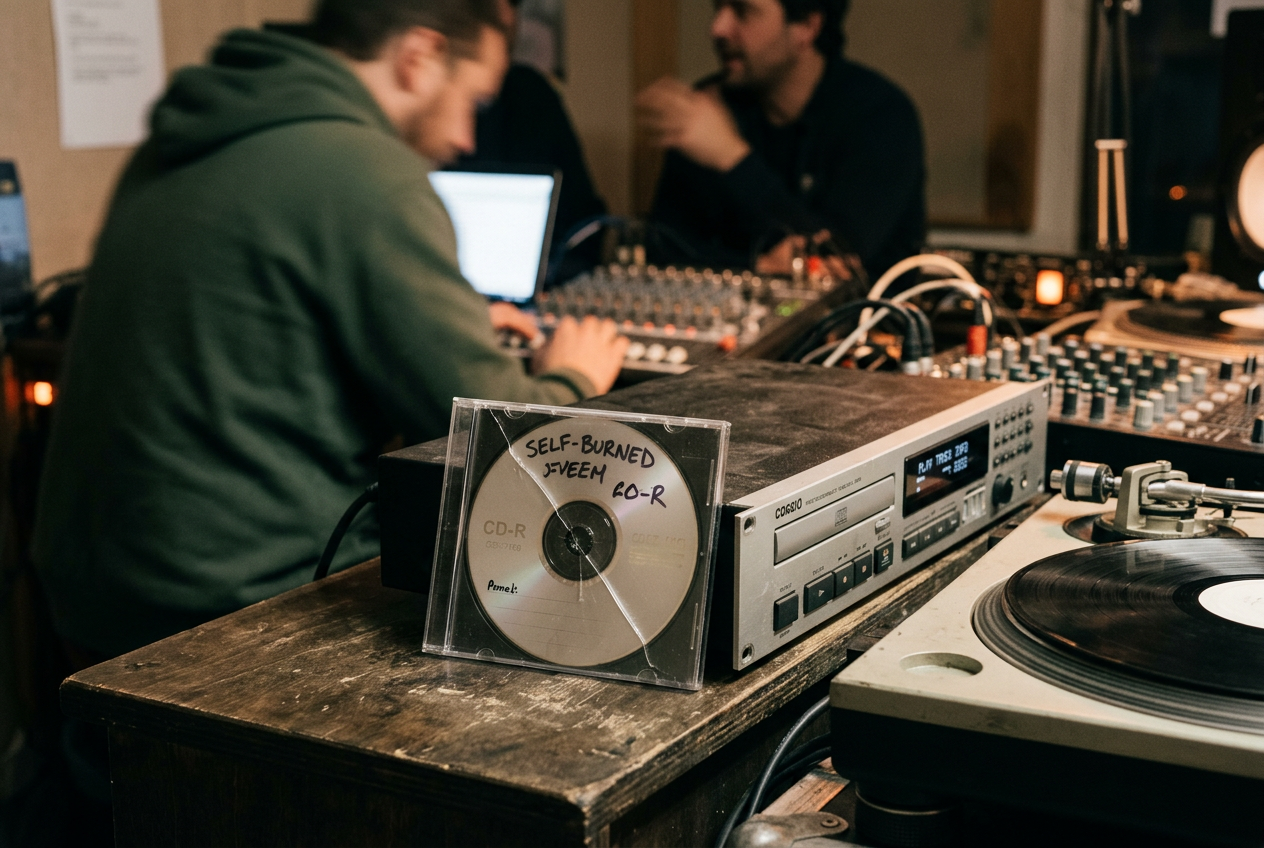
The problem arrives in a cracked jewel case.
Inside is a silver CD-R with three track names written in black marker, handed to the station by a local producer and filed among commercially manufactured CDs, promo singles and other objects that never acquired a clean platform identity. The disc reads. The files play. One track fits the set.
On the major streaming services checked beside the studio computer, the release is absent.
This is the sort of gap streaming has trained listeners to misunderstand. A missing song looks like a search failure, perhaps a spelling problem or an artist too obscure to have uploaded properly. Inside a live radio set, where the next selection needs to start on time and at broadcast quality, absence becomes more precise. The song exists.
The station has it. A platform does not.
The CD-R goes into the player.
That small transfer, from a hand-labeled disc to a community transmitter, reveals what local radio still does better than subscription catalogs. It keeps music available after the commercial systems around that music have stopped recognizing it as useful inventory.
The catalog is conditional
A streaming catalog presents itself as a library, but it behaves more like a set of temporary permissions. Labels, distributors and other rights holders deliver recordings under agreements covering particular services and territories; metadata identifies the artist, release and ownership; contracts remain active until somebody withdraws the recording, loses authority over it or decides the administrative work no longer pays.
For a major release with functioning rights management, that chain can feel permanent. For a small-run local record, a self-released EP or a label whose operator has moved on, each link is another place to disappear. A distributor closes an account. Two parties dispute ownership.
An old upload uses incomplete metadata. A release stays online in one country and vanishes in another. The artist has the master file but no longer has access to the service that delivered it.
None of these outcomes means the music ceased to exist. They mean the platform no longer has a usable instruction to serve it.
The station’s CD-R has no subscription layer and no dashboard. It has a readable audio file. Physical possession does not erase copyright or grant unlimited reuse, but a licensed radio station operates through broadcast agreements rather than requiring every recording to maintain an active retail listing. In the United States, the licensing structure also differs between terrestrial broadcasts and digital simulcasts, which is why stations keep logs and treat online transmission as more than an extension cord from the booth.
The distinction matters. Spotify and Apple Music need an authorized recording delivered into their systems. A DJ needs lawful station infrastructure, a playable source and enough information to log what went out. These routes overlap when the industry is working.
Underground music lives in the parts where they do not.
Available can still mean unusable
The next failure is less dramatic. A track appears in search, complete with artwork, but only as the wrong version.
For domestic listening, this can register as an annoyance. In a set, it changes the music. The platform copy may be a later remaster with a different level, an album edit that removes the opening bars needed for a transition, a re-recording filed under the original title or an explicit version that cannot go out during the station’s current programming window. Search has technically succeeded.
Programming has not.
This is where the idea of catalog size becomes slippery. Platforms count recordings as available even when the version a working DJ needs is buried, mislabeled or replaced. Radio exposes the difference between a song as an abstract title and a recording as a particular performance, master and mix. The distinction is boring until the wrong drums enter.
The set moves to vinyl. The record has surface noise and requires cueing by hand, but it contains the intended mix. Its usefulness comes from being fixed. Nobody can silently substitute a remaster on the shelf, collapse two artists with the same name into one profile or change the file after a rights dispute.
The object may deteriorate. It does not update itself into something else.
That stability costs labor. Records need storage, turntables need maintenance and station libraries become difficult to search when their cataloging depends on old databases, sleeve notes and whatever somebody wrote on masking tape. Physical media is not automatically democratic either. Scarce pressings become expensive, and a collection built through decades of access can reproduce the same gatekeeping as any other private archive.
Still, the record works. The platform listing does not.
The direct file is a social format
A later selection comes from a digital folder rather than a service. The artist supplied the file directly, with a title and enough identifying information for the station log. It has no jewel case. It also has no platform intermediary deciding whether the audience is large enough to justify keeping the release administratively alive.
Direct artist files look technologically ordinary because they are ordinary. A WAV file, an uncompressed digital audio format, can move through email, a download link or a drive without becoming a subscription product. What matters is the relationship attached to it. Someone knew the program, trusted the station to play the correct version and delivered the recording in a form the booth could use.
Platforms turn this relationship into a scalable intake system. That helps artists reach listeners far outside a local scene, but scale requires standardization, and standardization punishes the releases most likely to have incomplete paperwork, shifting aliases or no business operation behind them. A platform cannot preserve a scene merely by hosting the tracks that passed its current checks. It preserves what remains commercially and administratively legible.
Community radio uses a messier test. Can the station identify the work, document the play and put it on air under its licensing arrangements? That leaves room for music whose circulation still depends on a person carrying it into a room.
The labor does not disappear. It moves to the DJ, the music director and the volunteer who checks a file before broadcast, corrects a title or works out whether two near-identical versions are the same master. Streaming makes this labor invisible by pushing it upstream to rights holders and distributors. When those parties stop doing it, the track falls out of the interface.
The cracked jewel case remains useful because the station accepted that work years ago and kept the result.
Radio stores context, not just audio
The strongest part of the set is not that it avoids streaming. It does not. Catalog services are used where they supply the right recording, and rejecting them on principle would replace one form of fragility with another. A station that relied only on rare vinyl would narrow who could participate and spend money it may not have.
The practical system is mixed. Physical media covers releases that never entered platform catalogs or later dropped out. Direct files carry current local work and broadcast-ready versions. Streaming handles accessible material quickly, particularly when a DJ needs to confirm a release or reach something the station does not own.
Each source compensates for another source’s failure.
This hybrid setup also preserves context that platforms flatten. The CD-R sits near other releases delivered to the station during the same period. A paper sleeve may name a local label, studio or collaborator absent from the service metadata. The DJ remembers which room played the track, which program first supported it or why the available album version is wrong.
Those details are not sentimental extras. They help identify the recording and keep it connected to the scene that produced it.
Recommendation systems work from behavior and metadata at enormous scale. They are good at finding adjacency among items that remain inside the system. They cannot recommend a track the rights pipeline removed, and they cannot infer local importance from a recording that never accumulated enough platform activity to become visible.
Radio can. A DJ can place one unavailable local track beside a current release and an older influence, making an argument that no automated playlist could construct because one of its terms is missing from the database. The value is curatorial, but the mechanism is material: the station retains sources outside the catalog.
Preservation happens before anyone calls it history
Archives usually become respectable after the scene has ended, when institutions can describe its flyers, recordings and clothes in the past tense. Community radio performs a rougher version while the music is still socially active. It keeps the inconvenient format. It accepts the file with imperfect metadata.
It plays the mix that a commercial service replaced.
This does not make every station an archive, and plenty of station libraries are one failed hard drive or building move away from losing material. Volunteers leave. Shelves fill. Undocumented files become as unsearchable as missing streams.
Preservation needs backups, cataloging and people with time, all of which cost money even when the music arrived free.
Yet the live set demonstrates the minimum viable form. Keep more than one route to the recording. Do not treat a platform listing as ownership. Retain the version that was supplied, along with enough context to identify it later.
Near the end of the program, the silver CD-R returns to its cracked case. There is no grand rescue. One local recording played because a station maintained a machine that could read it, a license structure that could carry it and a culture in which somebody still thought to look on the shelf.
Questions people ask
Why do songs disappear from streaming platforms?
Recordings can vanish when distribution agreements end, ownership changes, metadata conflicts arise or a rights holder withdraws a release. Small and self-released catalogs are especially vulnerable because keeping old material online requires continuing administrative control, even when the audio files themselves still exist elsewhere.
Can a radio station play music that is not on Spotify or Apple Music?
A track does not need a retail streaming listing to be broadcast. The station still needs the relevant licenses, must follow its logging and content rules, and needs a lawful playable source, which may be a record, CD or file supplied directly by the artist or rights holder.
Is physical media safer than streaming for preserving music?
Physical media gives a station a stable copy that cannot be remotely removed or replaced, but it can be damaged, lost or made inaccessible by broken equipment. Preservation works best across formats, with maintained physical copies, backed-up files and catalog records that explain what each version is.
Why are direct artist files important to community radio?
Direct files let artists provide the exact mix, edit and audio quality a program can use without waiting for a distributor to place it on a service. They also keep a local relationship attached to the recording, although the station must still verify, store and document the file properly.
One update a day
Today's story, in your inbox
One story each morning — no hype, no filler, no algorithm deciding for you.