An Instagram Ban Does Not Delete the Police Copy
Instagram can remove an account from public view while preserving its records for legal requests. The disabled-account notice tells you almost nothing about where the data remains.
August 26, 2026 · 8 min read
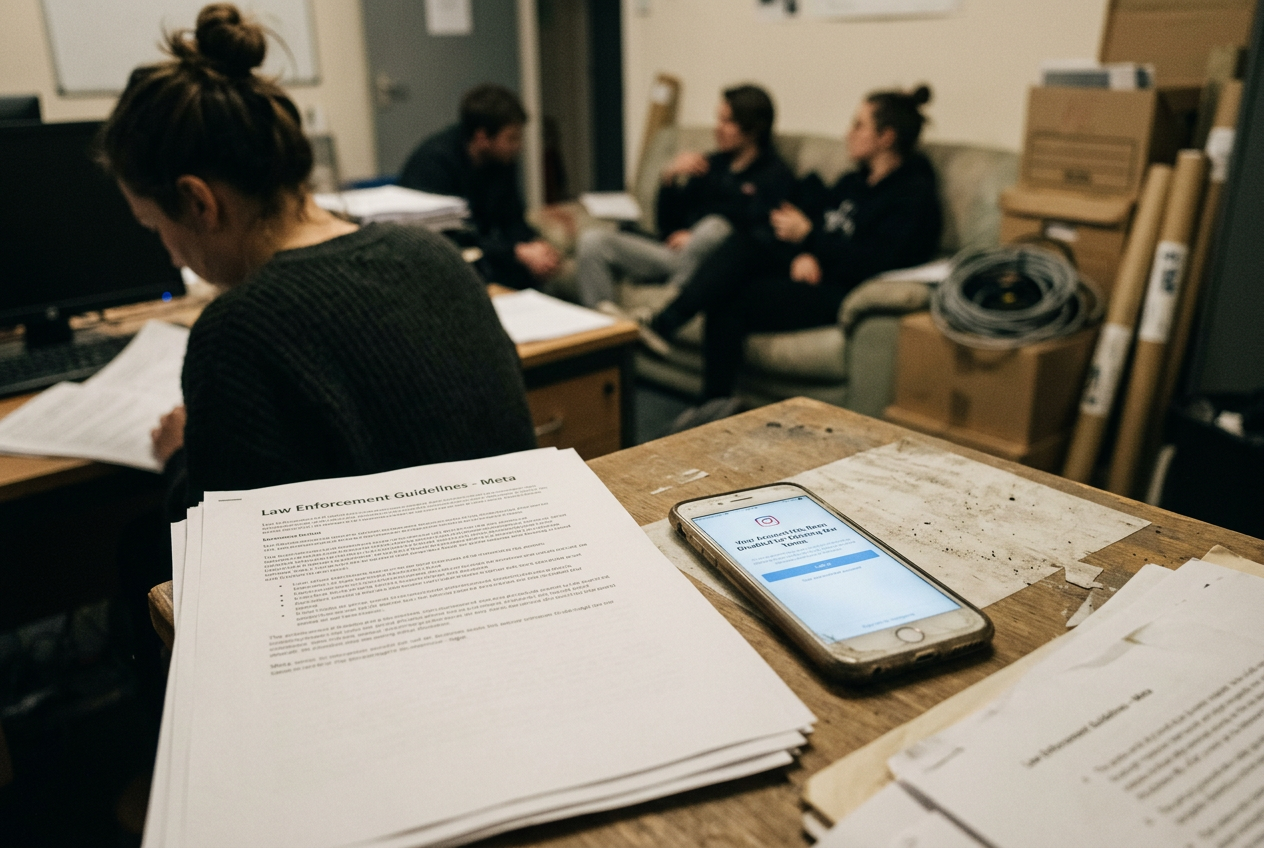
The concrete object here is Instagram’s disabled-account notice. It occupies one phone screen. The profile no longer loads, posts disappear from public view, and the person behind the account may lose access to messages, contacts and appeal tools.
That screen looks final. Institutionally, it is not.
Meta’s documentation separates visibility, deletion, preservation and disclosure, even though the interface compresses them into one apparent event: the account is gone. Each action belongs to a different system, answers to a different internal team and can leave a different copy of the same post in place.
This matters most after law enforcement has requested records. Removing an account does not recall a disclosure already delivered, and disabling one does not necessarily start Instagram’s deletion timetable. Moderation removes a person from the room. It can leave the file cabinet intact.
The public-post clock starts before the ban
Take a public Instagram post that later becomes part of a moderation case. While the post is visible, anyone who can reach it may save the image, record the caption, note the username or capture the page. That includes other users, commercial monitoring services, journalists and government investigators viewing material available to the public.
Instagram controls the live version on its service. It does not control every screenshot, screen recording, browser cache or downloaded copy made while the post was public. There is no universal expiration clock for those copies, because they sit in systems owned by other people and institutions.
A platform ban therefore changes access going forward. It does not reverse publication. The distinction sounds obvious until the disabled-account notice appears and the original URL stops working, which encourages the false conclusion that the underlying material has vanished everywhere else too.
Law enforcement may also seek nonpublic account records from Meta. According to Meta’s published law-enforcement guidance, the material available depends on the legal demand and what Meta still holds. A disclosure can range from subscriber details and connection records to stored account content, with stronger legal process generally required for content in the United States. A search warrant, for example, is a court-authorized demand based on probable cause; it can compel stored content covered by its terms.
The platform’s public guidance describes categories and procedures. It does not promise that every requested field exists, nor does it mean every police request automatically receives a complete account. Scope, jurisdiction, the form of legal process and the records available at the time all matter.
Once Meta sends records, however, the agency has its own copy. Instagram cannot make that copy disappear by banning the account, approving an appeal or later completing account deletion. The receiving institution controls its evidence systems and retention rules. Meta’s documentation largely ends at the handoff, which is precisely where the user’s control ends too.
A disabled account is not a deleted account
Meta’s help documentation treats account deletion as a user-initiated process with a cancellation period. For Instagram, the company says an account and its information are permanently deleted after 30 days, while the broader deletion process can take up to 90 days. During the initial period, the material is not available to other Instagram users.
That last phrase does a lot of work. Unavailable to other users does not mean erased from every Meta system.
Meta says copies may remain after the main deletion period in backup storage used for recovery from data loss or technical failure. It also reserves the ability to retain information for legal issues, terms violations, harm-prevention efforts and other stated obligations. Those exceptions make the public timetable a qualified commitment, not a universal destruction deadline.
A moderation ban follows another path. When Instagram disables an account for an alleged rules violation, the immediate action concerns access and visibility. Meta may need the associated records to review an appeal, document enforcement, detect attempts to return or address legal obligations. Its privacy documentation says retention depends on why the information is needed, including service operations, safety, legal compliance and protection of rights.
This is the point hidden by the disabled-account notice. The screen reports the user-facing status of the account. It does not certify that backend records have entered the deletion queue, list which records remain, identify backup copies or disclose whether a legal hold has interrupted ordinary deletion.
The company has reasons to keep those systems separate. Moderation needs to act quickly enough to remove material or users from view. Deletion has to work across active databases, backups and connected services. Legal-response staff must avoid destroying records covered by a valid preservation demand.
Combining all three into one irreversible button would create operational and legal risk for Meta, while separating them leaves the user with a clean screen and a messy institutional afterlife.
The difference also cuts against a familiar platform defense. Companies often present moderation as decisive when discussing safety and provisional when users demand an explanation. Both descriptions can be true because the decisive part is public visibility, while the provisional part concerns records, appeals and enforcement history. The account can be socially dead and administratively useful.
A preservation request starts a third clock
A preservation request tells a provider to freeze records it already possesses while law enforcement obtains the legal process required for disclosure. In the United States, Meta’s guidance points to the Stored Communications Act, the federal law governing government access to many stored electronic records.
Under that framework, a qualifying request can require preservation for 90 days, with one additional 90-day extension. This clock is binding in a way an interface message is not. The legal duty falls on the provider once the statutory requirements are met.
Preservation is not the same as disclosure. It does not, by itself, authorize Meta to hand over everything, and it is not an order to collect a running feed of future activity. It keeps specified existing records from disappearing while investigators pursue a subpoena, court order or warrant appropriate to the material they seek.
That distinction explains how an account can move through contradictory-looking states. A post may disappear from public view today. The account may be disabled before a deletion request can be completed. Records covered by a preservation demand may remain frozen even as Meta’s ordinary retention systems would otherwise remove them.
If lawful process later compels disclosure, the resulting package may outlive the profile, the phone and the moderation dispute that made the account disappear from view.
Meta also asks law enforcement to identify accounts precisely and submit requests through its designated system. That administrative detail matters. Preservation attaches to records the company can identify and still holds; it does not reconstruct information that was never stored or had already been deleted before the request arrived.
The clocks can therefore produce different outcomes based on timing. Investigators who save a public post before removal already possess that copy. A preservation request arriving while account records remain may stop their ordinary deletion. A demand that arrives after relevant records are gone cannot make Meta regenerate them.
The disabled-account notice reveals none of this sequence.
The package leaves the platform’s jurisdiction
People often speak about “their data” as if possession remained singular. A law-enforcement disclosure makes the plural unavoidable. Meta may retain one version, backup systems may hold another, and an agency may store the produced records in an investigative or evidence platform. Prosecutors, defense lawyers, courts or outside forensic contractors may later receive additional copies under the rules governing a case.
Their retention clocks do not come from Instagram’s deletion page. They may be shaped by evidence policies, public-records law, litigation duties, court orders and agency systems. None of those clocks resets because Meta restores the account or concludes that a moderation action was mistaken.
This is where platform transparency becomes thin. Meta publishes enough documentation to show that preservation and disclosure exist, but a user looking at a disabled profile cannot see whether either occurred. Legal demands may be accompanied by restrictions on notice, and Meta’s ability to notify users depends on law and circumstance. Silence is not proof that no request exists.
It is also not proof that one does.
The honest claim is narrower. A ban tells you what Instagram has done to access. It does not tell you what Meta retains, what law requires it to freeze, what it has disclosed or what another institution now stores.
That should change how moderation is described. “Removed” is a visibility status unless the company specifies otherwise. “Deleted” comes with staged processing and exceptions. “Preserved” means ordinary deletion has been interrupted for identified records.
“Disclosed” means a copy has crossed the institutional boundary and cannot be pulled back through an Instagram setting.
The disabled-account notice remains on the phone. Behind it, several clocks keep running, and only one of them belongs to the person who can no longer log in.
Questions people ask
Does
Instagram delete data immediately after banning an account?
No. Disabling an account removes access and public visibility, while deletion follows a separate process. Meta’s documentation also allows retention for backups, safety, legal compliance, terms enforcement and other stated needs, so a ban should not be read as a destruction notice.
Can police obtain an
Instagram post after it has been deleted?
Possibly, if a copy was saved while public or relevant records still exist in Meta’s systems and lawful process reaches them. A preservation request can freeze records Meta already holds, but it cannot recreate material that was gone before the request arrived.
Does a preservation request give police the account automatically?
No. Preservation keeps specified existing records from being deleted for a limited period. Law enforcement still needs the appropriate subpoena, court order or warrant before Meta may be compelled to disclose particular categories of information.
Can restoring an
Instagram account erase records already sent to police?
No. Once Meta has disclosed records, the receiving agency controls its copy under the rules that apply to its investigation and evidence systems. Restoring the profile changes the account’s status on Instagram; it does not recall material already delivered elsewhere.
One update a day
Today's story, in your inbox
One story each morning — no hype, no filler, no algorithm deciding for you.