Your Protest Livestream Outlives the Protest
Once public video is copied, deleting the stream does not recall it. Investigators can search old footage by faces, clothing, words, places and time.
August 23, 2026 · 8 min read
During the January 2021 attack on the US Capitol, one garment became an index: a sweatshirt printed with “Camp Auschwitz” and “Work Brings Freedom.” It appeared across public photographs and video, then in federal case materials. The wearer did not need to announce his name on camera. The sweatshirt connected frames that might otherwise have looked unrelated.
That is the useful, ugly lesson. Public video is no longer merely a broadcast watched by whoever happened to be online. It becomes a file, then a set of frames, then a searchable collection of faces, text, clothes, voices and locations. The original audience can disappear while the evidence keeps acquiring new audiences.
This does not mean every livestream becomes admissible evidence, or that every identification made from one is accurate. It means the recording has entered an ecosystem the broadcaster does not control. Platforms keep data. Viewers make copies.
Researchers archive posts. Police collect public material directly or receive it through tips. Commercial vendors sell tools that make a pile of visual material easier to search.
The livestream ends. The circulation does not.
A broadcast becomes several records
A livestream feels temporary because the interface emphasizes the present: viewer counts, comments, a red recording symbol, the small panic of a battery icon. Underneath, the platform is processing video into different sizes and sending those versions through its delivery network. Depending on the service and account settings, it may also retain a replay, account records and technical logs.
Viewers add another layer. They can screen-record a phone, download a replay, clip a section or point a second camera at the display. Newsrooms and independent archivists may preserve footage because it documents police conduct. Political groups may save the same footage to identify opponents.
A deletion request to the original platform does not reach those copies.
Even a poor copy can be useful. Investigators can extract still frames, slow a sequence and compare the same person across several cameras. Optical character recognition, software that turns visible writing into searchable text, can pick up a slogan, street sign or business name. A distinctive garment may connect the person leaving one block with the person entering another.
The “Camp Auschwitz” sweatshirt worked this way: the text made the body wearing it easier to follow across a crowded visual record.
Sound also travels. A stream may capture a legal name shouted from off-camera, the name of an organizing group, a transit announcement or a meeting point. Automatic transcripts are messy, especially in crowds, but they give a searcher terms to test against the recording. A human can correct the machine later.
Cheap indexing turns hours of video into a document someone can query.
Search changes the value of old footage
A forgotten clip becomes more useful when another record arrives. Police may already have body-camera footage, building surveillance, license-plate data, an arrest photograph or material submitted through a public tip portal. A public stream can supply the bridge between them.
Facial recognition adds another route. The technology compares measurements from a face in one image with faces in a larger collection and returns possible matches, not a finding of identity. Public reporting has documented law enforcement use of commercial facial-search systems, including during investigations tied to the Capitol attack. The result can be wrong, particularly when the source frame is blurred, angled or badly lit, yet a bad candidate list can still redirect an investigation toward a real person who must then deal with the consequences.
Clothing searches can be more basic and, in a dense camera environment, more persuasive than people expect. A black helmet, pale backpack or patch on one sleeve narrows the field when several recordings cover the same few minutes. None of those details is unique in isolation. Sequence supplies the force: the person with the patch appears beside a particular sign, passes a particular storefront and later stands near an arrest.
The vendors benefit from making this material searchable. Platforms benefit from keeping people live and sharing. Police departments pay for software, data access and analysis, while the people captured in the footage receive neither notice nor control. The broadcaster gets engagement metrics.
Everyone else inherits the archive.
Investigation is not admission in court
Police being able to view a video is different from a prosecutor being able to introduce it at trial. Public material generally requires no special legal process to watch. Nonpublic account content and provider records can require a subpoena, court order or warrant, depending on what the government seeks and which law applies. A preservation request can direct a provider to retain existing account data while investigators pursue the required process; it is not, by itself, permission to receive everything preserved.
In court, authentication is the first practical gate. Under the federal evidence rules, the party offering a video must produce enough information to support a finding that it is what the party claims. A witness might recognize the scene, or the file’s metadata, upload history and distinctive details might establish the connection. State rules vary, and judges decide disputes in context.
A repost is not automatically excluded because it is a copy. Courts often admit duplicates unless there is a genuine dispute about authenticity or admitting the copy would be unfair. Nor is every spoken line automatically hearsay, a statement offered to prove the truth of what it says. Words may be offered to show identity, notice or effect rather than truth.
Those distinctions are binding only as a court applies the relevant rules to a specific case.
Editing still matters. A clip that removes the minutes before police use force may create a false sequence without containing a technically altered frame. Compression can obscure detail. Missing audio can change meaning.
Chain of custody, the record of who possessed and handled evidence, helps explain what happened to a file, though gaps often affect how much weight a judge or jury gives it rather than producing automatic exclusion.
The evidentiary threshold is not a quality seal. A video can be admitted and still be incomplete, misleading or wrongly interpreted.
Preserve an original before making a safer copy
If the purpose is to document misconduct, the most defensible workflow separates preservation from publication. Keep the original file unchanged. Make a working copy for clipping, captions and redaction. Record the account URL, approximate capture time with time zone, location if safely known, and how the file was obtained.
Notes made close to the event can explain details that become opaque months later.
A cryptographic hash, a digital fingerprint calculated from a file, can help show that an original has not changed. Alter the file and the hash changes. It does not prove the recording is true or complete, but it can support a later account of which version was preserved first.
Storage creates its own exposure. An original containing faces and voices should not drift through shared folders merely because cloud syncing was convenient. Limit access to people who need it, use encrypted storage where practical, and decide who can authorize release. Keeping everything forever is not neutral.
It extends the period in which a breach, subpoena, internal dispute or careless link can expose the people recorded.
These practices reduce avoidable damage. They do not create anonymity, establish a legal privilege or replace advice from a qualified lawyer in the relevant jurisdiction.
Redaction has to survive the exported file
Livestreaming offers almost no review window. Recording locally and publishing later creates time to inspect the frame, although delayed publication can reduce the immediate accountability value that made live video attractive. That tradeoff is real. A platform toggle cannot resolve it.
Start beyond the face. Tattoos, mobility aids, patches, jewelry and distinctive shoes can identify someone across recordings. So can the route they take home. Reflections in windows may reveal people outside the intended frame, while audio can expose names, medical information or an organizer’s instructions.
Location metadata stored by the device may remain in the original even when a platform strips it from the public upload.
For a public copy, an opaque mask is generally harder to interpret than light pixelation or a cosmetic blur that leaves the shape of a face intact. Export the redaction into a new flattened file and watch that file from beginning to end. Tracking masks can slip for a few frames. Captions can restore a name that was muted in the audio.
A thumbnail may display an unredacted opening image even when the later frames are covered.
Keep the unredacted original separate if preservation is necessary. Do not overwrite it with the edited version, and do not assume the platform will preserve your preferred copy. Once the public export is posted, another person can pair it with neighboring footage and reconstruct what the crop removed.
The sweatshirt from the Capitol footage is the blunt version of this problem. Covering a face would not have hidden text that distinctive. Redaction must account for the whole person and the surrounding sequence, not just the rectangle where a face appears.
The decision happens before the live button
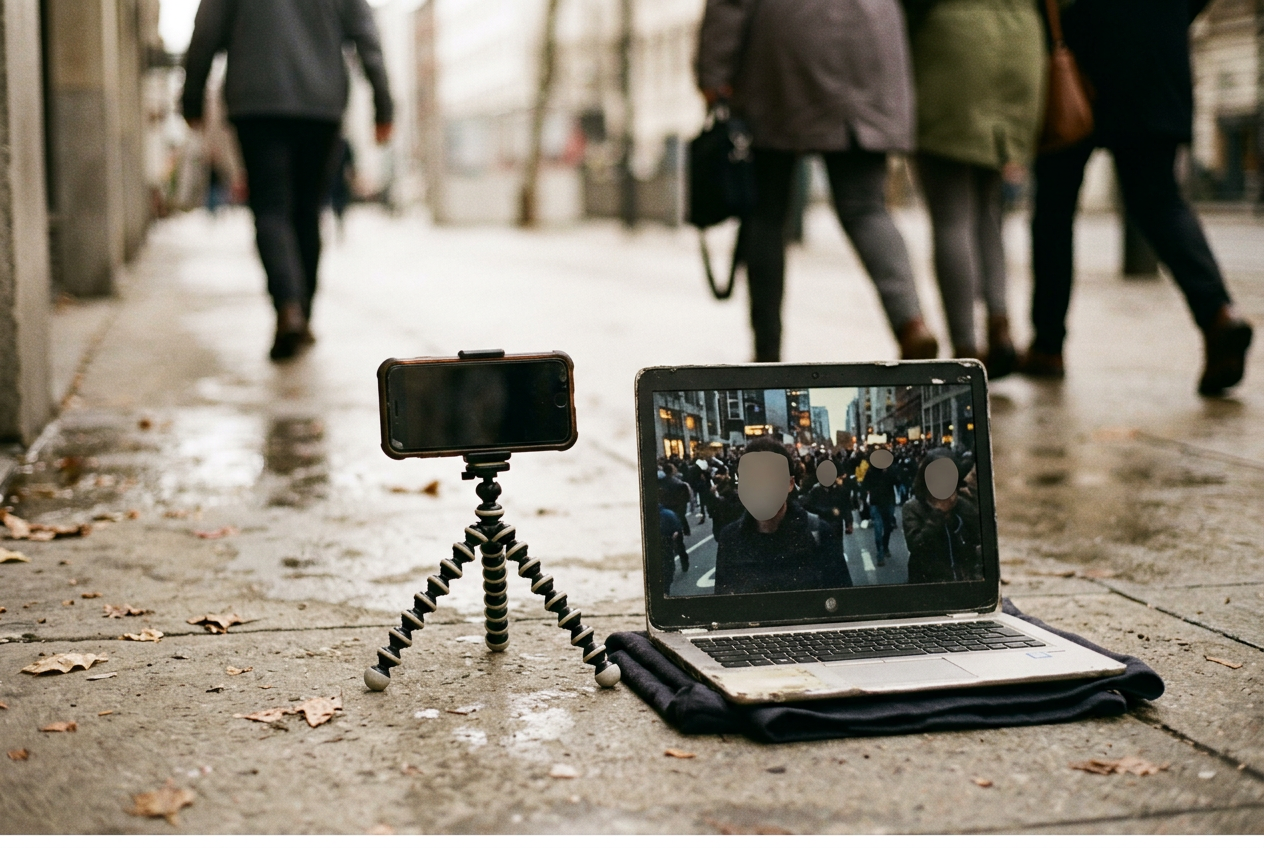
A broadcaster can decide in advance whether the job is immediate public transmission or durable documentation. Trying to do both from one phone, in a moving crowd, pushes every privacy decision into the worst possible moment.
A narrow frame can avoid bystanders but lose context around police conduct. A wide frame can establish sequence while collecting dozens of uninvolved faces. Filming from behind may reduce facial exposure, though clothes, gait and companions still connect people across cameras. Delaying a post can create a redaction window.
It can also delay scrutiny when official accounts are already hardening into fact.
There is no universal setting. There is only a clearer statement of purpose, a smaller collection of unnecessary identifying detail, and an honest warning to people nearby that public footage may be copied. Anyone promising that a blur, disappearing-story setting or deleted account will make a protester anonymous is selling confidence the technology cannot deliver.
Questions people ask
Can police use a protest livestream without a warrant?
Police can generally watch and save material made public, just as any viewer can. Access to private messages, nonpublic account content or certain provider records may require legal process, and the required process depends on the data and jurisdiction. Public availability does not guarantee that a court will admit the recording.
Does deleting a livestream remove it from an investigation?
Deletion may remove the public replay from the original account, but it cannot recall screen recordings, downloads, tips, archives or copies already preserved by the platform. A preservation request may also require a provider to retain existing data while investigators seek the legal authority needed to obtain it.
Is blurring faces enough to protect protesters?
No. Clothing, tattoos, voices, companions, routes and visible text can connect a person across recordings, while weak blur or faulty motion tracking may expose frames. Redaction can reduce risk, especially when applied before publication, but it cannot promise anonymity once several cameras have documented the same event.
Can an edited protest video still be used in court?
Potentially. The party offering it must authenticate the recording, and disputes about missing context or alteration can affect admission or weight. Preserving the untouched original, documenting edits and keeping the redacted export separate makes the file history easier to explain, down to the sweatshirt visible in each version.
One update a day
Today's story, in your inbox
One story each morning — no hype, no filler, no algorithm deciding for you.