Your Protest Livestream Can Identify People Who Never Went Live
Live video can document misconduct while handing faces, movements and permanent copies to police or harassers. Most platform privacy tools arrive after exposure.
August 21, 2026 · 7 min read
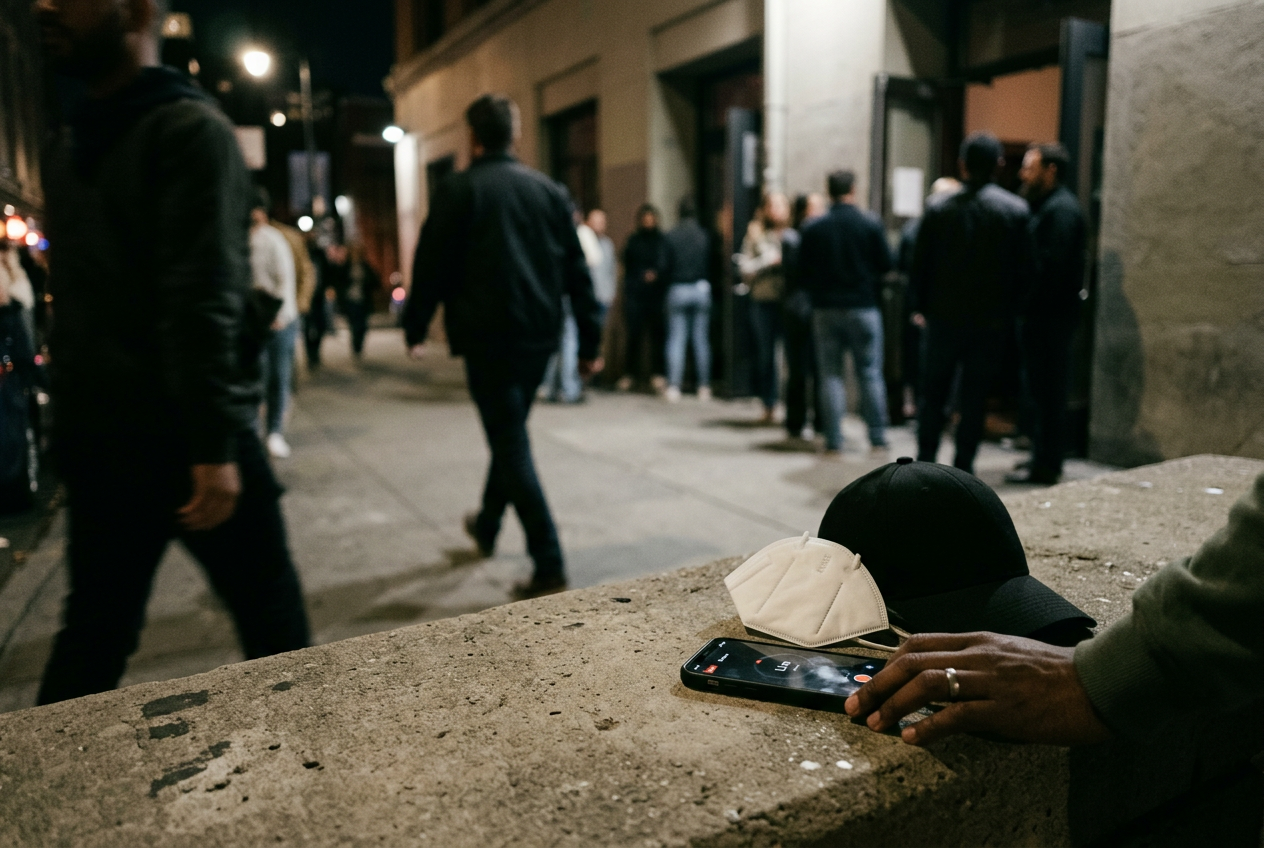
Start with a white, folded KN95 held by ear loops beneath a plain black baseball cap. Straight on, the mask covers the lower face and the brim shades the eyes. Turn sideways, look up or enter bright light, and the arrangement stops doing what its wearer hoped. The profile remains visible.
So do the ears, hairline, clothes, gait and the people walking beside them.
Now put that person in the background of a livestream.
They did not choose the camera, write the caption or approve the archive. They may not know they appeared until a colleague sends a screenshot, a campus administrator recognizes the jacket, or a hostile account posts a clipped frame beside a name. The streamer controls publication. The person in the white mask carries the consequences.
That asymmetry is the central privacy problem with protest livestreaming. A camera can deter misconduct and create an independent record when official accounts change. It also produces evidence that institutions, employers and harassers do not need to collect themselves. Both uses begin with the same pixels.
The privacy controls protect accounts, not crowds
Instagram Live, TikTok LIVE and YouTube Live give streamers controls over audiences, comments, account visibility and the recording after transmission. Those controls matter. They do not amount to meaningful consent for people inside the frame.
The useful test has four parts. Can the streamer conceal a bystander’s face before viewers receive it? Can the streamer keep the route from becoming public? Can a person in the frame object without controlling the account?
Can the streamer recover every copy after the broadcast ends?
On the major consumer platforms, the answer is usually no.
YouTube offers face and custom blurring for video in its post-upload editor, which can help with an archived stream. That is an editing control, not a shield over the live transmission. Instagram and TikTok provide effects and moderation tools, but they do not give a streamer dependable, automatic blurring for every bystander moving through a live crowd. Face effects are designed around the person holding the phone.
The crowd remains raw material.
Location protection is similarly narrow. Turning off a location tag prevents one explicit label. It does not remove street signs, transit announcements, storefronts, police unit markings or the route visible over the streamer’s shoulder. Open-source intelligence, meaning information assembled from publicly available material, can place a video through those clues without access to the phone’s GPS data.
Archive settings close only one door. A platform may save a replay, let the creator download it or allow deletion later, depending on the service and account settings. Viewers can screen-record the original transmission, clip it through platform tools or point another camera at the screen. Deletion changes what the originating account supplies.
It cannot recall the broadcast.
The white KN95 and black cap therefore face two systems. One is the platform’s stated privacy architecture. The other is the practical ability of anybody watching to pause, enlarge, copy and compare. The second system wins most of the time.
Build the frame before the crowd enters it
A streamer should establish a threat model before going live. A threat model is a plain account of who may seek the footage, what they could infer from it and which people would bear the harm.
At a protest, that group may include police, immigration authorities, school officials and organized harassers. The risk will not fall evenly. A legal observer standing openly in an identified role occupies a different position from an undocumented attendee, a minor or somebody whose employer does not know they are there. A public street is not an equal-risk environment merely because everyone can be seen.
The safest framing begins tighter than most social video encourages. Keep the lens on the conduct being documented rather than sweeping across the crowd for scale. Film officials from an angle that places demonstrators behind the camera where possible. Avoid slow pans over faces.
Do not linger on tattoos, mobility devices, name badges or distinctive clothing when those details add nothing to the record.
This costs attention. The person filming has to watch the edge of the frame while following events, and that is harder than holding a phone overhead and letting the platform consume whatever enters. It may also produce less dramatic footage. That is a reasonable loss.
The crowd is not free production design.
The mask-and-cap combination shows why framing matters more than presumed anonymity. A folded KN95 obscures the mouth and much of the nose, but a high camera angle can expose the eyes while a side view preserves the profile. No ordinary garment makes identification impossible. The streamer can still keep that face out of the shot.
Account settings come next. Disable public location labels and avoid captions that announce an exact intersection, meeting point or planned route. A limited audience reduces distribution but does not create confidentiality, because approved viewers can save and forward what they receive. Assign another person to monitor comments if staffing permits.
A commenter who names somebody in the frame has converted visual exposure into searchable identification, and the camera operator may not see it while filming.
Treat live as publication, not capture
Recorded video leaves time between an event and its audience. Live video removes that interval, which is precisely why platforms promote it and why it is so difficult to make safe. There is no edit bay between the white KN95 entering the frame and a stranger taking a screenshot.
Use verbal warnings when filming near people who may not see the phone, provided an announcement does not interfere with immediate safety. If someone asks not to appear, redirect the lens rather than debating the legal boundaries of public photography in the middle of a volatile scene. Recording rules vary by jurisdiction. A platform’s permission to stream is not a finding that every use of the footage is lawful or responsible.
Avoid narrating identifying details. A streamer can document an arrest without stating the arrested person’s name, workplace or immigration status. Do not read information from a sign-in sheet or medical bracelet. If a participant is injured, keep the camera away from their face unless they give informed permission and the image has a clear documentary purpose.
Comments need active moderation because identification often happens there rather than through sophisticated facial recognition. One viewer recognizes the jacket. Another supplies a first name. A third links an account.
The platform has now assembled a dossier through ordinary engagement features, with no specialized surveillance tool required.
Commercial incentives run in the opposite direction. Live video keeps viewers present, generates comments and gives the platform more behavioral data about what holds attention. Broad reach benefits the service and can benefit the streamer. The bystander receives no revenue, no moderation dashboard and no reliable veto.
They are visible inventory.
The archive has more than one owner
After the stream, inspect the replay before leaving it public. On YouTube, apply available blur tools to exposed faces and distinctive details. On any platform, cut sections that reveal staging areas, vehicles or people receiving medical support. If the service does not support adequate editing, remove the replay and upload a redacted version instead.
That work can take longer than the stream. Blurring moving people frame by frame is slow, automated tracking can lose a face when it turns, and compressed footage makes review harder. A static blur may also fail when the subject moves outside it. Watch the full result rather than trusting the first tracking pass.
Save an original only when there is a defined reason, then protect access to it. Cloud photo backups can create another copy outside the social platform. Shared folders can widen access through permissive links. None of this means footage should never be preserved.
It means preservation is an affirmative decision with custodians, copies and foreseeable claimants.
Public video may be viewed or downloaded by police without a demand to the platform. Account records or nonpublic material are different: companies describe how they respond to subpoenas, warrants and other legal process in their transparency materials, while a preservation request asks a provider to retain specified data pending further process. Deleting a public replay does not erase a copy already obtained by another party.
Platforms also offer reporting and privacy complaint routes, but these are remedial. YouTube can consider whether a person is uniquely identifiable in a privacy complaint, alongside public interest and newsworthiness. Meta and TikTok accept reports under their own rules. None of those channels prevents the first exposure, and review can arrive after the useful window for identification has passed.
Return to the white KN95 beneath the black cap. The wearer took a concrete precaution. Its fit failed at the profile, as most improvised concealment does. The platform offered tools to manage the account.
The only person positioned to prevent the shot was still the streamer.
Questions people ask
Can a protest livestream automatically blur every face?
Major consumer livestreaming platforms do not offer a dependable control that detects and obscures every bystander before the video reaches viewers. YouTube can blur faces or selected areas during later editing, but moving crowds, side profiles and partial obstructions still require review.
Does deleting a livestream remove it from the internet?
Deleting a replay removes the copy controlled by that account or platform surface. It does not erase screen recordings, downloaded clips, reposts or copies already obtained by institutions. Search for reposts, document harmful copies and use the relevant platform reporting channels, while recognizing that removal may remain incomplete.
Can police use footage that was streamed publicly?
Publicly available footage can generally be watched and copied like other public material. Access to nonpublic content or account records follows different legal processes and varies by jurisdiction, but the practical distinction is blunt: police do not need a platform request to watch a stream available to everyone.
Is filming a protest always harmful?
No. Video can document force, establish a timeline and challenge official narratives. The safer practice is to film the conduct that needs a record while excluding uninvolved people, then review any archive before publication. The evidentiary value lies in the event, not in collecting every face around it.
One update a day
Today's story, in your inbox
One story each morning — no hype, no filler, no algorithm deciding for you.