AI Recipe Videos Don’t Need the Food to Work
A giant cheese-stuffed onion ring kept its perfect shape as it crossed platforms, even while the recipe beneath it changed. That mismatch is the business model.
August 19, 2026 · 8 min read
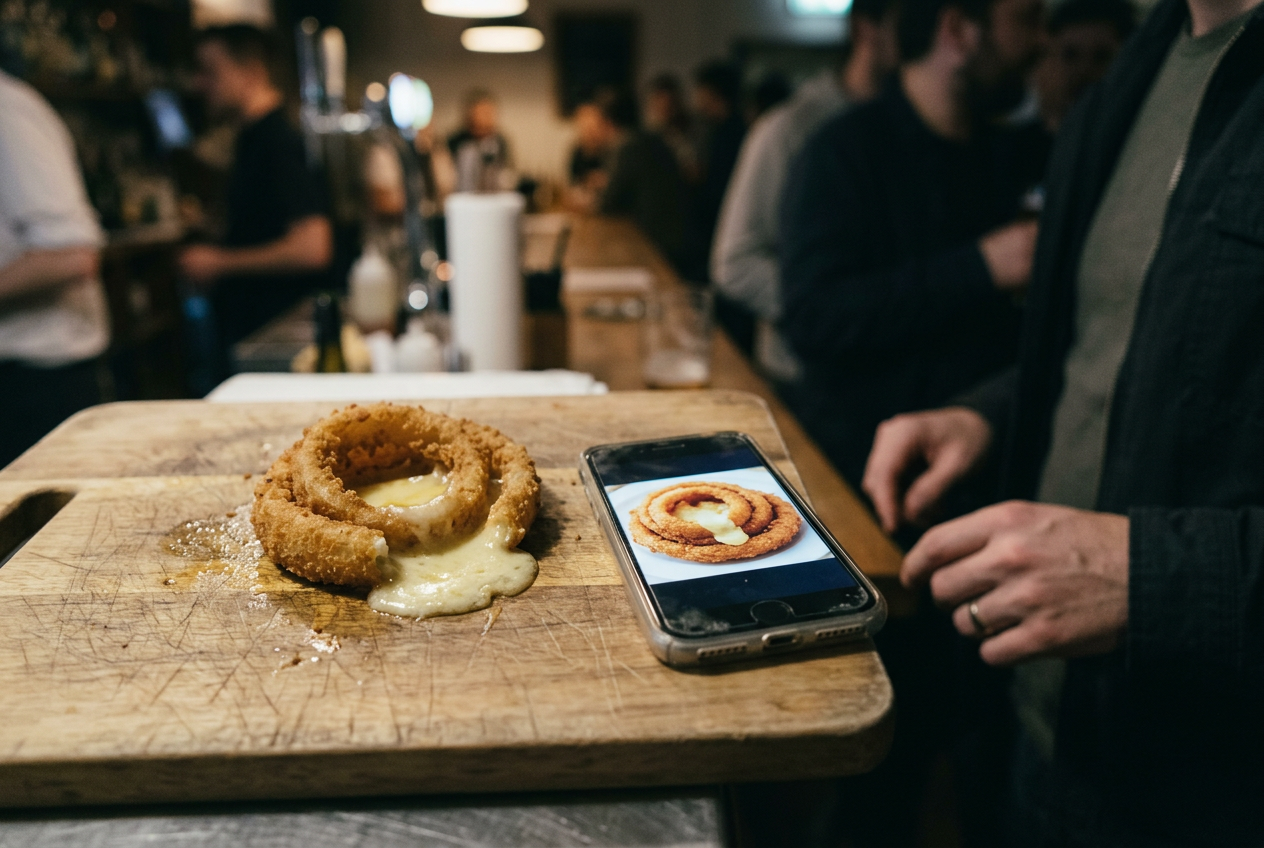
The onion ring looked architectural. It was as wide as a dinner plate, evenly breaded, and packed between its concentric layers with molten orange cheese. A knife passed through without dragging the filling. The cut face held its shape.
No steam softened the crust, no cheese escaped through a gap, and no onion layer slid out of position.
It appeared in several short-form posts with different crops, different text overlays and captions that did not agree about how to make it. One version described separating the onion into rings and nesting them around cheese. Another treated the onion as a single object to be stuffed, breaded and baked. A third caption introduced ground meat that never appeared in the pictured cross-section.
The image remained stable. The recipe moved around underneath it.
That is the useful fact. The problem with AI recipe videos is larger than synthetic food looking strange, although the physics can be entertaining. Their durability comes from a split between the part platforms can measure and the part they cannot. A platform can register that you paused, replayed, saved, commented or sent the clip to someone.
It cannot see the onion collapsing on your cutting board later that evening.
The picture makes a promise the caption does not have to keep
I treated the onion-ring post as a cooking document rather than a piece of spectacle. First came the frame-by-frame check. The outer crust showed a nearly identical crumb pattern before and after the cut, while the cheese retained a smooth internal surface instead of stretching, tearing or coating the knife. The onion layers had no visible fasteners, batter seams or compression where the blade entered.
None of those details alone proves that an image was generated. Together, they show that the video withholds the transitions a cook would need to verify. The crucial actions happen outside the frame: assembling the layers, moving the breaded onion into hot oil or an oven, turning it, and lifting it onto the board without breaking it. The clip offers preparation fragments and then a finished object.
Continuity, meaning evidence that the same food persists across shots, is missing.
The caption sounds more complete because it contains recognizable kitchen verbs. Slice. Stuff. Coat.
Bake. Those verbs create procedural confidence without resolving the physical problem. Onion contracts and releases water under heat. Cheese melts and seeks an exit.
Breadcrumb coating does not brace several slippery concentric layers into a freestanding wheel.
A basic kitchen reconstruction exposed the gap. Separating a large onion into intact nested rings was manageable; packing cheese between them without distorting the shape was not. Coating the assembled object required pressure, which shifted the inner rings, while heating softened the onion before the exterior could become the rigid shell shown in the post. The result remained food.
It was also recognizably onion, cheese and crumbs. It did not become the object in the video.
That distinction matters. A failed AI recipe can still produce something edible, which gives the publisher cover and leaves the cook wondering whether technique was the problem. The post never has to claim that every layer will remain mathematically aligned. It only has to place an image of that outcome above a plausible list of ingredients.
The caption is portable infrastructure
Across reposts, the onion image carried more authority than any specific method. Captions could be shortened, expanded or replaced because their main function was not to preserve a tested recipe. They supplied searchable ingredient terms, a reason to save the post and enough detail to head off the immediate complaint that no recipe had been included.
Copied captions often degrade through a familiar chain. A generated image or video appears with a loose description. Another account adds measurements or cooking temperatures from a conventional recipe for a vaguely similar dish. A later repost trims the wording to fit a platform caption, strips attribution and keeps the most engagement-friendly instruction: save this for later.
At each transfer, the post becomes harder to audit. The image may have come from one account, the method from another site and the voice-over from a text generator. Reverse-searching a frame can reveal earlier appearances, but provenance is often less useful than it sounds because the earliest discoverable upload may already be an automated compilation. The content has been assembled from parts that were never required to agree.
The onion ring’s conflicting captions were therefore a feature of circulation, not an incidental editing error. A tested recipe binds its photograph to a sequence of actions. Portable recipe content breaks that bond. The picture attracts attention; the caption catches search traffic and saves; the account keeps whatever distribution follows.
No single creator needs to maintain the fiction for long. The post can be downloaded, cropped and reissued by accounts operating across TikTok, Instagram Reels, Facebook and Pinterest, with each platform providing another chance for the same visual to find an audience unfamiliar with its earlier versions. The food does not improve during that journey. Its metadata does.
Failure arrives outside the ranking window
Recommendation systems, the software that selects and orders posts for each user, do not need to determine whether a recipe works before distributing it. Full ranking formulas remain private, and they differ by platform, but the interfaces openly solicit measurable actions such as likes, shares, saves and comments. AI food is engineered to invite those actions before anyone shops for an onion.
Visual novelty does most of the work. The giant ring is legible within a second, looks difficult enough to feel valuable and uses familiar ingredients that lower the viewer’s suspicion. Saving it is easier than evaluating it. Commenting on whether it is real also helps the post circulate, as does tagging someone who might attempt it.
Kitchen verification has the opposite tempo. A viewer must remember the saved post, buy ingredients, prepare the dish, wait through cooking and decide whether the discrepancy came from the recipe or their own hands. By then the original video may be buried among hundreds of saves. A warning comment, if the cook leaves one, competes with immediate reactions from people who have not tried anything.
This produces an asymmetric feedback system. Success is recorded at the moment of desire. Failure is delayed, dispersed and psychologically expensive to report, especially when the outcome is an unattractive but edible pile rather than a dramatic hazard. The ranking system sees a strong post.
The cook sees a weak recipe. Neither view is required to correct the other.
Comments calling an image fake do not necessarily solve the problem. They can turn verification into another engagement prompt, extending the life of the clip while preserving the spectacular frame at its center. The onion ring does not need universal belief. It needs enough hesitation for people to stop scrolling.
Who gets value from the impossible onion
The immediate beneficiaries vary. An account may receive platform revenue where such payments are available, direct viewers toward an ad-supported recipe site, build a following for later sponsorships or place affiliate links near cookware and ingredients. Reposting at volume also lowers the cost of discovering which visual premises travel. Most attempts can disappear.
One giant onion wheel can be repackaged repeatedly.
Platforms receive inventory that is cheap to produce and easy to test. Each clip creates another surface for advertising and another set of behavioral signals about what holds attention. The platform does not need the account to earn much from a particular post; abundant supply is useful on its own.
The costs land elsewhere. Viewers lose time, ingredients and confidence. Legitimate recipe developers compete with posts that skip testing, reshooting and correction, all of which make real food publishing slower and more expensive. The copied caption can imitate the shape of their work without paying for its central service: proving that the instructions and result belong together.
Labels for generated media would help with provenance, but they would not fully address the onion ring. A disclosed synthetic image can still sit above a borrowed recipe, and a partially generated video can combine real preparation footage with an impossible finished shot. The practical standard should be correspondence. Does the post show the same dish being made, and do the instructions account for the result on screen?
That standard is dull. It also works. Show the assembly without strategic cuts. Show the food leaving the pan.
Let the knife drag cheese across the board. Real cooking creates friction, residue and variation. Verification means leaving those details in.
The onion wheel’s perfection was never its only tell. The more consequential evidence sat beneath it, where three captions described three different dishes while the same immaculate cross-section waited to be saved.
Questions people ask
Why do fake AI recipes get so many saves?
Saving records aspiration before testing. A visually novel dish can look useful enough to keep even when the viewer has not checked the ingredients, timing or continuity between shots. The platform receives that positive signal immediately, while any failed cooking attempt occurs much later and may never produce a public response.
Can an AI-generated recipe still be edible?
Yes. Familiar ingredients and conventional cooking language can produce edible food even when they cannot produce the pictured object. That partial success protects weak posts because cooks may blame their technique for the mismatch, particularly when the failure is messy rather than dangerous.
How can
I check an AI recipe video before cooking it?
Look for uninterrupted footage of assembly, cooking and serving, then compare every visible component with the caption. Missing transitions, conflicting methods across reposts and a finished cross-section that ignores melting, moisture or gravity are stronger warnings than odd-looking pixels alone.
Who gets paid when an AI recipe video spreads?
Depending on the account and platform, value can come from creator payments, advertising, affiliate links, sponsorship potential or traffic to an external recipe site. Platforms also benefit from cheap, abundant posts that generate watch time and interaction, whether or not the dish survives contact with a kitchen.
One update a day
Today's story, in your inbox
One story each morning — no hype, no filler, no algorithm deciding for you.