Campus Protest Rules Now Police the Tent’s Sidewalls
Public universities are recoding protest as a problem of structures, sound and sleeping. The rules look neutral because they describe equipment, while discretion decides whose equipment becomes an offense.
August 11, 2026 · 8 min read
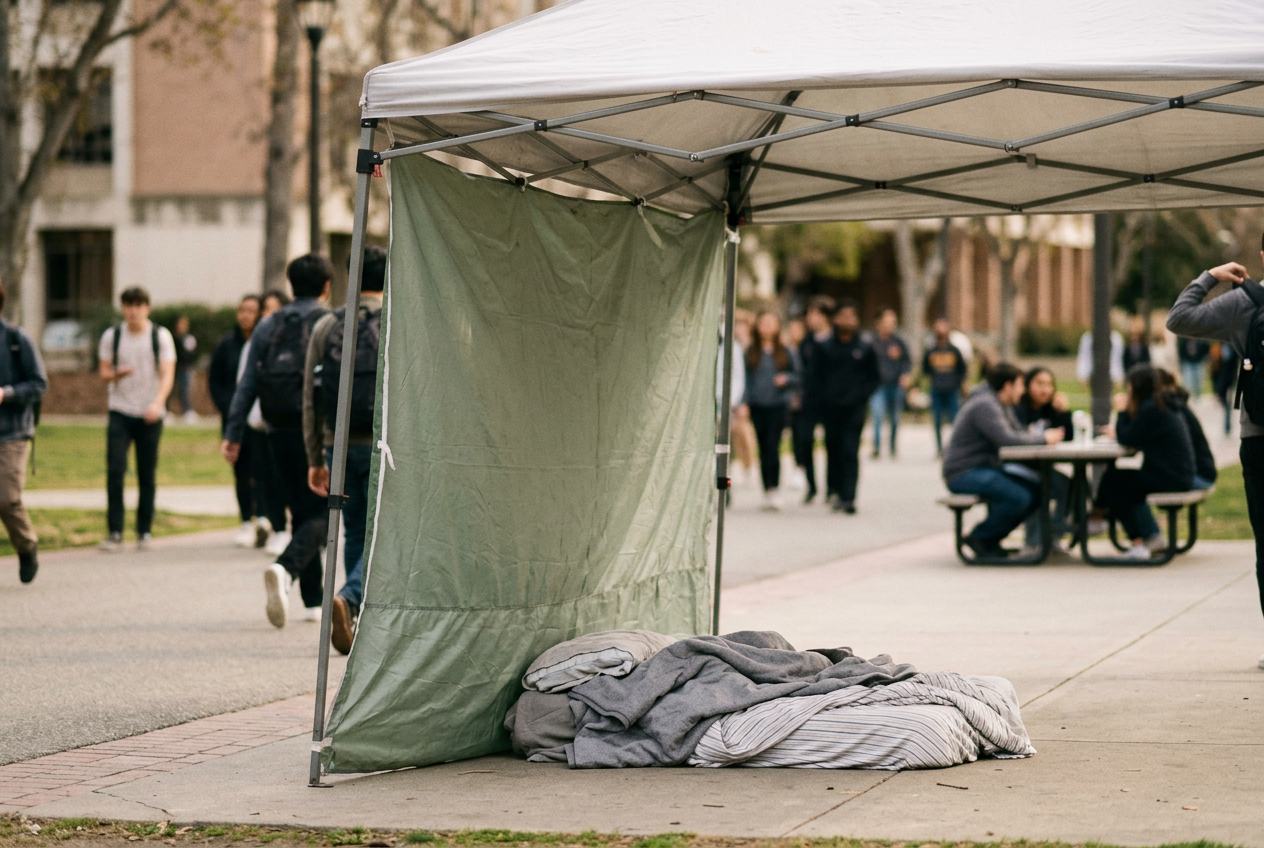
Start with a square pop-up canopy: polyester roof, folding metal frame, removable sidewalls. Open on every side and staffed during the day, it can resemble an information table or event shelter. Add fabric walls, leave bedding underneath or keep it standing overnight, and the same object can become an unauthorized structure, evidence of camping or the center of an encampment.
That conversion is the point. Across public university systems, post-encampment rules increasingly describe protest through the physical characteristics of campus space: what may touch the ground, what can remain after dark, how far sound travels and whether a face is visible. Political conflict enters the policy manual and comes back out as facilities management.
The language does real work for administrators. A university does not have to announce that a particular movement has become intolerable. It can say the canopy has too many enclosed sides, the loudspeaker lacks approval, the sleeping bag proves overnight occupation or the mask frustrates identification. Campus police then enforce a technical violation that already looks settled on paper.
It is not settled. At a public university, the First Amendment still applies, and rules that appear neutral can be unconstitutional when they burden one viewpoint, grant officials excessive discretion or get enforced against disfavored speakers. The harder question is rarely whether the institution owns the lawn. It is who gets to use it, under what conditions, and who receives a warning before the police arrive.
The canopy changes category
The University of California directed its campuses in 2024 to prohibit encampments and unauthorized structures, restrict masking intended to conceal identity and require people to identify themselves in specified circumstances. The California State University system likewise tightened systemwide rules around camping, overnight activity and structures. Individual campuses retain their own maps, reservation systems and time, place and manner regulations, which govern when, where and how speech occurs rather than what opinion it expresses.
Indiana University adopted an expressive-activity policy that restricted overnight protest, required approval for certain structures and addressed face coverings used to obscure identity. The University of Michigan also moved protest disputes into rules covering disruptive activity, structures, access and identification. The documents differ, and later litigation or revisions can change what administrators may enforce. Their shared design is more important than identical wording.
A tent is difficult for that design because it has several uses at once. It blocks rain. It stores supplies. It creates privacy.
It lets people remain. During an encampment, those functions help a protest turn from a scheduled event into an occupied place with food, medical supplies, meetings and sleep. An open canopy can be classified as temporary event equipment; attach the sidewalls and the university can classify it as shelter. Put a blanket beneath it and officials may call the activity camping.
The object has not declared a political position. Its classification has changed.
That distinction lets administrators split one protest into separate violations. The structure goes to facilities staff. Sleeping goes to student conduct. Noise goes to event management.
Refusal to leave goes to campus police. A student may face discipline through a conduct code even without a criminal charge, while a visitor may receive a trespass order that bars reentry. None of those measures needs to be labeled a speech restriction to end the speech occurring there.
Sound and masks widen the control surface
Amplified-sound rules offer a similar mechanism. Universities have a legitimate interest in keeping classes, hospitals, libraries and offices usable. Many campuses therefore limit speakers and megaphones by location, hour, volume or advance approval. The constitutional issue starts when the permit system becomes a prior restraint, meaning speech needs official permission before it can occur, without clear standards or a prompt route for review.
A decibel limit can be measured. “Disruptive” sound is looser. One administrator may tolerate a marching band, a homecoming event or a university-sponsored rally that can be heard across a quad, then treat a protest chant as interference because complaints reached the right office. The written rule supplies the vocabulary.
The enforcement record supplies the meaning.
Masks create an even less stable boundary. UC and Indiana policies have addressed face coverings worn to conceal identity, while preserving room for health, disability, religious or other protected reasons. That intent requirement sounds narrower than a blanket ban, but it asks an officer or administrator to infer why somebody covered their face during a crowded protest where illness, doxxing and retaliation are all plausible concerns.
Anonymous political speech has constitutional protection, though that does not produce an unlimited right to conceal identity in every campus confrontation. A university may investigate misconduct and require identification in circumstances authorized by valid rules. It cannot safely treat every keffiyeh, respirator or medical mask as evidence of bad intent. The factual judgment happens on the ground, often before any formal hearing, and removal from the protest cannot be undone by a favorable decision weeks later.
The square canopy appears again here. Its sidewall can protect supplies from weather or block a camera’s view. Administrators do not need to decide which purpose is politically legitimate if the structure rule forbids enclosure. Surveillance becomes an architectural question: visibility is permitted, privacy is a violation.
What is binding, and what is a press release
University announcements often blend several kinds of authority. A system president’s directive can bind campus administrators internally, but it is not a criminal statute and does not override the Constitution. A campus regulation may become enforceable through student and employee conduct codes. An event guide may describe operational expectations without carrying the same disciplinary force.
Police still need legal authority for arrest, citation or trespass enforcement.
Federal constitutional precedent matters most at public institutions because they are government actors. Under the standard for time, place and manner restrictions, a speech rule generally must be content neutral, narrowly tailored to a significant government interest and leave open adequate alternative channels for expression. “Narrowly tailored” does not mean the least restrictive imaginable rule, but administrative convenience alone does not end the analysis.
The Supreme Court’s decision in Clark v. Community for Creative Non-Violence remains important. The Court upheld a National Park Service rule against sleeping in symbolic tents on parkland, accepting the camping restriction as a valid regulation of conduct. Universities can point to that precedent when they prohibit overnight occupation.
It does not grant them a blank check to define every extended protest as camping or to enforce a nominally neutral ban only when administrators dislike the message.
Selective enforcement can support claims of viewpoint discrimination or retaliation, but proving it takes records. Protesters need comparisons: which other groups used canopies, stayed late, amplified sound, covered faces or blocked paths, and what happened then. Universities control much of that evidence through permits, incident reports, video, emails and disciplinary files. The neutral rule arrives ready for court.
The pattern showing unequal treatment must be assembled afterward.
Permission moves the cost upstream
These policies also change who pays. A group that must reserve space, find a sponsor, identify organizers, coordinate sound and remove equipment every night spends time before it speaks. If an event policy adds security planning, insurance or facilities review, the burden grows, even where those requirements are lawful and evenly applied. Spontaneous protest loses by design because it cannot complete paperwork before the event that triggered it.
Public universities cannot base security charges on hostility to a speaker’s message. The Supreme Court rejected that kind of discretionary fee in Forsyth County v. Nationalist Movement, where anticipated audience reaction affected the cost of a permit. Yet administrative burdens need not appear as a single invoice.
They can arrive as mandatory meetings, limited office hours, equipment rules and approval chains that established organizations know how to navigate.
Enforcement costs move the other way. Universities pay staff and police to document structures, issue orders and clear sites. Students bear confiscated equipment, missed classes, legal defense and disciplinary risk. The institution then presents the operation as restoring normal use of space, although it chose the rule, the timetable and the moment when negotiation became removal.
This does not make every tent ban unlawful. Fire lanes must remain open. Accessible routes matter. People need to enter buildings.
Overnight structures create safety and sanitation demands that a one-hour rally does not. The cynical move is treating those concrete concerns as if they answer every constitutional and political question, then refusing to publish enforcement criteria detailed enough for outsiders to test consistency.
A better policy would identify measurable obstructions, fixed quiet hours, defined fire-safety requirements and clear notice before removal, while recording exceptions and publishing enforcement data. It would separate protected masking from conduct that independently violates a rule. It would provide rapid appeal because a review completed after the semester ends does little for speech suppressed now.
The sidewalls remain a useful test. If a university permits the open canopy for alumni events, recruitment tables and football weekends, then treats attached fabric as an urgent threat only during a political encampment, the issue is not merely the shape of the shelter. The enforcement history is the policy.
Questions people ask
Can a public university ban protest encampments?
Usually it can restrict camping and overnight occupation through content-neutral rules tied to safety, access and use of property. The rule still must comply with the First Amendment, and enforcement cannot target an encampment because administrators oppose its message while comparable violations receive permission or tolerance.
Are campus mask bans legally binding?
A published university rule may bind students or employees through conduct codes, but it is not automatically a criminal law. Its validity depends on wording, authority, exceptions and enforcement. Rules based on an intent to conceal identity also require officials to distinguish that intent from health, disability, religious and anti-doxxing concerns.
Why do amplified-sound permits matter so much?
Sound permits let universities protect classes and nearby facilities, but they also give administrators an early decision point over who may be heard. Clear hours and measurable limits constrain discretion. Vague standards such as “disruptive” leave more room for complaints, institutional preference and selective enforcement.
What should students check before using a tent at a protest?
Check the current campus regulation, system directive, event rules and student conduct code rather than relying on an announcement alone. The decisive details may include overnight hours, sidewalls, staking, bedding, reservations and removal orders. Litigation can suspend part of a policy, so the published rule may not describe the full legal position.
One update a day
Today's story, in your inbox
One story each morning — no hype, no filler, no algorithm deciding for you.