Fentanyl Test-Strip Instructions Fail in Club Bathrooms
A fentanyl test strip is easy to carry. Getting a trustworthy result amid bad lighting, mixed drugs, scarce water and a locked bathroom door is the harder part.
August 11, 2026 · 8 min read
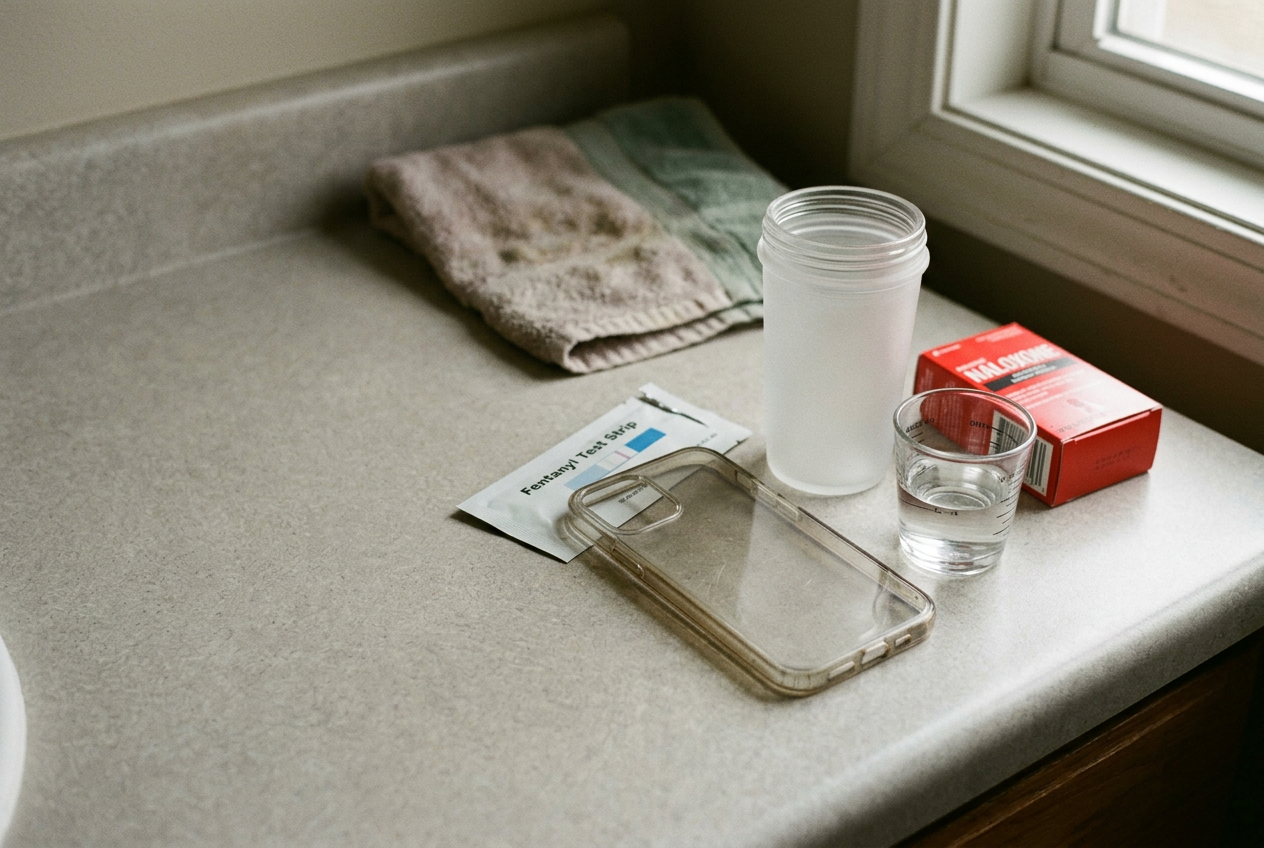
The concrete object is a single foil-wrapped fentanyl test strip tucked behind a phone case. It weighs almost nothing. Beside it, in the field setup, are the things its instructions quietly require: the correct amount of clean water, a clean container, decent light, a timer and enough privacy to read several lines of small print.
Only the strip fits behind the phone.
That is the practical gap. A fentanyl test strip is a lateral-flow immunoassay, a paper device that reacts when its target is present in a liquid sample. Public-health guidance can make using one look like a brief dip-and-read job. Manufacturer instructions tend to reveal the rest: prepare the sample at the specified dilution, immerse the correct end to the marked line, wait for the stated interval and interpret the control and test lines according to that product’s diagram.
None of those directions is unreasonable. Together, they describe a small workstation. A club bathroom is not one.
This hands-on evaluation tested the workflow with an unused strip and no controlled substances. It did not assess chemical performance. It compared the physical demands of common manufacturer and public-health directions with the conditions surrounding a night out. This is practical harm-reduction reporting, not medical advice or a guarantee that any substance is safe.
The strip is only the visible part of the kit
Before leaving home, the foil packet looks almost comically adequate. Then each instruction starts asking for infrastructure.
The sample needs a clean vessel. The water amount matters because a mixture that is too concentrated can interfere with some strips, particularly when testing certain stimulants, while uncontrolled dilution makes the result harder to interpret against the manufacturer’s method. The strip needs to stay below its maximum immersion line. The result needs light good enough to distinguish a faint mark from an indentation in paper.
A phone timer can handle the waiting interval, assuming the phone is charged and not being used to find friends. Water is less cooperative. The bathroom tap may be motion-activated, hot, inaccessible or visibly filthy. A bottle cap is portable but not necessarily clean or useful for measurement.
A disposable cup takes space and can get crushed in a pocket. The nightclub has provided plumbing, technically. It has not provided a testing station.
For the field setup, the foil-wrapped strip remained the easiest object to manage. The clean screw-top sample cup was bulkier. A small water container introduced leakage. The product directions survived contact with the bathroom; their assumptions did not.
The fix begins before the door. Read the instructions for the exact strip while sober and in good light. Check that the packet is sealed and within its labeled shelf life. Pack the strip with a clean container and whatever measuring tool that product requires, rather than assuming all fentanyl strips use the same quantities.
Bring naloxone as well. Testing and overdose reversal do different jobs.
Mixed substances complicate the reassuring line
Public-health messaging often has to be short enough for a card, poster or social tile. Chemistry is less considerate.
Some fentanyl test strips can produce misleading results when particular substances are present at high concentrations. Methamphetamine and MDMA are among the drugs commonly flagged in product guidance and harm-reduction instructions as requiring greater dilution with some strips. Formulations vary. A ratio copied from a different manufacturer, an old flyer or somebody’s screenshot may not match the packet in your hand.
That matters on a night out because mixed substances are normal even when the person holding them did not request a mixture. Powders and pressed pills can contain fillers, active ingredients and contaminants that are not visible. A strip may detect fentanyl or some related compounds, depending on its design, but it does not identify everything in the sample. It does not measure dose.
It does not certify purity. It does not detect xylazine merely because xylazine has become part of the same public conversation.
If a product’s instructions say that a concentrated stimulant sample can interfere, use the specified dilution and follow its retesting guidance. If the required volume cannot be measured in the bathroom, the honest conclusion is not that close enough will do. The honest conclusion is that the setting cannot support a dependable check.
This is where the tiny strip creates false confidence through no fault of its paper. It produces lines. People understandably want those lines to deliver a verdict broader than the device can support.
Sampling is where convenience starts lying
Fentanyl may not be distributed evenly through a powder or pill. Harm-reduction workers often describe this as the chocolate-chip effect: one portion can contain fentanyl even when another portion from the same supply does not. Testing a few loose grains therefore says most about those grains.
Testing the entire amount can reduce sampling uncertainty, but it may require dissolving that amount and planning around the product-specific method. That is much easier before reaching a venue, where a stable surface and clean equipment exist, than in a stall with a wet floor and a queue outside. Anyone considering full-batch testing should use instructions from the strip manufacturer or a reputable local harm-reduction service, since preparation methods differ and improvised online directions age badly.
When full-batch testing is not possible, sampling from different parts may provide more information than taking material from one convenient edge. It still leaves blind spots. A negative result from a partial sample cannot speak for material the water never touched.
The foil-wrapped strip behind the phone case does nothing to solve that problem. Portability gets it into the room. Representativeness determines whether the room learns much from it.
Reading the result is product-specific
Many fentanyl strips use a counterintuitive pattern in which one visible control line indicates a presumptive positive result and two lines indicate a negative result. That convention is not permission to ignore the packet. Different devices can use different markings, and any result without the required control line is invalid.
Faint lines create another nightlife problem. For products whose instructions say any visible test line counts, a faint second line may still be interpreted as negative. That does not make the substance safe, and it does not override sampling or dilution problems. Bathroom lighting can turn a product-specific interpretation rule into squinting at paper under a phone flashlight while somebody hits the door.
Read the result during the interval stated by the manufacturer. A mark that appears much later may not mean what the timed instructions say it means. Photographing the strip can help preserve what was visible at the correct time, but a camera can also flatten faint contrast or shift color. The packet remains the authority for that device.
If the result is positive, invalid or impossible to read, the safest option is not to use the substance. A local harm-reduction program may be able to provide another strip, more suitable equipment or drug checking with tools that offer more information than a binary paper test.
A negative result changes risk, not reality
The cleanest possible negative result still has a jurisdiction. It applies to the tested liquid, the compounds that strip can detect and the conditions under which the test was run. It cannot promise that an untested portion is identical. It cannot rule out every fentanyl analog or another dangerous ingredient.
It cannot predict how a body will respond to the substance, especially alongside alcohol or other drugs.
That is why the practical precautions do not disappear after a negative. Avoid using alone. Keep naloxone visible and tell other people where it is. Avoid mixing substances, which can make effects less predictable and complicate an emergency.
Use less than usual if there is any uncertainty. These measures are imperfect, but they do not depend on one paper line carrying the whole night.
If someone is unresponsive, breathing slowly or not breathing normally, call emergency services and give naloxone according to its package directions. Provide rescue breathing if trained and stay with the person. Naloxone will not harm someone merely because opioids were not the cause, but an apparent recovery does not remove the need for emergency help.
The institutional failure here is modest enough to escape notice. Manufacturers sell a test. Public agencies often distribute that test because it is cheap to carry and easier to scale than staffed drug checking. The user supplies the clean water, measurement, workspace, interpretation and response plan.
A technically available tool becomes a private logistics problem, usually handled by the person with the fewest good surfaces available.
The better nightlife kit is less elegant than the strip alone: product-specific instructions read in advance, sealed testing supplies, a clean container, measured water and naloxone. Better still is testing before the night starts, or using a harm-reduction service that can supply the missing infrastructure. The foil packet can remain behind the phone as a backup. It should not be mistaken for the whole system.
Questions people ask
Can a fentanyl test strip prove that a drug is safe?
No. A negative result only describes the tested sample within the strip’s detection limits, and fentanyl may be unevenly distributed. The strip also does not identify every dangerous substance, measure strength or predict interactions. Keep other precautions in place and treat uncertainty as real.
Why can stimulants cause confusing fentanyl test-strip results?
Some strips can react incorrectly when certain stimulants are tested at high concentrations. The relevant substances and dilution guidance depend on the product, so use its current instructions rather than a universal recipe. If the required measurement cannot be made reliably, test somewhere better equipped.
What belongs in a practical night-out testing kit?
Bring the strip in its sealed packet, its instructions, a clean container, the measuring equipment and water specified by the manufacturer, plus naloxone. Read the directions before leaving home. A strip carried alone is portable, but it leaves the hardest parts of testing to improvisation.
What should happen after a positive or invalid result?
The safest choice is not to use the substance. Keep it away from other supplies to prevent mix-ups, and contact a local harm-reduction organization if retesting or more detailed drug checking is available. If anyone shows signs of an overdose, call emergency services and use naloxone as directed.
One update a day
Today's story, in your inbox
One story each morning — no hype, no filler, no algorithm deciding for you.