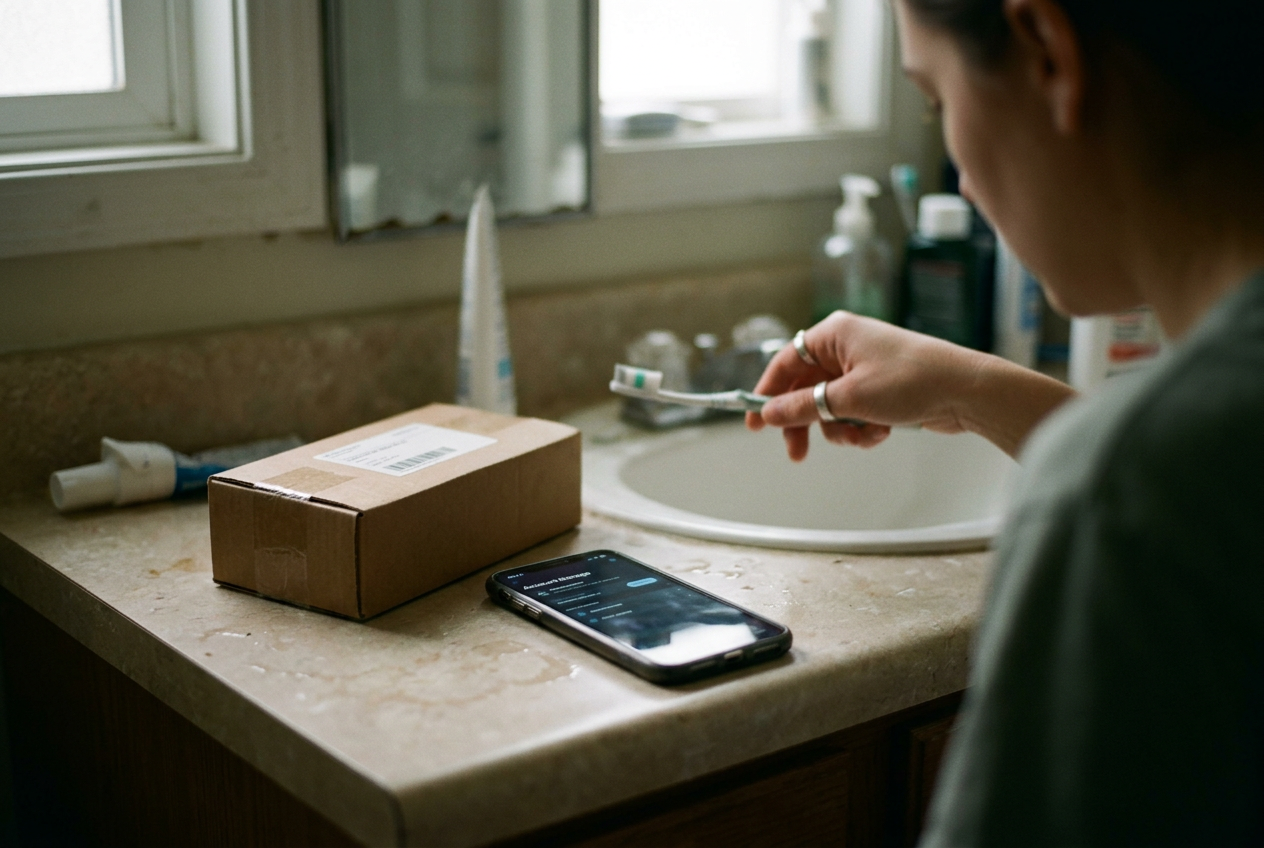
A Fentanyl Test Strip Can Miss What’s Elsewhere in the Pill
The strip reads the water it touches, not the whole pill by default. The sampling work that makes a result meaningful is often the part public-health cards compress or omit.
August 11, 2026 · 8 min read
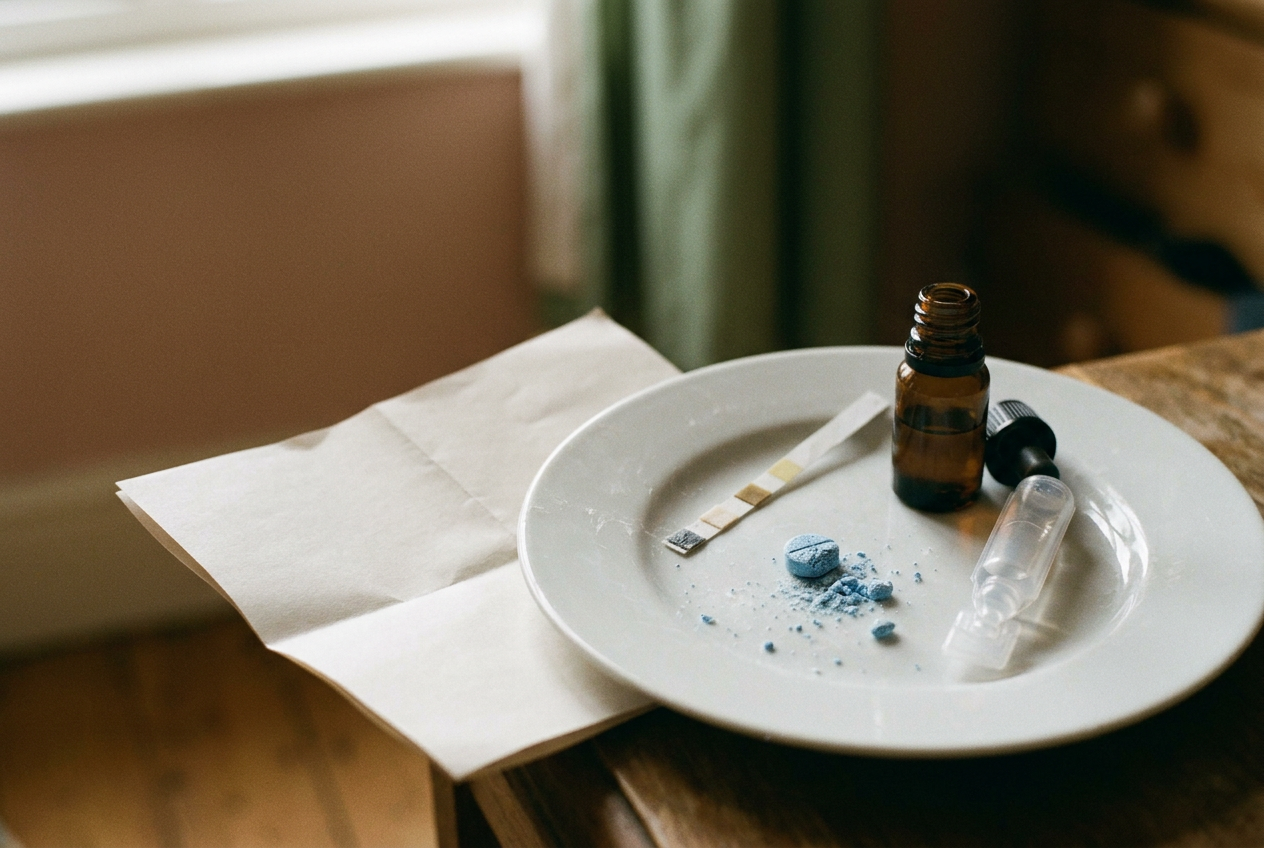
The object here is one blue pressed pill sold as oxycodone, sitting on a white ceramic dish. Its color and stamped marking tell us nothing reliable about its contents. Neither does the fact that another pill from the same bag tested negative.
Public-health instructions often make the next part look clean: add water, dip a strip, wait for lines. In hands-on demonstrations by harm-reduction educators, the blue pill has to be crushed, mixed and usually dissolved if the person wants the sample to represent the whole tablet. That difference is the story. The strip is easy.
Sampling is where certainty falls apart.
This is harm-reduction information, not medical advice, and no home test can certify an illicit pill as safe. Fentanyl test strips are immunoassays, meaning paper strips treated with antibodies react to fentanyl or some related compounds in a liquid sample. They can provide useful information. They cannot identify every substance, measure potency or inspect material that never entered the sample.
The strip does not test a pill
It tests water.
More precisely, it tests the small amount of dissolved material carried across its reactive area. If the solution contains enough of a compound the strip recognizes, the line pattern changes. The strip has no knowledge of the original tablet, its manufacturing conditions or the powder left on the dish.
That sounds pedantic until the blue pill is broken open. Counterfeit tablets are not always pharmaceutical products made under controls that keep ingredients evenly distributed. Powders may be mixed poorly. Material can clump.
Pills that look identical can differ, and fentanyl may be concentrated unevenly within one pill or across a batch. Harm-reduction educators sometimes describe this through the “chocolate chip cookie effect”: a sample taken from one spot may miss what sits elsewhere. The phrase is friendly. The mechanism is not.
A scraping from the blue coating might produce a negative result while another section contains fentanyl. Testing half improves coverage over testing a few grains, but it still leaves an untested half. Testing one pill says little about the next pill in the bag, even when the stamp, color and seller are the same. A negative result belongs to the tested solution, under the conditions of that test.
Public messaging often lets it travel much farther.
What hands-on demonstrations add
The better demonstrations begin before the strip leaves its packet. They use a clean container and crusher, reduce the entire pill to a fine powder, and mix that powder thoroughly so one section is less likely to remain chemically isolated from another. When the whole pill is dissolved, the sample has a stronger claim to represent that pill, although the test still cannot establish dose, purity or safety.
This is the awkward fact the instruction card has little room for: representative testing may require giving up the pill as a pill. Crushing and dissolving it changes the form completely, adds time and needs clean equipment. Some public-health materials acknowledge whole-dose testing; others foreground a tiny sample because it is easier to describe and more likely to be attempted. Accessibility matters, but convenience changes what the result means.
Return to the blue pill on the dish. If only dust from one edge goes into the container, the procedure is not useless. It is a test of that dust. The honest interpretation must stay narrow, which is difficult when a neat pair of lines appears to settle the matter.
Follow the directions supplied with the specific strip or by the program distributing it. Water amounts, dipping limits and reading windows can vary by product and by the drug being tested. More concentrated is not always more accurate: some drugs can interfere at high concentrations, producing a result that looks positive even when fentanyl is absent. Adding an improvised amount of water can create the opposite problem by diluting the target below what the strip can detect.
The basic discipline is less cinematic than the result. Mix the chosen material thoroughly. Keep the liquid below any marked maximum line. Read the strip only during the stated window, because later changes may not be valid.
Photographing the result and bringing uncertainty to a local harm-reduction program can help, especially when the lines are faint or the substance may cause cross-reactivity.
A negative result is a limited sentence
Public-health cards need to be portable. They are printed small, handed out quickly and expected to work in bathrooms, parked cars, bedrooms and outreach tents. The card tends to turn a conditional tool into a binary interface: one pattern means positive, another means negative. A qualified educator standing beside the same strip can keep adding the clauses that print design removes.
The strip may not recognize every fentanyl analog, which is a chemically related compound with altered structure. It does not screen for every other opioid or sedative. It cannot detect xylazine unless a separate test designed for xylazine is used, and it cannot tell whether the amount detected is likely to be fatal. A positive result also does not disclose where the fentanyl sits or how much is present.
The larger omission is interpretive. “Negative” sounds like an attribute of the blue pill. Technically, it describes what the strip did not detect in one prepared solution at one moment. Those statements are not interchangeable.
False reassurance does not require a faulty strip. The strip can perform as designed while the sample fails to represent the pill, the water ratio is wrong, the reading happens outside the specified window or the user assumes fentanyl was the only relevant danger. The technology gets blamed for some of this, but the cleaner criticism belongs with institutions that distribute a binary tool without funding enough education to explain conditional evidence.
The cheap intervention has hidden labor
Test strips are attractive to public agencies because they are inexpensive, portable and distributable at scale. They fit into existing outreach. That is a real advantage, especially in places where laboratory drug checking remains scarce or legally fraught.
They also move a substantial burden onto the person facing the risk. The user must obtain the strip, trust the distributor, find water and a clean container, prepare a representative sample, interpret an imperfect line and decide what to do with information that may arrive moments before use. The blue pill on the dish is no longer a quick purchase. It has become a small laboratory problem without a laboratory.
Hands-on education costs more than a stack of cards because it requires trained people, time, space, repeat contact and supplies. Confirmatory drug checking, in which specialized equipment identifies compounds more specifically, costs more again and is not available everywhere. Institutions therefore fund the cheapest visible layer and call the tool empowering. It can be empowering.
It can also be a way of making an unstable drug supply into an individual reading-comprehension test.
A better public message would not abandon strips. It would state their limits in the main instruction rather than in fine print: test as much of the pill as possible, mix the sample thoroughly, treat partial sampling as partial information, and understand that a negative result lowers one uncertainty without removing overdose risk. Programs should pair distribution with demonstrations, naloxone and routes to more advanced drug checking where those services exist.
What to do with the result
A positive strip means fentanyl or a compound the strip recognizes may be present. The lowest-risk option is not to use the pill. A local syringe-service program, drug-checking service or health department may offer confirmatory testing and disposal information without requiring a medical appointment.
A negative result does not turn the blue pill into pharmacy oxycodone. Packaging, color and stamps are easy to copy. Avoid using alone, keep naloxone available, and make sure someone present knows how to recognize an opioid overdose and call emergency services. Naloxone can reverse an opioid overdose temporarily; more than one dose may be needed, and emergency help still matters.
The ceramic dish should remain in the frame. So should the powder stuck to its edge, the container, the strip instructions and the part of the tablet that never reached the water. Those details determine what the result can support. Two lines cannot carry evidence they were never given.
Questions people ask
Can I test a small scraping from a pill?
You can test a scraping, but the result applies only to that sampled material. If fentanyl is distributed unevenly, a scraping may miss it. Crushing, thoroughly mixing and testing the whole pill gives the sample a better chance of representing that pill, though no result establishes safety.
Does a negative fentanyl test mean the pill is safe?
No. It means the strip did not detect fentanyl it recognizes in the prepared solution under those test conditions. The sample may not represent the whole pill, and the pill may contain other dangerous substances that the fentanyl strip cannot identify.
Can a fentanyl test strip tell me how much fentanyl is present?
No. Standard strips give a qualitative result, meaning detected or not detected above the test’s threshold. They do not measure concentration, identify a safe dose or show whether fentanyl is distributed evenly. Confirmatory drug-checking equipment can provide more specific information where services are available.
What should
I do if the strip is positive or unclear?
The lowest-risk choice is not to use the pill. Keep the strip and contact a local harm-reduction or drug-checking program for interpretation, confirmatory testing or disposal options. If opioid use may occur, have naloxone nearby and ensure someone can call emergency services.
One update a day
Today's story, in your inbox
One story each morning — no hype, no filler, no algorithm deciding for you.