LinkedIn’s Video Feed Turns Office Status Into Watch Time
LinkedIn has adopted the vertical swipe, but professional identity changes what survives inside it. Every clip is also a résumé line, a sales call or a small bid for workplace rank.
August 24, 2026 · 7 min read
The navy merino quarter-zip was the problem.
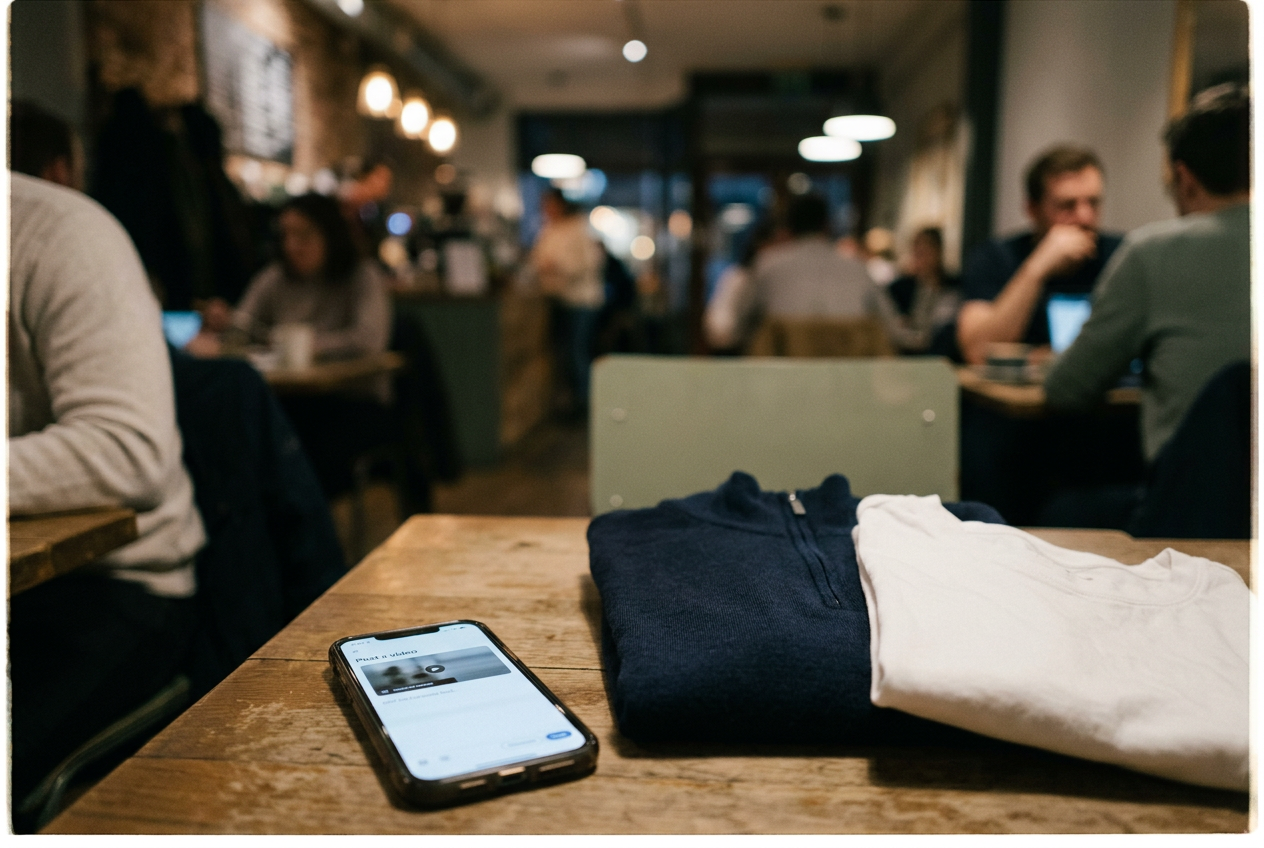
I wore it over a white crew-neck while recording a test clip for LinkedIn, with the zipper resting at the sternum and the phone held vertically at arm’s length. The material looked tidy without appearing formal. On another platform, this would be wardrobe. On LinkedIn, it communicated a whole employment category before I had said anything: salaried, laptop-based, available for a panel discussion.
I did not publish the clip. Holding it at the posting screen was enough to expose the pressure built into the product. My name, face, current role and work history would sit close to the video, while former colleagues, editors and possible clients could encounter it through the same account. The clip could travel, but the person in it could not become anonymous for the afternoon.
That constraint separates LinkedIn’s video feed from the short-form systems it resembles. The screen offers the established grammar: portrait video, immediate playback, vertical swiping and engagement controls within reach of the thumb. Yet LinkedIn attaches those mechanics to a persistent professional identity. The result is office culture rebuilt around a watch-time target.
The swipe arrived before the culture did
LinkedIn’s dedicated video experience collects clips into an immersive feed rather than asking users to open each post in the conventional home timeline. Interface placement varies by app version and account, but the intended behavior is clear when the feed appears: watch, react, comment or move upward for the next person speaking into a phone.
Watch time means the amount of attention a viewer gives a clip, including whether they remain, finish or continue watching. LinkedIn does not disclose a neat public formula that lets outsiders assign a weight to each action, and its ranking systems can change without a visible product announcement. Still, the interface asks for continuous viewing rather than isolated professional updates. That is a product decision before it is an algorithmic one.
The navy quarter-zip looked entirely at home there. During hands-on use, the recurring visual language was less chaotic than the wider short-video market: centered faces, readable captions, controlled interiors, presentation-ready clothing and openings that state the business lesson quickly. Editing conventions associated with TikTok and Reels remain useful, especially captions and a fast opening, but LinkedIn narrows the acceptable range of what those conventions can carry.
A creator can dance on LinkedIn. The account history remains attached.
This matters because short-form video systems learn from behavior at scale. A recommendation algorithm is software that orders content by predicting which item will produce a desired response from a particular viewer. LinkedIn has an unusually rich professional graph to inform that prediction: declared employers, job titles, industries, connections and interactions with work-related posts. A viewing session can therefore be interpreted through both attention and occupational relevance, even when users have inflated, abandoned or selectively edited their profiles.
TikTok often has to infer what you care about from what you watch. LinkedIn can begin with what you claim to do for work.
The engagement is wearing a name badge
Reactions, comments and repost activity remain legible around LinkedIn video, subject to the interface version and privacy settings in use. More important, engagement arrives with professional context. A comment is rarely just a string of text. It has a headshot, a role, an employer or a carefully worded substitute for one.
That changes the meaning of participation. Under a comic video elsewhere, a viewer can leave a throwaway response and disappear into a username. Under a LinkedIn clip about hiring, management or artificial intelligence, the same response may be read by a supervisor, an applicant or a prospective customer. Even a reaction can function as a light endorsement because the platform’s social architecture makes work relationships visible.
The feed can also show social context around a post, such as a connection’s interaction, making engagement part of distribution as well as reputation. A person who comments may help a clip circulate through adjacent professional networks, while the comment itself becomes evidence of taste, expertise or allegiance. The creator receives attention. The commenter performs judgment.
LinkedIn gets another reason for both people to return.
Visible counts still matter, but identity does more work than the number alone. A modest response from people with recognizable roles may carry more professional value than a larger pile of anonymous approval. That value is hard to standardize, which is convenient for the platform: users can interpret nearly any activity as networking progress and continue producing without a direct payment.
LinkedIn does not need every video to become culturally famous. It needs clips that move through commercially useful clusters of people.
The creator is also the product page
The quarter-zip made sense because LinkedIn video rewards controlled informality. A suit can read as corporate theater. A T-shirt can appear careless depending on the speaker’s industry. Soft knitwear over a clean collarless shirt occupies the familiar middle ground of contemporary knowledge work, where authority is meant to look approachable and preparation must pretend to be spontaneous.
That choice was not enforced by a moderation rule. It came from the anticipated audience.
Professional identity creates a form of pre-moderation inside the creator’s head. People avoid jokes that could age badly in a search result, strong claims they cannot defend to a peer and messier forms of self-disclosure that would be ordinary elsewhere. They also gravitate toward performances with an obvious workplace return: compressed expertise, leadership lessons, career confession, conference fragments, product demonstrations and commentary on whatever technology has reached the meeting agenda.
The cost is not only embarrassment. A weak TikTok can be forgotten. A weak LinkedIn video can sit beside an employment history and make the creator look less capable at the exact task being advertised. That risk favors people whose jobs already reward public speech, personal branding and salesmanship, while making the feed less inviting to workers who face stricter conduct rules, unstable employment or employers inclined to treat public visibility as disloyalty.
This is why the dominant performance feels polished even when the camera work is basic. Creators are not merely seeking viewers. They are auditioning for clients, employers, recruits and peers at once, which pushes each clip toward statements broad enough to circulate but safe enough to survive contact with the office.
Attention pays indirectly
The economic loop differs from a broad entertainment platform with a visible creator payout program. Many LinkedIn creators are not expecting the platform to pay them for each successful clip. The hoped-for return sits outside the video player: consulting work, speaking invitations, subscriptions, sales leads, recruitment interest or higher status within an industry.
That arrangement works well for LinkedIn. Advertisers pay for access to professionally categorized audiences, while creators supply video that encourages those audiences to spend more time inside the product. Some creators may convert that attention into money, but they carry the production cost and the uncertainty. The platform sells the setting.
A vertical clip also gives LinkedIn more behavioral information than a static résumé update. Completion, abandonment, replay and subsequent interaction can indicate interest even when a viewer refuses to react publicly. These signals are generally invisible to other users, and LinkedIn does not provide enough public detail to reconstruct how each one affects recommendation. The opacity matters.
Creators can see the surface response and some analytics on their own posts, but they cannot inspect the decision that placed one clip before a particular viewer and withheld another.
So they optimize what they can see. They tighten the opening, add captions, frame the face more closely and repeat topics that previously drew professional recognition. The navy quarter-zip becomes part of the system because it lowers visual risk. The advice becomes broader because broad advice travels across job categories.
A feed full of individual career expression converges on the same room, the same framing and the same careful certainty.
LinkedIn has not imported another platform’s culture wholesale. It has applied short-video circulation to a database of professional identities, then left users to turn workplace credibility into material. The final test clip remained unpublished on my phone, still framed from chest to forehead, with the zipper fixed at the point where it looked deliberate but not dressed up. That tiny adjustment was the feed working before the upload.
Questions people ask
Does LinkedIn have a TikTok-style video feed?
LinkedIn offers an immersive vertical-video experience that supports swiping from one clip to the next, although its placement can differ across app versions and accounts. The viewing gesture resembles TikTok, but LinkedIn surrounds each clip with professional identity, network context and workplace consequences.
What signals can viewers see on LinkedIn videos?
Viewers can generally see reactions, comments and repost activity, depending on the interface and a post’s privacy settings. They can also see who performed many of those actions, often alongside job information, which makes engagement useful as professional signaling rather than a bare popularity count.
How does
LinkedIn decide which videos to recommend?
LinkedIn does not publish a complete weighting formula. The platform can draw on viewing behavior, engagement, network relationships and professional information supplied through profiles, but outsiders cannot verify the contribution of each signal or assume that the same ranking logic applies to every account.
Do
LinkedIn video creators get paid for views?
LinkedIn video usually offers an indirect commercial return rather than a broad, dependable payment for views. Creators may use attention to win clients, sell services, attract recruits or raise their standing, while LinkedIn benefits from longer sessions and a larger supply of content around which it can sell advertising.
One update a day
Today's story, in your inbox
One story each morning — no hype, no filler, no algorithm deciding for you.